The Barth Saga is a comedy. It began with a real 1988 Barth motorhome, bought for six thousand dollars in freezing rain by a friend of mine who is a considerably better mechanic than he is a judge of motorhomes, and with the stream of texts, voice memos and photographs he sent about it afterwards. Almost everything after that is fictionalised: scenarios exaggerated, disasters escalated well past plausibility, timelines compressed, characters composited, several chapters invented outright.
Nobody here should be read as a portrait of a real person and nothing in quotation marks should be read as a transcript. Some of it happened. Most of it did not, or did not happen remotely like that.
Twelve chapters below. There are seventy-six.
“This isn’t fiction anymore I’m afraid.”
Larry, 4:51 AM
The Purchase
Larry took an Uber one hour and twenty minutes to inspect a motorhome he had specifically told the dealer not to start. He wanted to hear a cold engine, because a cold engine is honest. The dealer started it anyway and pulled it around front.
It was freezing rain. Too much ice to get on the roof. His hands stopped working inside his gloves. So he inspected the part he could reach, which was the inside.
“the interior, man, the interior was incredible”
Cobalt blue vessel sink. Hardwood floors. Crown molding. Somebody had spent thousands of hours building a boutique hotel inside a 1988 motorhome, and Larry reasoned that a man who does that does not leave the roof leaking. The logic is sound. It is also the logic of a man in freezing rain who cannot get on the roof and needs a reason not to.
He bought it. On the way home the belts screamed every time he touched the defroster, and forty-five minutes from his house the power steering quit. He muscled sixteen thousand pounds through the turns into his neighbourhood using his arms, while a woman walking her dog stood and watched.
“in hindsight, probably not the smartest thing to do”
Chapter 1: The Six Thousand Dollar Dream
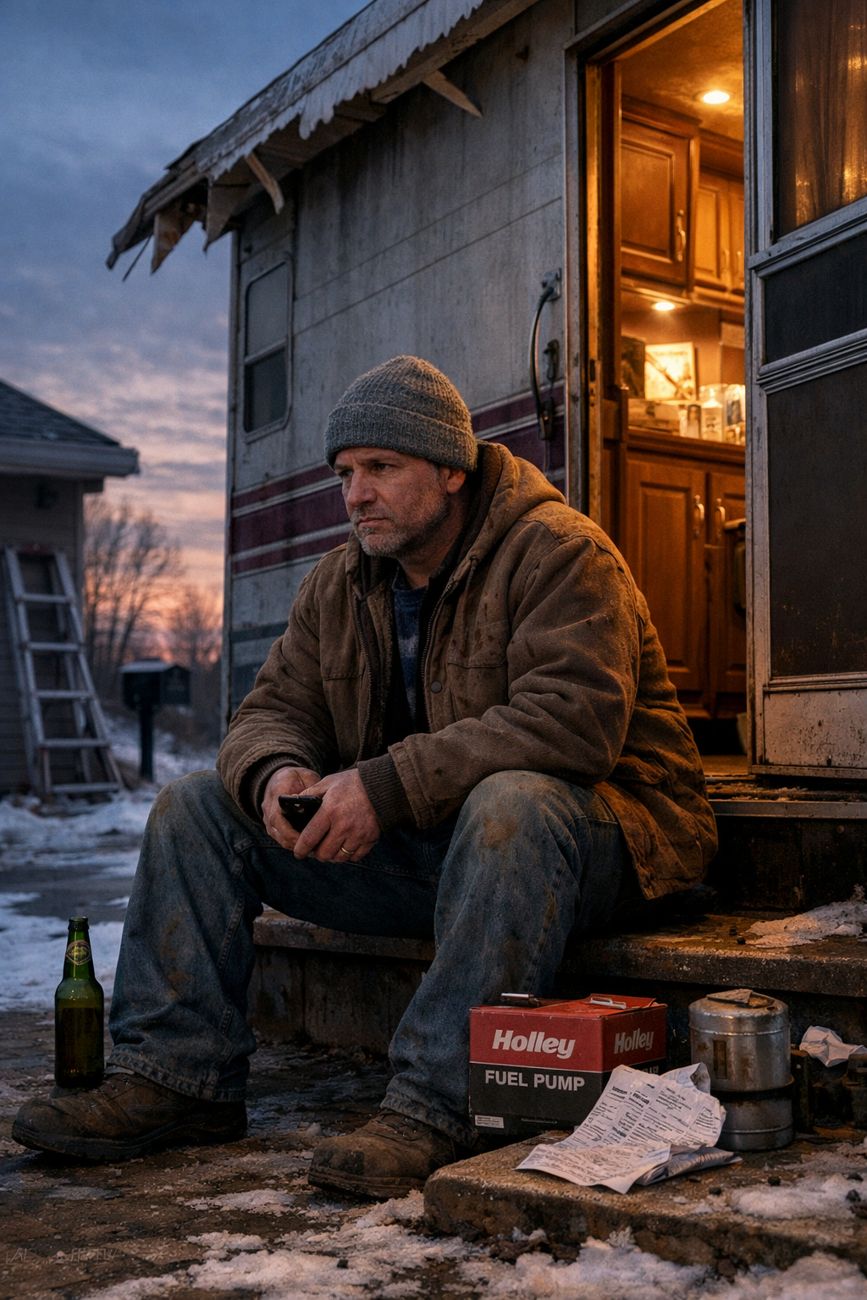
No shop would touch the engine, because every system on it had been custom modified by somebody else. So Larry crawled underneath in ten-degree Michigan weather and fabricated fuel pump mounts himself, five minutes at a time, going indoors between attempts to get his hands back.
He got it running. He drove it out of the driveway and destroyed the mailbox. He backed it in and tore the soffit off the house. He took it onto the highway, where it stalled halfway across with traffic stacking up behind it. Then he learned he had no title, which meant that if it died for good he could not legally junk it, store it, or prove it was his.
He found storage for seventy dollars a month. He was now paying rent on a vehicle he could not prove he owned, could not reliably drive and could not abandon.
He also worked out, somewhere in there, that his wife had destroyed the previous mailbox, at this same address, with the previous Barth.
Chapter 2: Don Quixote Syndrome
Standing in the driveway looking at the hanging soffit, the second dead mailbox and the vehicle that had done both, Larry texted a friend a self-diagnosis.
“Maybe I have Don Quixote syndrome and need to talk to a psychiatrist.”
He explained the reference: tilting at windmills, noble quests based on fictional ideals in a world that refuses to conform to them. Then he explained it better.
“Foolish quests. I’m addicted to the despair and elation of fixing stupid shit that no one cares about”.
He added that the Barth had also damaged the ladder, and that the roads were icy with complete carnage on the freeway. Then he said he was thinking of taking the Barth out for a spin.
His friend replied that he hoped Larry got it running properly. It deserved it. The world deserved it. Neither of them was joking.
Chapter 5: Maybe I Should Take the Barth Out for a Spin
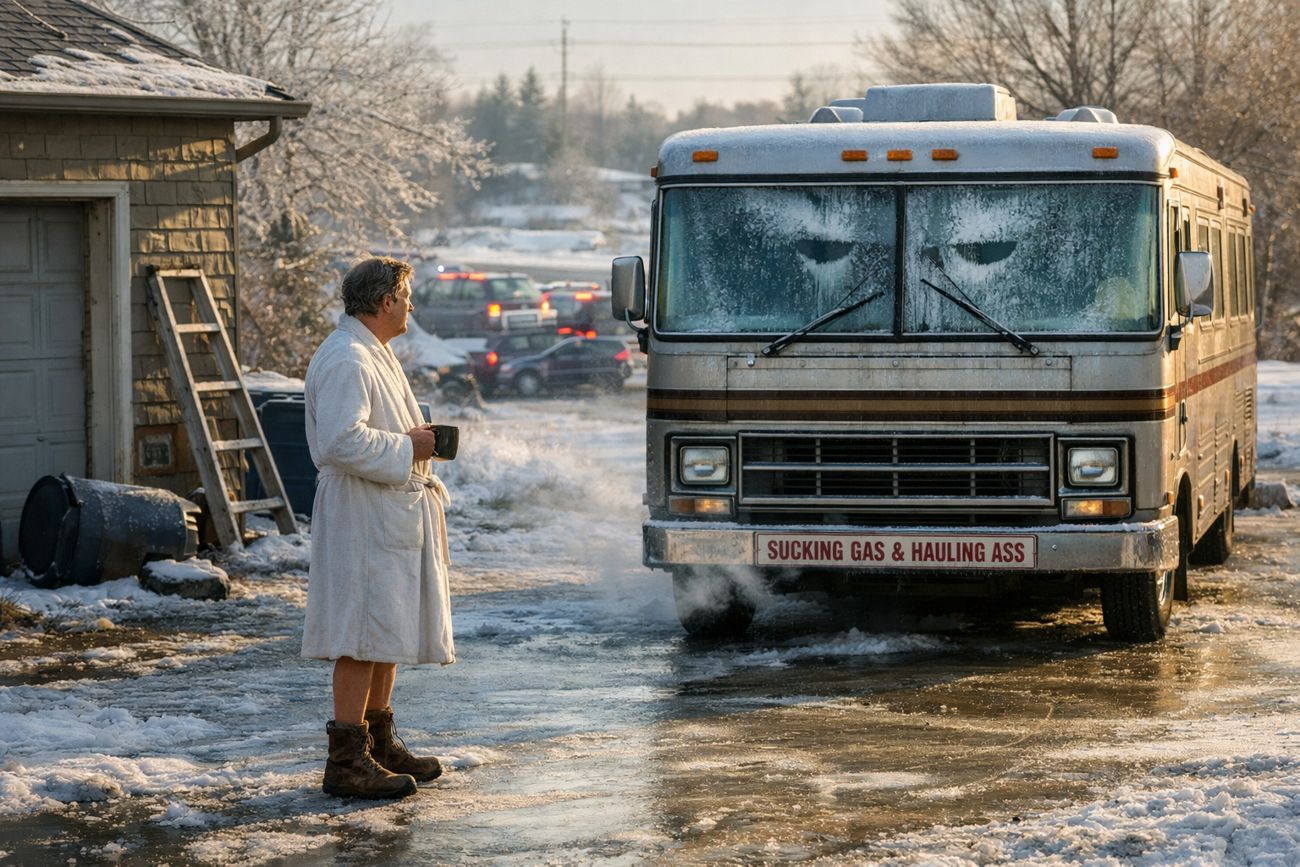
Next morning the sky was clear and almost cheerful, the wind was violent, and the street had that lethal shine that fools everybody. Through the subdivision entrance you could see the freeway doing what freeways do when the road looks fine.
Larry stood at the end of his driveway in a bathrobe and boots with a cup of coffee. He was not looking at the carnage. He was looking at the Barth, which he had already started that morning.
Chapter 8: Park Doesn’t Mean Park
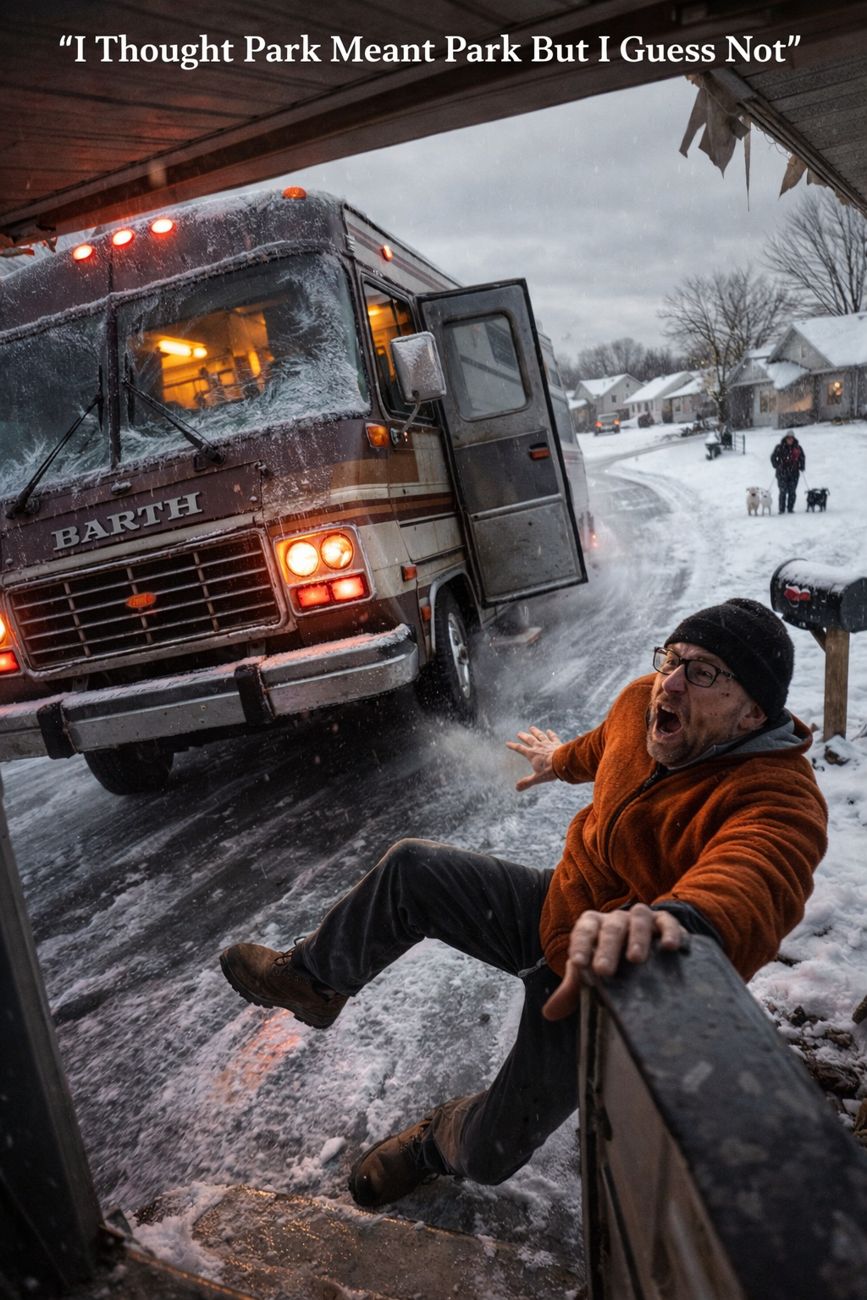
Days later he fought the stalling Barth up his sloped driveway, reached the top, put it in park and exhaled. The gear indicator read P.
The Barth began rolling backward.
The automatic parking brake, it turns out, only engages when the engine is off. Sixteen thousand pounds went back down the driveway, hit the house, killed the mailbox and kept going toward the street. A neighbour walked two small dogs past, unaware.
“I thought park meant park but I guess not.”
Chapter 10: No Driver’s Door
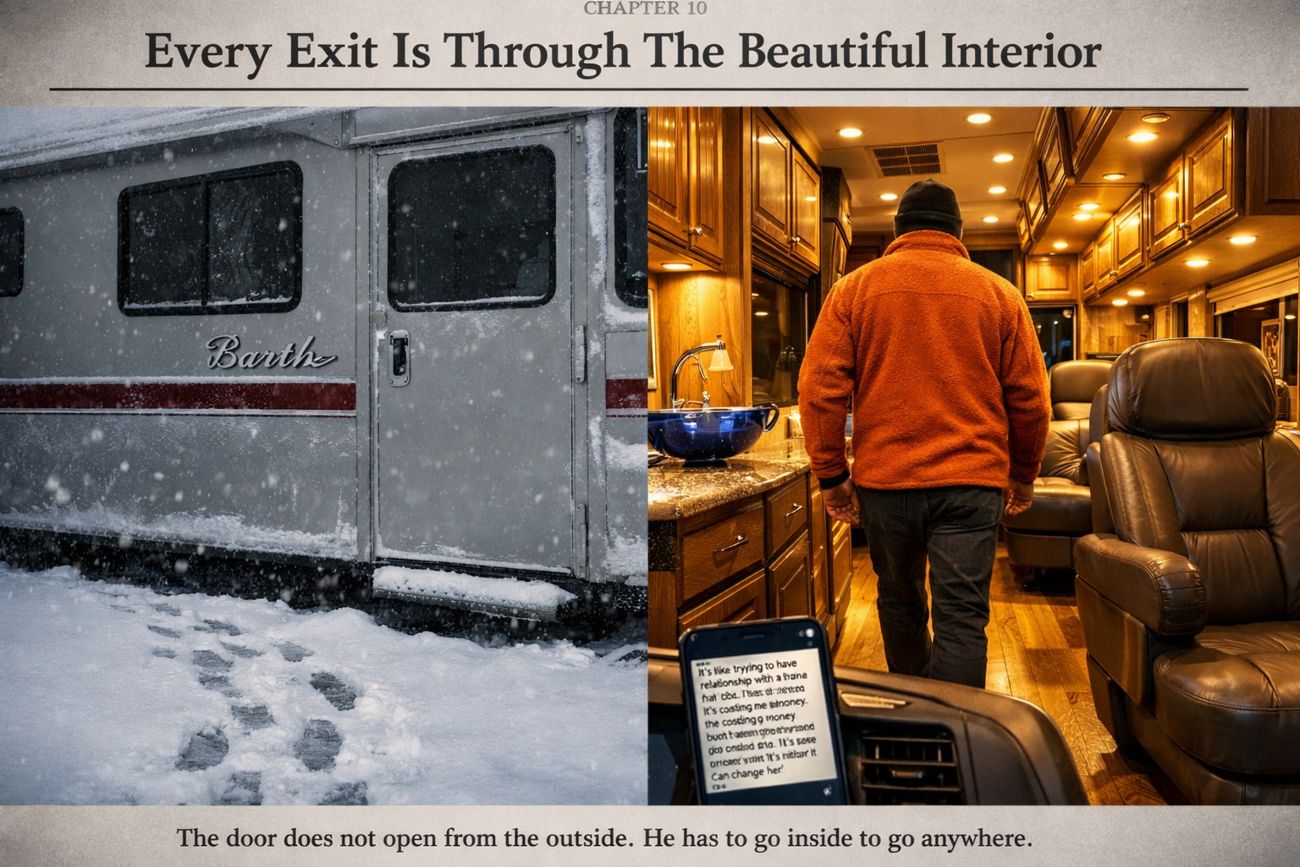
The driver’s door does not open. Which means every exit is through the back, and every exit through the back runs the full length of the interior: the leather, the hardwood, the cobalt sink, the crown molding, and then out into whatever is currently going wrong.
That is the trap, and Larry describes it more precisely than anyone else in this story could.
“It’s like trying to have a relationship with a 10 that is total bitch. It’s costing me money it’s costing me time it’s ruining my mental health, but every time I go inside and see the interior I say ‘it’s worth it I can change her’.”
Chapter 26: The $6,000 Dream
Here is where it stops being only funny.
Debbie, Larry’s wife of thirty years, does not want a husband with a man cave and a television. She wants the exact thing Larry is chasing. She wants to be swept off her feet in a motorhome and driven around America.
“He goes out and buys a luxury RV, that runs, and sweeps her off her feet on a trip around the US visiting all the attractions, living in luxury. Instead she got a Barth running on 7 cylinders or less of 8 getting about 2 miles to the gallon and possibly pushing oil out the exhaust.”
She wants to arrive at Yellowstone. He wants to fix the fuel pump in the Yellowstone parking lot. Both of those are the trip. Only one of them is the dream.
Chapter 31: The Disconnected Wire
Months in, changing the spark plugs, Larry found it. One plug wire on the driver’s side, in the spot where you can just barely get a hand in, completely disconnected.
“Damn poor Barth the plug wires are really hard to get to on the driver side and you can barely get hand in there. I thought I had followed them all but today when I went to change the spark plugs one of them was completely disconnected. I wonder how long the poor thing was running like that.”
That wire was the dead cylinder. The dead cylinder was raw fuel going out the exhaust. The raw fuel was the ruined oxygen sensor, which was the fuel injection running in limp mode, which was the rough idle and the stalling and the performance on the highway in front of everybody.
The previous owner had paid a Ford mechanic seven hundred dollars to look the vehicle over. The mechanic missed it. Larry, on his back with a flashlight and no qualifications whatsoever, did not.
Chapter 59: 600% Performance Increase
By February the Barth was on the road to Utah with both of them in it, and against everything, it was working. In Hot Springs, Arkansas, Debbie booked a treatment at an actual spa. Larry waited for her to leave, then crawled underneath the motorhome to examine its plumbing.
That sentence contains the entire marriage.
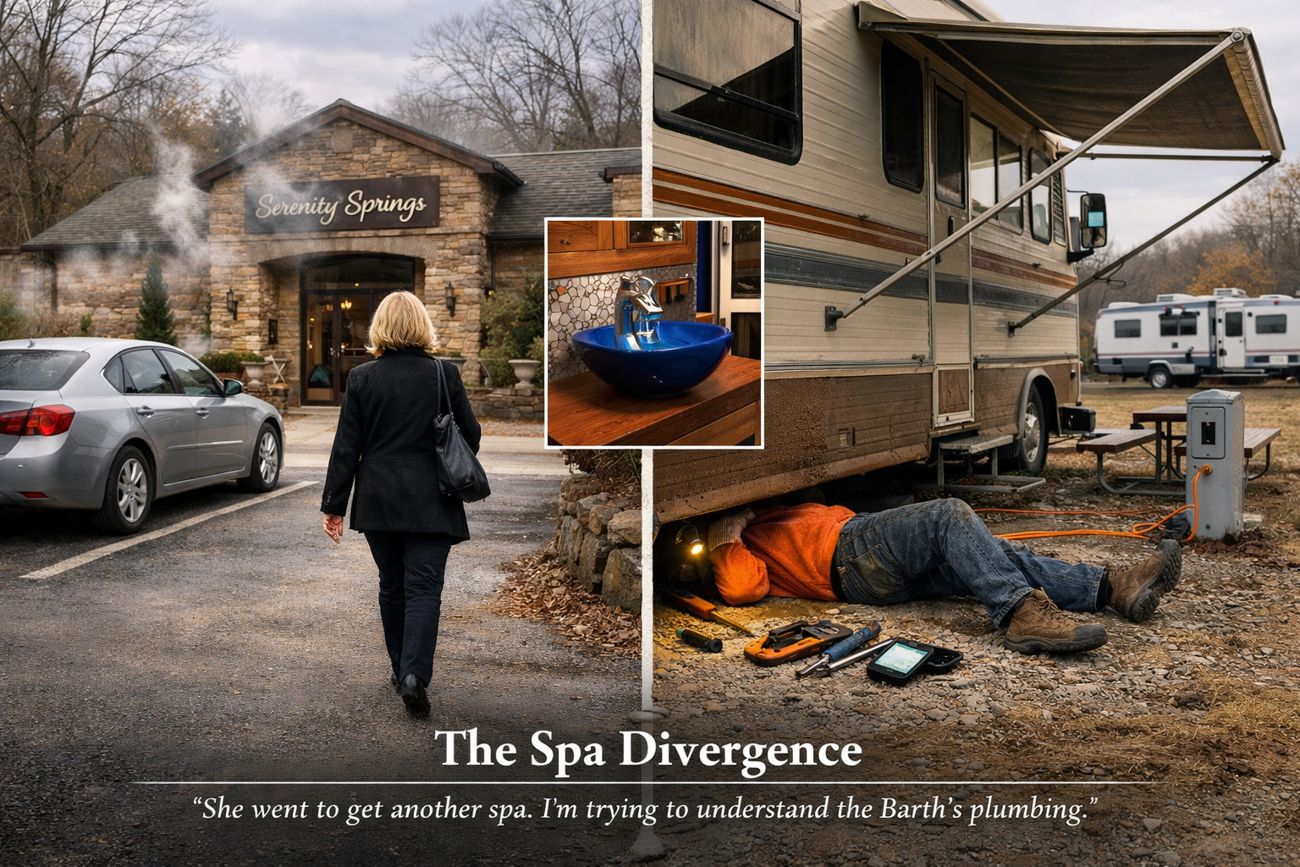
What he found under there delighted him. A three-way water heater that runs off engine heat, so the Ford 460’s spectacular inefficiency gets recycled into hot showers. He sent a thirty-eight second video about the bedroom doors: heavy, residential-grade, one on each side, so two people living in an aluminium tube can stop being in each other’s presence when they need to. He did not send a video about the engine.
Then he drove to Oklahoma.
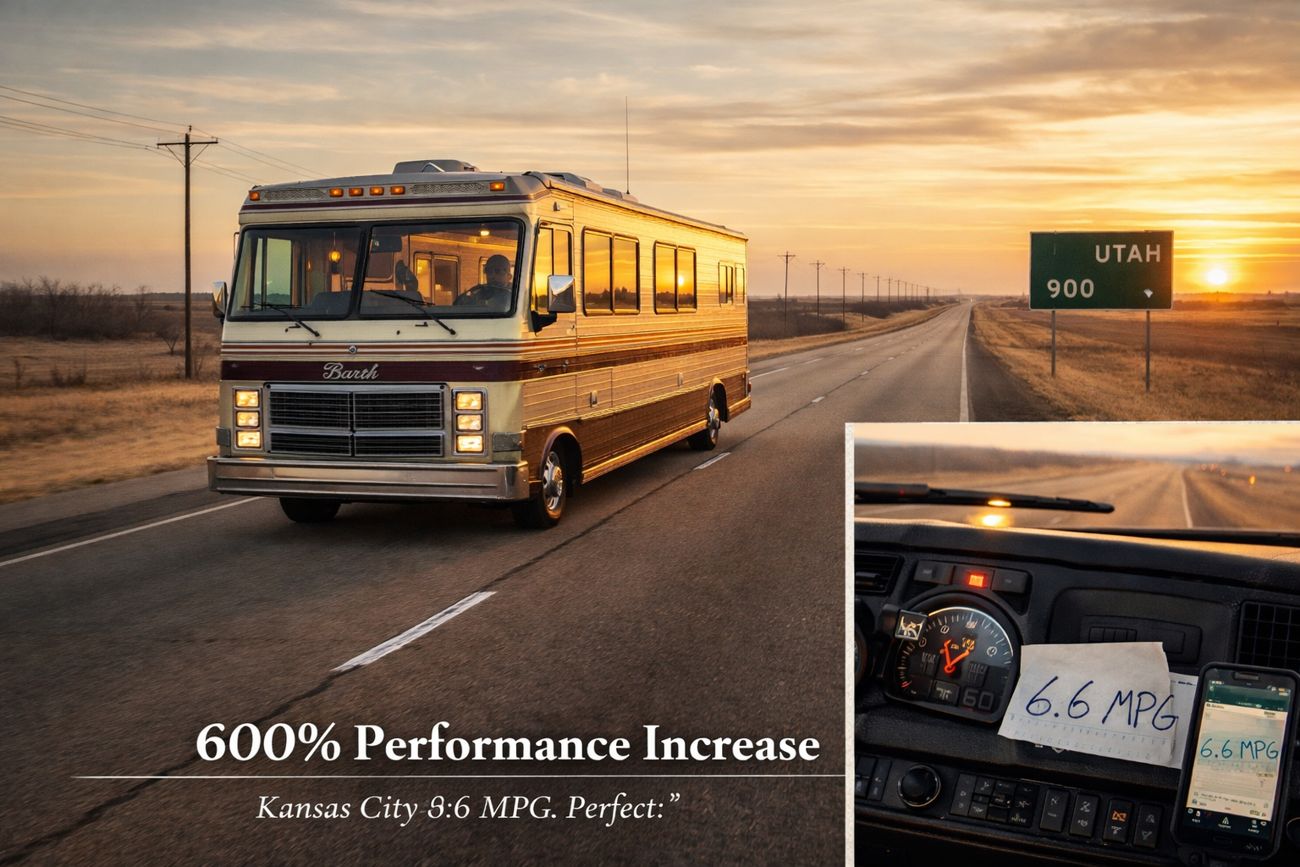
“Kansas City 6.6 MPG. Perfect!”
“Make that Oklahoma City.”
“That’s a 600% performance increase!!!”
It is about a 230% increase. But Larry math runs on emotional magnitude rather than arithmetic, and 6.6 miles per gallon in a sixteen-thousand-pound vehicle is, to the man at the wheel, perfect.
Chapter 61: Five Texans
They started the morning at Buc-ee’s. Larry ate a Beast Breakfast Burrito, read the ingredient label with real technical appreciation, and bought a bottle of radiator stop-leak reinforced with aramid fiber, the material used in body armour, because there were mountains coming.
Debbie wanted out. The stipulation she had negotiated before leaving Michigan entitled her to a first-class ticket home, or a limousine, or a chartered Learjet, if the Barth broke down. The Barth had not broken down. Its heroism was her problem.
They made it five miles.
In a gravel lot next to grain silos, in fifty mile an hour wind, the twenty-five foot awning tore off one side of the vehicle, stayed attached at the other, and beat against the Barth like a sail.
“I’m an old sailor in a gale trying to get the thing, do something or the thing, I can’t do anything with it.”
Five Texans stopped. Farm guys, ball caps, the kind of men who can fix anything. They got on the roof, could not make the hardware release, and cut the awning off. That left a seventy-five pound aluminium pole with nowhere to go, so they opened the small bathroom window and fed it inside, where it now lies the length of the hardwood floor like a spine. On the way in, a spring-loaded mechanism let go and cut one of the Texans’ hands.
The five Texans will never know they are in a chapter.
Chapter 62: Albuquerque
The forecast said blizzard in the mountains. By then Debbie had been through the belt squeal that made strangers stare, the coolant puddle that appeared under the engine at every single stop, a turkey vulture that hit the front of the Barth dead centre on the chrome script, and an awning that stayed in Amarillo. She looked at the weather. She looked at her husband.
“we get to Albuquerque, I dump her off, and she could see I was just determined to get the damn thing to Utah, no matter what the weather was”
I dump her off. Three words.
The stipulation had been written for mechanical failure. Nobody drafted a clause for the moment a wife reads the forecast, looks at the man and the vehicle, and decides quietly that Albuquerque is far enough.
She went to a hotel. Larry could not park on the slope outside it, because he does not trust the automatic parking brake and has never once used the leveling jacks, being afraid they will stick in the down position and the Barth will never move again. So he left. Midnight, coffee, the mountains, alone.
Chapter 64: Monroe
He drove eighteen hours. Twenty miles short of Monticello the crosswind and the snow squall arrived together and the professional truck drivers, the ones who know when to stop, pulled over. Larry is a retired airline pilot. He has landed 737s in crosswind. He knew the route turns south at Monticello, and south was downwind.
“I knew as soon as I get to Monticello, I’m turning downwind. So I gutted it out.”
It cleared five miles later. On the San Rafael Swell the temperature gauge went to 244 degrees, and he sat on the shoulder in the dark watching it come back down, then took the grade at twenty-five miles an hour in first gear.
He got to Monroe.
“my adrenals were completely shot”
The Barth is parked on the gravel next to the Queen Anne house Larry restored. The water lines froze overnight. There is an icicle hanging off the water tank, a vulture feather stuck to the front, a ratchet strap holding the awning scar down beside the chrome script, and a speedometer that reads 140 miles an hour while the vehicle sits still.
“how much of my life do I want to spend on this thing?”
“you got to have something to do and something to keep you entertained. So you tick on these stupid, stupid projects, and it becomes your life and your obsession, and then after you’re done, you go, well, why did I do that? What did it really get me?”
The last thing he said was “beautiful beast”.
Chapter 75: The Last Ride
Skip forward. Larry spent months reprogramming the FiTech, the racing fuel injection system at the centre of nearly every mechanical chapter in this story, and found the timing was significantly off. He dialled it in.
The engine, for the first time in the entire saga, was running perfectly.
So he took Debbie on a test drive. That detail is essential. The woman who has wanted the trip since before the Barth was the Barth was in the passenger seat on the day the engine finally ran correctly. He wanted her to feel it.
They drove up Clear Creek Canyon and east on Interstate 70 toward seven thousand eight hundred feet.
The engine ran perfectly. And then the engine stalled, because the extra inline fuel filters Larry had added to protect the fuel system had clogged enough to starve the perfectly running engine of fuel. The fix caused the problem.
He made an illegal U-turn on a federal interstate and pulled onto the shoulder. The automatic parking brake, nonfunctional since the day of purchase, was still nonfunctional. Debbie jumped out and put a rock under the wheel.
Pause there. The wife who wanted Yellowstone was now standing in the Utah wind putting a rock under the tyre of a motorhome whose parking brake is an item of decorative hardware. She had joined the operation. She was pit crew now.
Park still did not mean park. The rock did.
They turned around and started back down the canyon. And then Larry heard a loud bang.
The drive shaft had separated from the transmission. The engine was still running. The engine was running perfectly. It simply was no longer connected to anything that moved. He pressed the accelerator, the engine revved, and nothing happened.
So he coasted. Sixteen thousand pounds, gravity, a canyon descent, and thirty seconds to work out whether he could reach the Joseph exit on momentum alone. He could. He hit forty miles an hour on gravity and got it off the freeway.
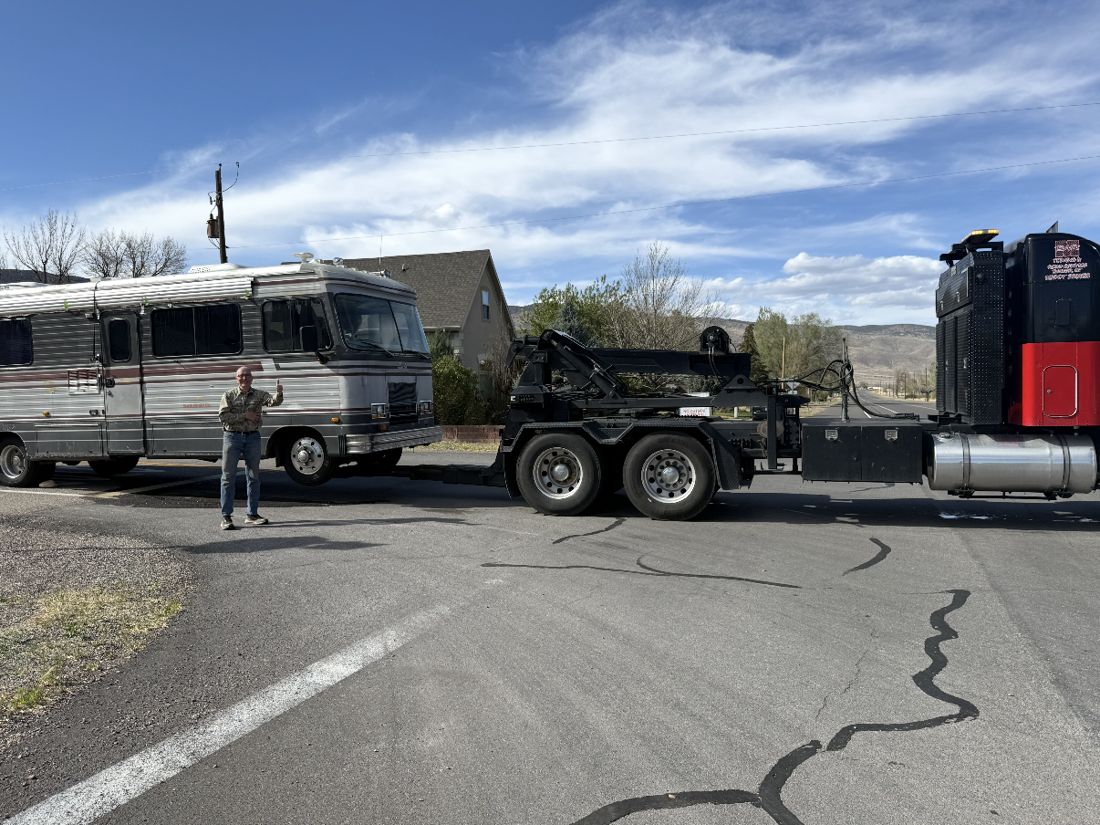
Larry’s messages arrived in this order, thirty seconds apart:
“Not possible.”
“Last ride in the Barth”
“The entire drive train broke loose on the freeway”
“$800 tow”
“I’m going back now to look for the drive train”
The tow truck brought it to the Queen Anne house. And the engine was running perfectly. That is the detail that matters. Larry won the fight he had been fighting. The engine, removed from the Barth and put on a stand with clean fuel, would run perfectly for as long as you asked it to.
The engine was never the problem. The problem was everything the engine was connected to.
There are seventy-six chapters of this
You have read twelve. The other sixty-four contain a turkey vulture, a plasma donation centre, a bathroom stacked to the ceiling with unopened whiskey, a psychiatrist, a GPS that routed a 1988 motorhome toward Alaska, a set of leveling jacks nobody has ever dared press the button on, and a man who at one point commissioned a chapter about his own hypothetical divorce, in the third person, and then supplied the location scouting for it.
Read the complete saga. Seventy-six chapters, sixty-eight illustrations, and every image prompt that produced them, printed underneath the pictures.
How this was made
The Barth Saga is fiction built on real scaffolding, and the scaffolding is the part worth talking about.
What I started with was a mess. Months of text messages arriving out of order. Voice memos recorded at highway speed inside a vehicle loud enough to require earplugs. Undated photographs with no captions. A friend who kept sending material about a motorhome, then started reading what came back, then started sending production notes.
Seventy-six chapters and sixty-eight illustrations came out of that. None of it came out of one clever prompt, and anyone who tells you otherwise is selling you a screenshot.
What it took was a system: a Claude Project holding the whole archive so no session ever started from zero; a written voice guide the model had to match on every pass, with the failure modes named; a rule against improvising dialogue, so a line in quotation marks came from the source material or was not written as a quote at all; an internal consistency rule, so the mailbox that dies in Chapter 1 is still crooked in Chapter 23 and the parking brake that fails in Chapter 8 is the reason there is a rock under a wheel in Chapter 75; per-chapter briefs listing the facts each chapter depended on, checked before and after drafting; image prompts written as documents rather than one-liners, because visual consistency across dozens of pictures comes from written continuity rules and not from asking nicely; and then rounds of cutting, which is where most of the work actually lives and the part nobody puts in a demo.
That is the difference between using AI and getting something out of it. Not a clever prompt. A structure that stays useful across weeks of messy input.
I build this kind of structure with people and businesses through Takeoff Consulting, here in Richfield, Utah.