This is the complete version, seventy-six chapters of it. If you have not read the short one, start there. It takes four minutes and it will tell you whether you want the other twenty-two thousand words.
The Barth Saga is a comedy. It began with a real 1988 Barth motorhome, bought for six thousand dollars in freezing rain by a friend of mine who is a considerably better mechanic than he is a judge of motorhomes, and with the stream of texts, voice memos and photographs he sent about it afterwards. Almost everything after that is fictionalised. Scenarios are exaggerated, disasters are escalated well past plausibility, timelines are compressed, characters are composites, and entire chapters are invented outright, including several that a man in the story commissions about himself.
Nobody here should be read as a portrait of a real person and nothing in quotation marks should be read as a transcript. Some of it happened. Most of it did not, or did not happen remotely like that. Assume you cannot tell which, because somewhere around chapter forty neither could we.
“This isn’t fiction anymore I’m afraid.”
Larry, 4:51 AM
Contents
- Part One: The Foundation. Prologue and Chapters 1 to 30. Michigan, winter, two mailboxes.
- Interlude: The Divorce Arc. Five futures that never arrived.
- Part Two: The Breakthrough. Chapters 31 to 40. One wire.
- Part Three: The Journey. Chapters 41 to 58. Michigan to Arkansas.
- Part Four: The Arrival. Chapters 59 to 69. Arkansas to Monroe, Utah.
- Part Five: After Monroe. Chapters 70 to 76. The Daisy Timeline, and the last ride.
- How this was made.
Every illustration on this page was generated from a written prompt. The prompts are included underneath the pictures they produced, unedited, so you can see the instruction and the result side by side.
Part One: The Foundation
Prologue: The Purchase
Larry took an Uber one hour and twenty minutes to inspect a motorhome he had specifically told the dealer not to start. He wanted to hear a cold engine, because a cold engine is honest. The dealer started it anyway and pulled it around front. Larry’s inspection protocol was violated before he arrived.
It was freezing rain. Too much ice to get on the roof. His hands stopped working inside his gloves. So he inspected the part he could reach, which was the inside.
“the interior, man, the interior was incredible”
Cobalt blue vessel sink. Hardwood floors. Heavy doors. Crown molding. A three-way water heater. Somebody had spent thousands of hours building a boutique hotel inside a 1988 motorhome, and Larry reasoned that a man who does that does not leave the roof leaking. The logic is sound. It is also the logic of a man standing in freezing rain who cannot get on the roof and needs a reason not to.
He had owned a Barth before. He respected the brand. He thought he was good enough to handle any Barth. His ego, he says now, was a little ahead of his brain.
He bought it. He turned on the defroster and the belts screamed. It backfired once, on the test drive, and then not again, so he stopped thinking about it. Forty-five minutes from his house the power steering quit.
“I hear this, bam.”
He muscled sixteen thousand pounds through the turns into his HOA neighborhood using his arms, while a woman walking her dog stood and watched.
“I was so worn out to steer the fucker. And I parked it on the street in front of the house because I didn’t dare want to try to get it up the driveway.”
The next day, in three degrees, he crawled underneath and found the hydraulic boost belt installed upside down. A Ford mechanic had supposedly inspected this vehicle. He called a mobile mechanic. The mobile mechanic’s truck broke down. Even the rescue needed rescue.
“in hindsight, probably not the smartest thing to do”
Everything that happens in the next seventy-six chapters was present on the day of purchase. The belt squeal, day one. The disconnected plug wire, day one, one backfire. The power steering, day one. The interior, day one, the trap. The ego, day one. And the woman with the dog, day one, the witness. Someone always sees.
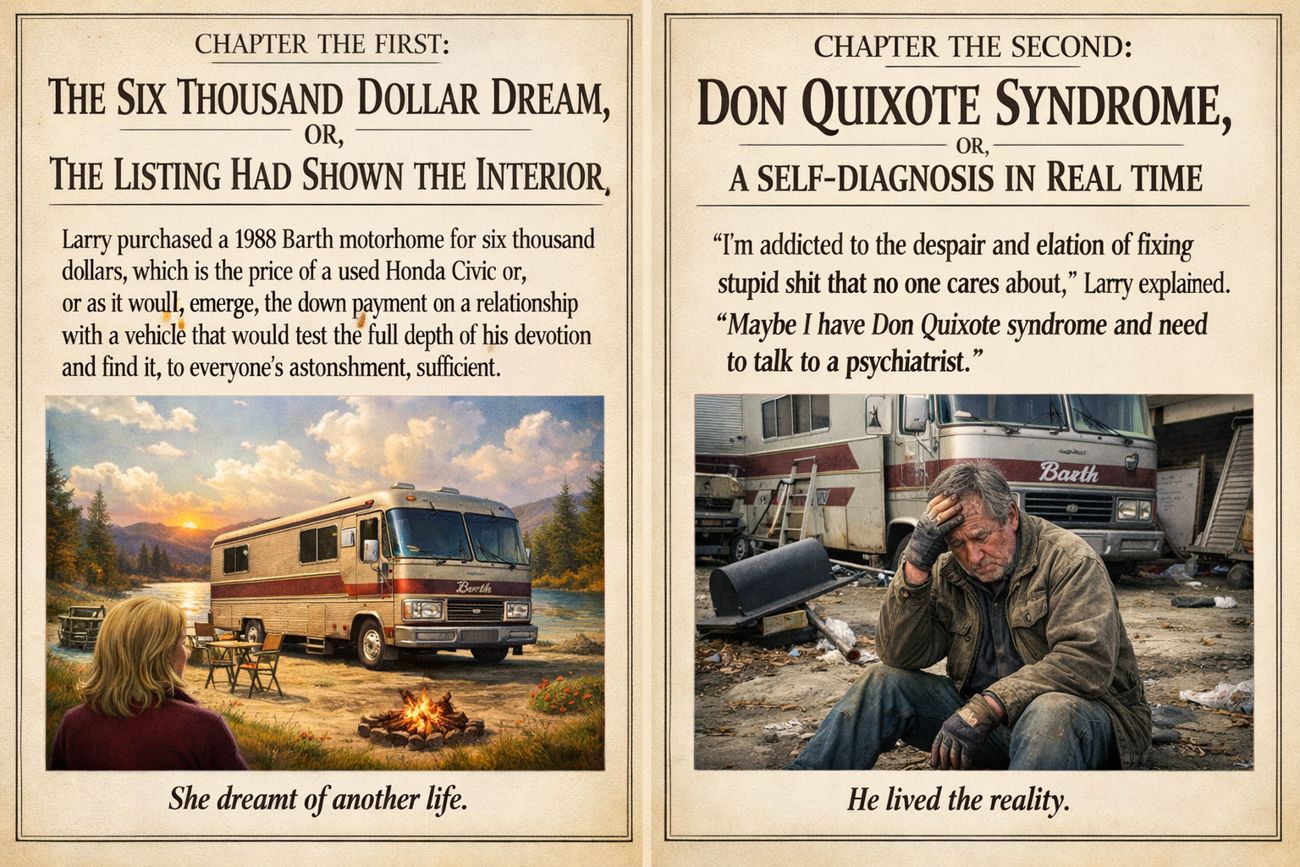
Chapter 1: The Six Thousand Dollar Dream
On paper it was the deal of a lifetime. Interior completely redone, high-end everything. An engine fitted with racing fuel injection rated at over two hundred gallons per minute.
In practice it did not run, and no mechanic would touch it, because every system on it had been custom modified by somebody else. So Larry crawled underneath in ten-degree Michigan weather and fabricated fuel pump mounts himself, five minutes at a time, retreating indoors between attempts to get his hands working again.
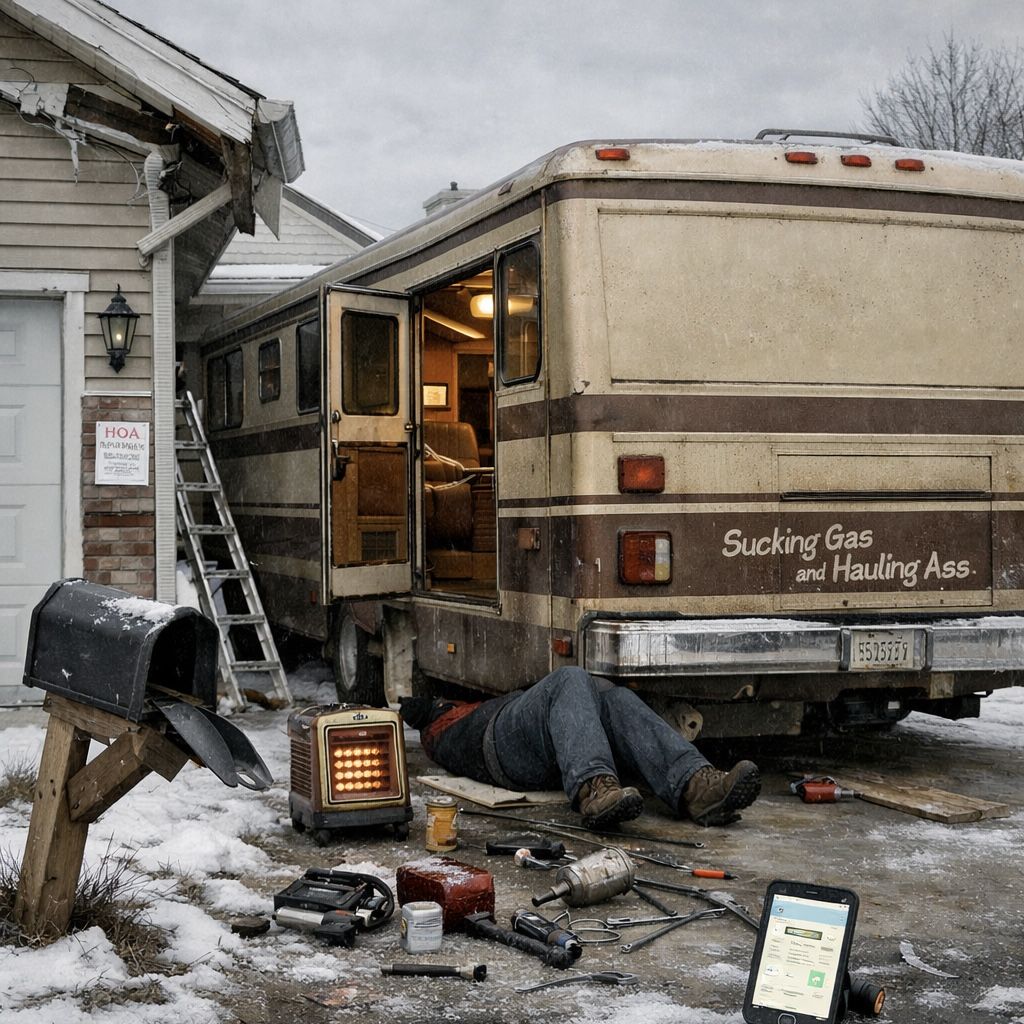
He got it running. He drove it out of the driveway and destroyed the mailbox. He backed it in and tore the soffit off the house. He took it onto the highway, where it stalled halfway across, sixteen thousand pounds that would not restart, with traffic stacking up behind it. Then he discovered he had no title, which meant that if it died for good he could not legally junk it, store it, or prove it was his.
He found storage for seventy dollars a month within walking distance. He was now paying rent on a vehicle he could not prove he owned, could not reliably drive, and could not abandon. He was consulting an AI chatbot for mechanical advice. He asked what UPS charges to ship sixteen thousand pounds. The answer was next day air.
He also worked out, somewhere in there, that his wife had destroyed the previous mailbox, at this same address, with the previous Barth.

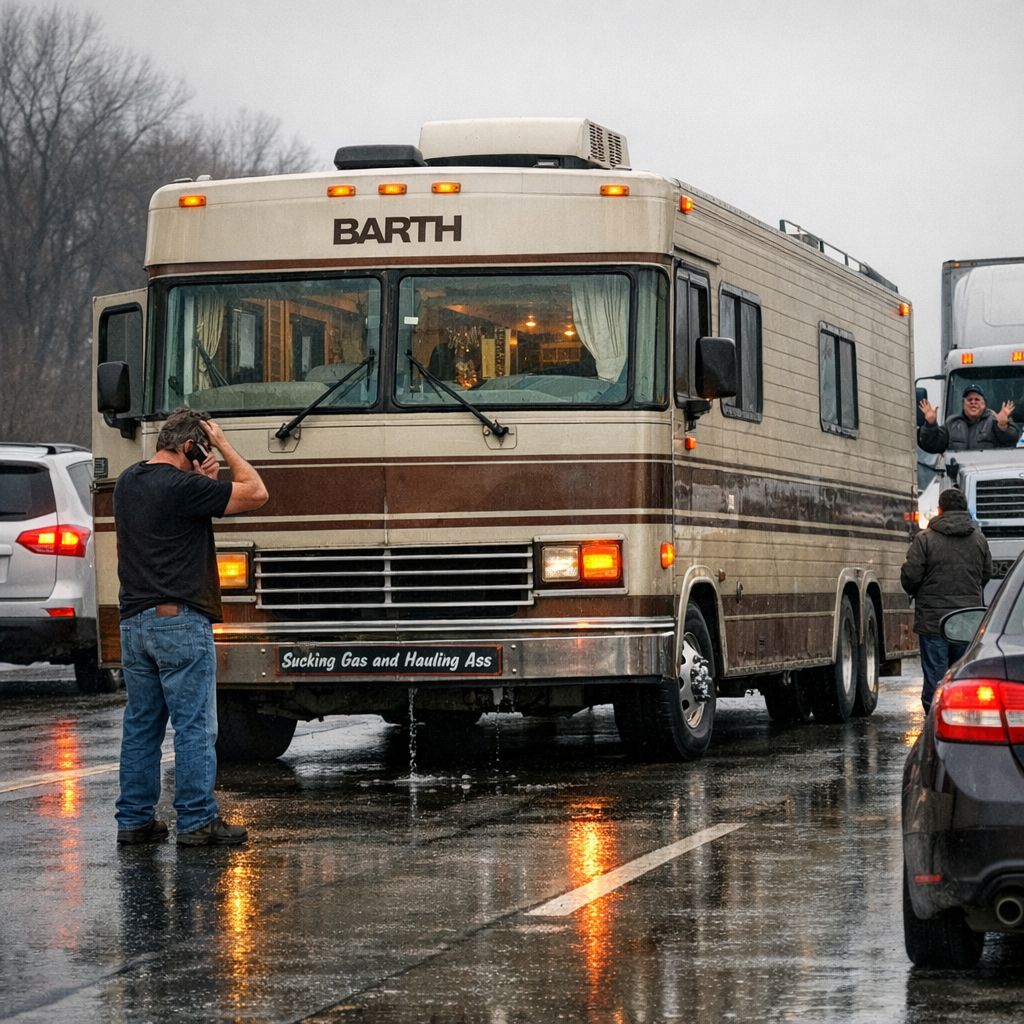
The image prompt that produced this: Prompt 1, The Highway Stall
A hyperrealistic photograph taken from the perspective of stopped traffic on a Michigan highway in winter. Gray daylight, flat and cold. The road appears clear but has that deceptive black ice sheen.
Center frame: A massive 1980s Barth RV, tan and brown, 30+ feet long, sits dead in the middle lane, partially blocking two lanes. Hazard lights blinking weakly. A thin trail of something dripping underneath. The vehicle is so large it seems impossible, like a beached whale on asphalt.
The driver: A middle-aged man stands outside the driver's door, phone pressed to his ear, other hand on his head in the universal posture of "I don't know what to do." He's underdressed for the cold. He's looking at the RV like it has personally betrayed him.
Traffic: Cars backed up behind, some trying to merge around. A semi-truck driver visible in his cab, hands raised in a "what the fuck" gesture. Someone three cars back has gotten out to look, coat pulled tight, witnessing.
Key details: The RV has clearly been loved, clean exterior, that "Sucking Gas and Hauling Ass" bumper sticker. Through the windshield you can glimpse the incongruously beautiful interior. New tires, visibly new, which somehow makes it worse. A small handwritten note taped inside the back window: "NO TITLE – PLEASE DON'T TOW."
Mood: The specific humiliation of mechanical failure as public spectacle. 16,000 pounds of immovable problem. The scale of the RV against the man emphasizes how outmatched he is. Other drivers are annoyed but also confused, what even IS that thing and why is it here?
Lighting: Overcast winter highway light, everything slightly desaturated except the blinking hazards.
Chapter 2: Don Quixote Syndrome
Standing in the driveway looking at the hanging soffit, the second dead mailbox and the vehicle that had done both, Larry texted a friend a self-diagnosis.
“Maybe I have Don Quixote syndrome and need to talk to a psychiatrist.”
He explained the reference: tilting at windmills, acting out grand noble quests based on fictional ideals in a world that does not conform to them. Then he explained it better.
“Foolish quests. I’m addicted to the despair and elation of fixing stupid shit that no one cares about”.
He mentioned that the Barth had also damaged the ladder. He noted that the weather was clear but the roads were icy and there was complete carnage on the freeway. Then he concluded: maybe he should take the Barth out for a spin.
His friend replied that he hoped Larry got it running properly. It deserved it. The world deserved it. Neither of them was joking.
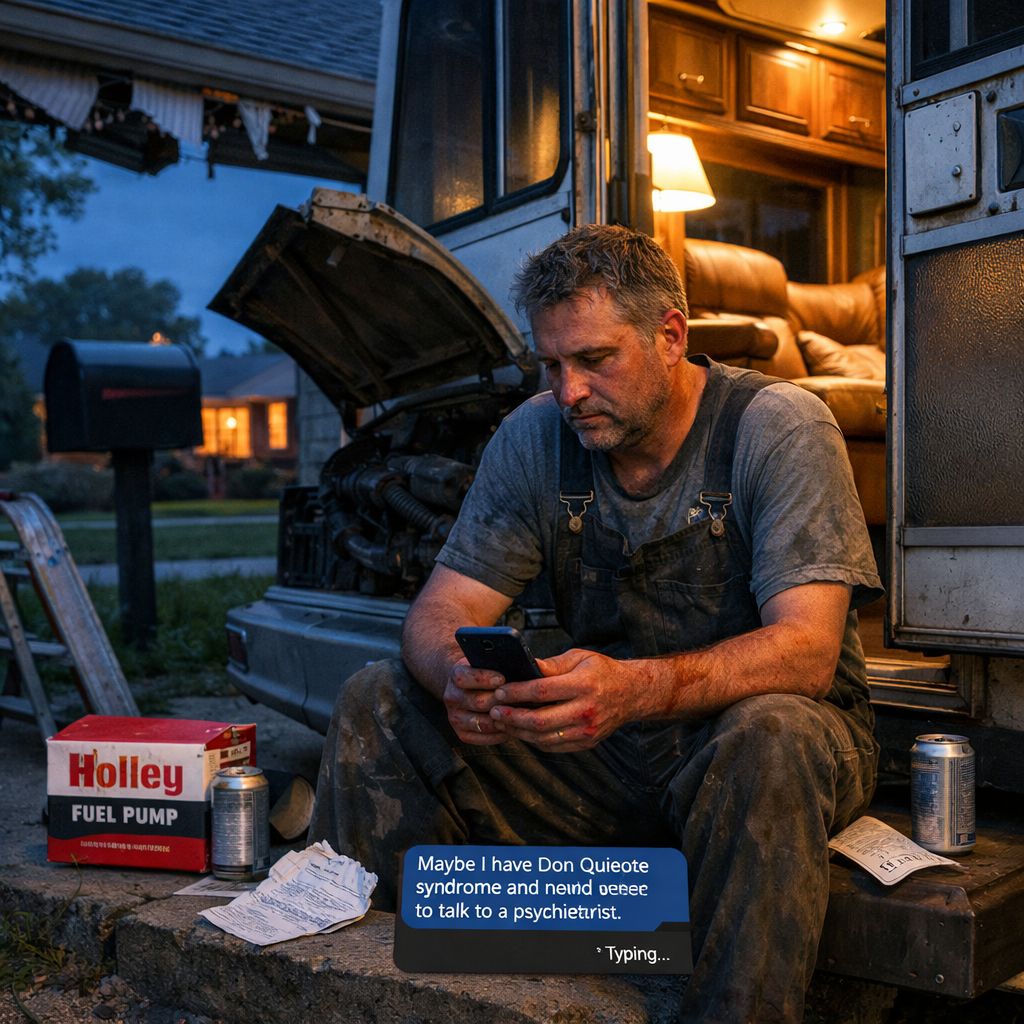
The image prompt that produced this: Prompt 2, Defeated Hopelessness
A hyperrealistic photograph, intimate and quiet. Dusk in a Michigan suburb, blue hour light. The Barth RV sits in the driveway, engine hood open, interior lights glowing warm.
The man: Sitting on the RV's entry steps, door open behind him. He's in work clothes stained with grease and fuel. His hands hang between his knees, red, raw, done for the day. He's not looking at anything. He's looking at the middle distance where answers should be.
His phone: Held loosely, screen visible. A text conversation. The last message he sent: "Maybe I have Don Quixote syndrome and need to talk to a psychiatrist." Below it, still typing: his friend's response.
The environment: The destroyed soffit visible in the background, hanging. The new mailbox standing where the old one died. The ladder with the dent. A neighbor's warm living room light visible across the street, normal life happening to other people.
Inside the RV: Through the open door, the beautiful renovated interior glows. Leather, wood, expensive lighting. A home that doesn't move. A dream that won't start.
On the step next to him: A Holley fuel pump box, empty. A filter. A printout of AI chatbot advice, crumpled. A beer, unopened, he hasn't earned it yet, or maybe he's past earning things.
Mood: The specific loneliness of loving something that only causes problems. Not anger anymore, just the quiet after. The posture of a man who described himself as "addicted to the despair and elation of fixing stupid shit no one cares about", currently in the despair part. The elation feels very far away.
Title Card Energy: "Foolish Quests" , or simply, "I Could Only Stand To Be Under It For Five Minutes At A Time."
Chapter 3: The Highway Stall
The Barth died on the highway, blocking traffic. Sixteen thousand pounds of immovable problem in the middle lane, hazard lights going, a semi driver with his hands up in the cab behind. New tires, visibly new, which somehow made it worse.
Taped inside the back window, a handwritten note: NO TITLE, PLEASE DON’T TOW.
Chapter 4: Defeated Hopelessness
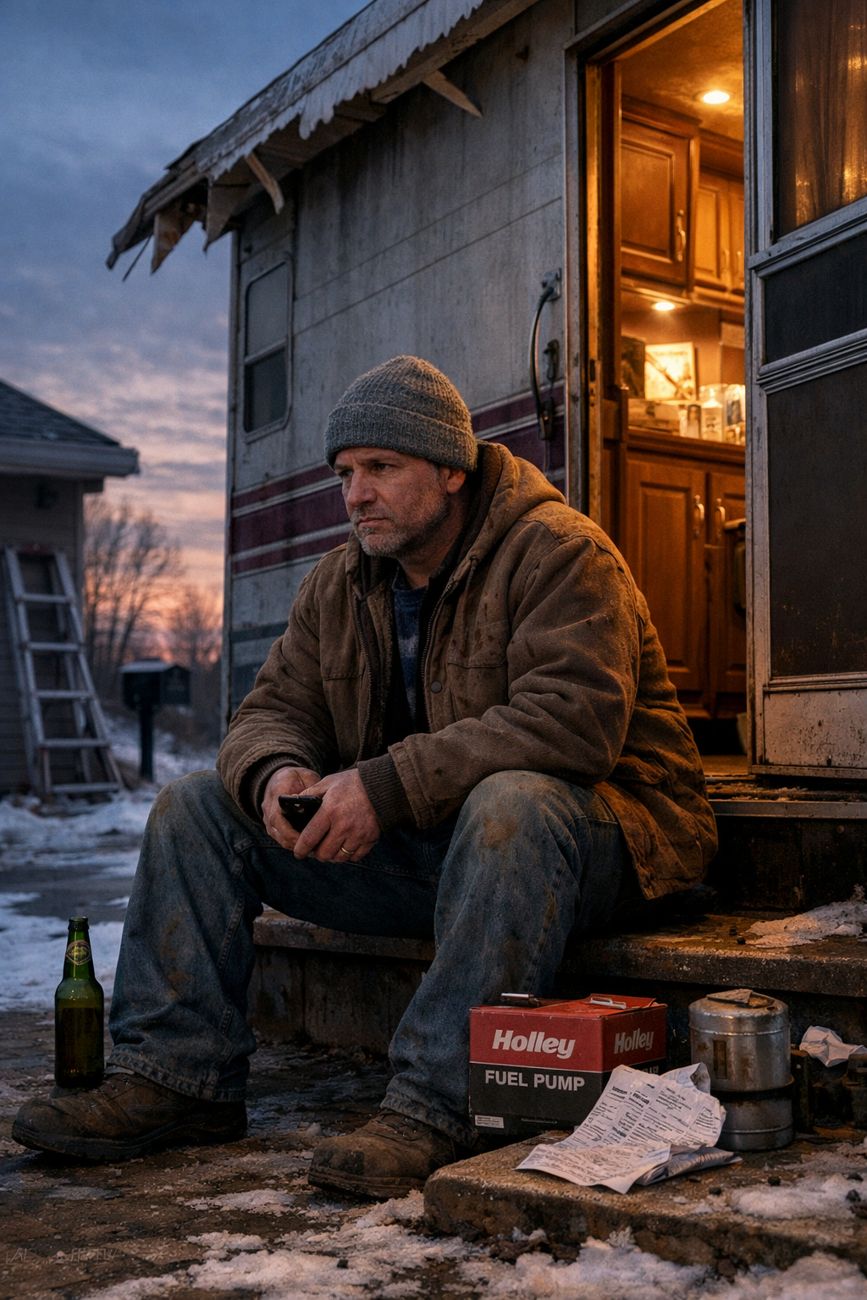
Dusk. Larry sits on the Barth’s entry steps with the door open behind him, hands hanging between his knees, red and raw and done for the day. He is not looking at anything in particular. He is looking at the middle distance where answers should be.
Behind him: the destroyed soffit, the new mailbox standing where the old one died, the ladder with the dent in it, and across the street a neighbour’s warm living room window, which is normal life happening to other people.
Beside him on the step: an empty Holley fuel pump box, a filter, a crumpled printout of chatbot advice, and a beer he has not opened, because he has not earned it yet.
Chapter 5: Maybe I Should Take the Barth Out for a Spin
Next morning the sky was clear and blue and almost cheerful, the wind was violent, and the street had that lethal shine that fools everybody. Through the subdivision entrance you could see the freeway doing what freeways do when the road looks fine.
Larry stood at the end of his driveway in a bathrobe and boots with a cup of coffee. He was not looking at the carnage. He was looking at the Barth, which he had already started that morning. His expression is not despair. It is the small smile of a man who has been beaten so thoroughly by an object that he is now considering doing something stupid on purpose.
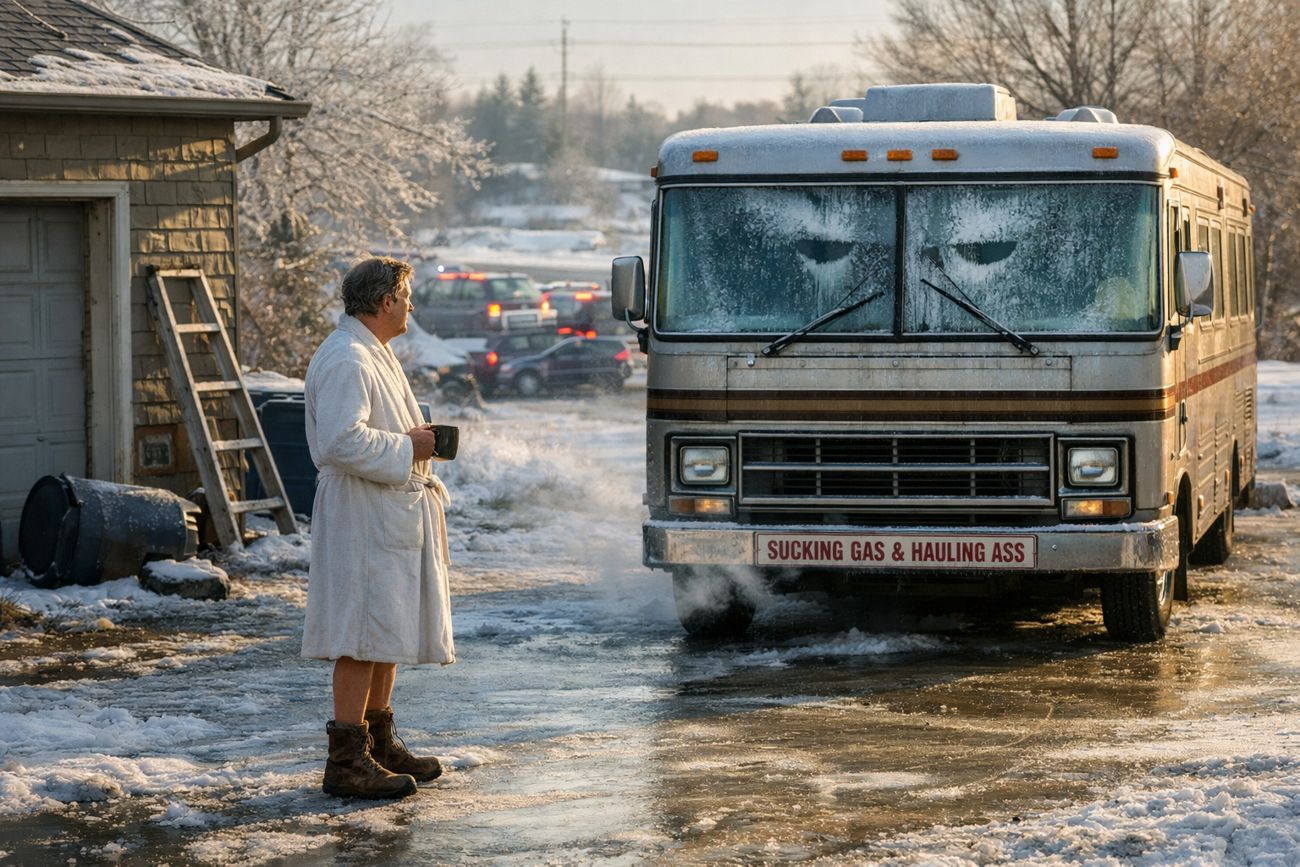
The image prompt that produced this: Prompt 3, Maybe I Should Take The Barth Out For A Spin
A hyperrealistic photograph, morning light in Michigan winter. The sky is deceptively clear, blue, crisp, almost cheerful. But the wind is visibly violent: tree branches bent, a garbage can lid mid-flight in the background, a neighbor's inflatable decoration dragging across a yard.
The road: The street in front of the house has that lethal shine. Black ice. Not snow, not slush, the invisible kind that fools you. In the distance, through the subdivision entrance, the highway is visible: brake lights, a car spun sideways, emergency flashers everywhere. Complete carnage. Everyone thought the roads looked fine.
The man: Standing at the end of his driveway in a bathrobe and boots, coffee in hand. He's not looking at the carnage. He's looking at the Barth. The Barth is looking back.
His expression: Not despair. Something worse. A small smile. The specific facial expression of a man who has been beaten so thoroughly by an object that he's now considering doing something stupid on purpose. The calm after sanity leaves. He's had a thought and he's not fighting it.
The Barth: Sitting in the driveway, enormous, patient, like it's been waiting for this moment. Frost on the windshield but the hood is warm, he already started it this morning. It's idling. The "Sucking Gas and Hauling Ass" sticker catching the early light. The destroyed mailbox beside it. The hanging soffit above. The dented ladder leaning. The battlefield of his own making.
His phone: Visible in his bathrobe pocket, screen glowing. A text he just sent: "Damn today is clear but the wind is howling and roads are icy. Complete carnage on the freeway everyone is fooled because the road looks clear."
The next text, unsent, but we know it's coming: "Maybe I should take the Barth out for a spin."
Key details: A neighbor across the street, visible through a window, on the phone, probably calling to report the HOA violation, unaware they're about to witness something historic. The RV's exhaust puffing in the cold. The man's bare ankles between bathrobe and boots. The coffee is still full. He woke up and chose chaos.
Mood: The specific energy of someone who has crossed over from "trying to solve a problem" to "becoming the problem." Not suicidal, just nihilistically playful. The roads are a disaster. His vehicle is a disaster. He has no title, no working fuel system he trusts, and 16,000 pounds of uninsurable maybe. And he's going to send it.
Lighting: Harsh winter morning sun, the kind that makes ice invisible. Everything looks beautiful and safe. Nothing is.
Tone: Dark comedy at its peak. The moment before a decision that is objectively wrong but emotionally correct. Don Quixote seeing the windmills and thinking "you know what, today feels right."
Title: "Foolish Quests: The Relapse" , or simply, "We Will See."

Chapter 6: Tuesday 8:15 AM, The Mission Begins
Larry wakes from nightmares about FiTech fuel injection, Honda Odyssey body swaps and catch-22 situations. It is three degrees outside. The Barth has to be moved before Debbie gets back on Thursday. Tomorrow is a snowstorm. Today is the window. The FiTech handheld will not turn on.
“Is it going to fuck me today or will I get lucky.”
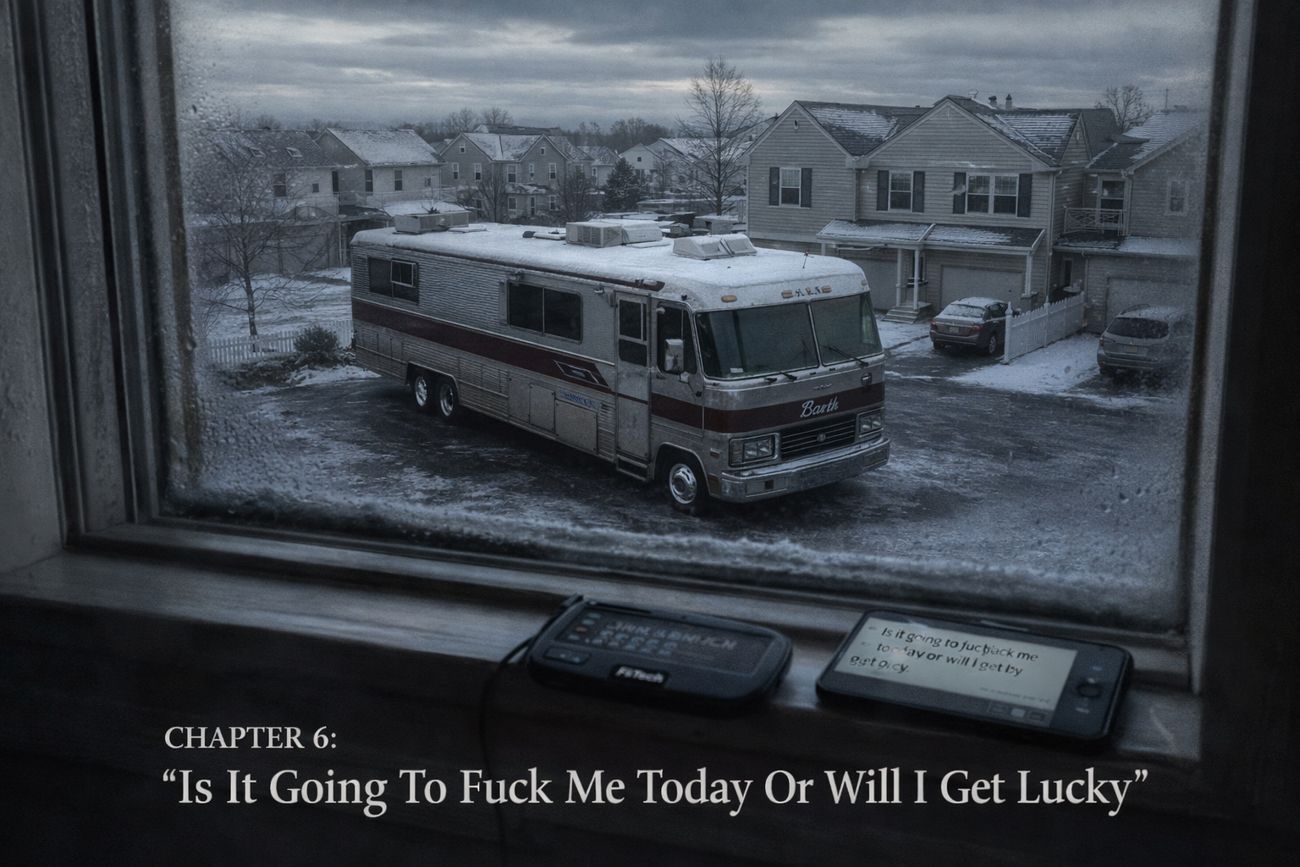
The image prompt that produced this: Prompt 4, Tuesday 8:15 Am
A photograph taken from a second-story window, we are looking down at the scene from inside the house, through cold glass, the photographer's breath probably visible if this were video.
The Barth: Sits in the driveway below, massive, dark blue with maroon trim, snow accumulated on the roof and AC unit. It looks like it's been there forever. It looks like it will be there forever. The new tires, the ones that were supposed to fix things, are visible, dusted with snow.
The neighborhood: Textbook HOA suburban development. Beige and gray townhouses, all identical, all watching. White fences. Bare winter trees. Everyone else's cars are normal-sized and functional. Everyone else made different choices.
The sky: That flat gray-blue of extreme cold. 3 degrees. The clouds say tomorrow's snowstorm is already assembling.
What we don't see but know: The man holding the phone, standing at this window, having just woken from dreams about fuel injection. The FiTech handheld that won't turn on. The wife's deadline. The math: today or never, broken diagnostic or not, 3 degrees or not, highway stall risk or not.
The energy: The specific calm before someone does something they know might go wrong but have no choice about. The Barth looks almost peaceful down there. It doesn't know about the nightmares. It doesn't know about the deadline. It just waits, 16,000 pounds of maybe.
Title: "Is It Going To Fuck Me Today Or Will I Get Lucky"
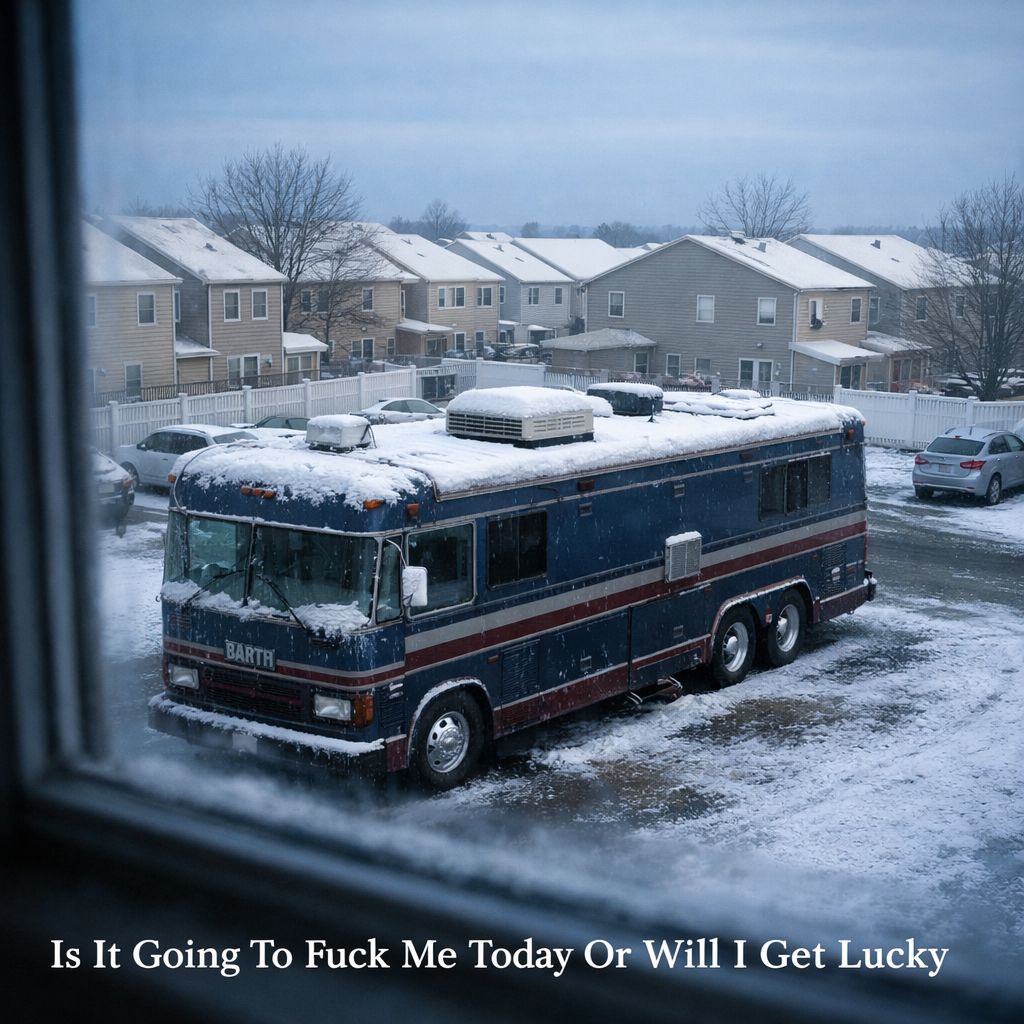
Chapter 7: The Untowable
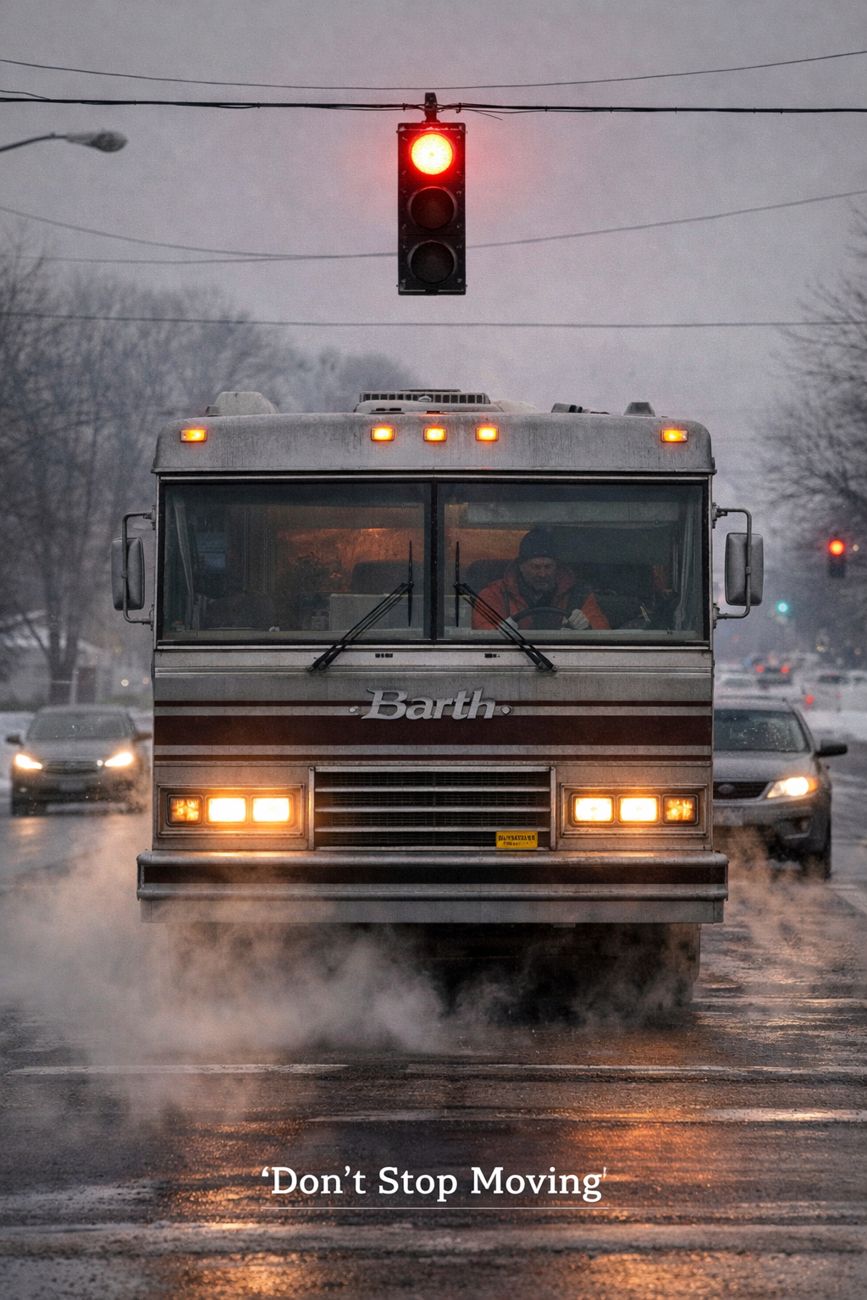
The automatic parking brake engages when the engine dies, which locks the wheels, which makes the Barth untowable. Not that it could be towed anyway, because no title means no tow authorisation. Every red light is therefore an existential event.
“As long as I don’t hit any red lights and have to stop the momentum it might make it.”
This is the plan. This is the whole plan.
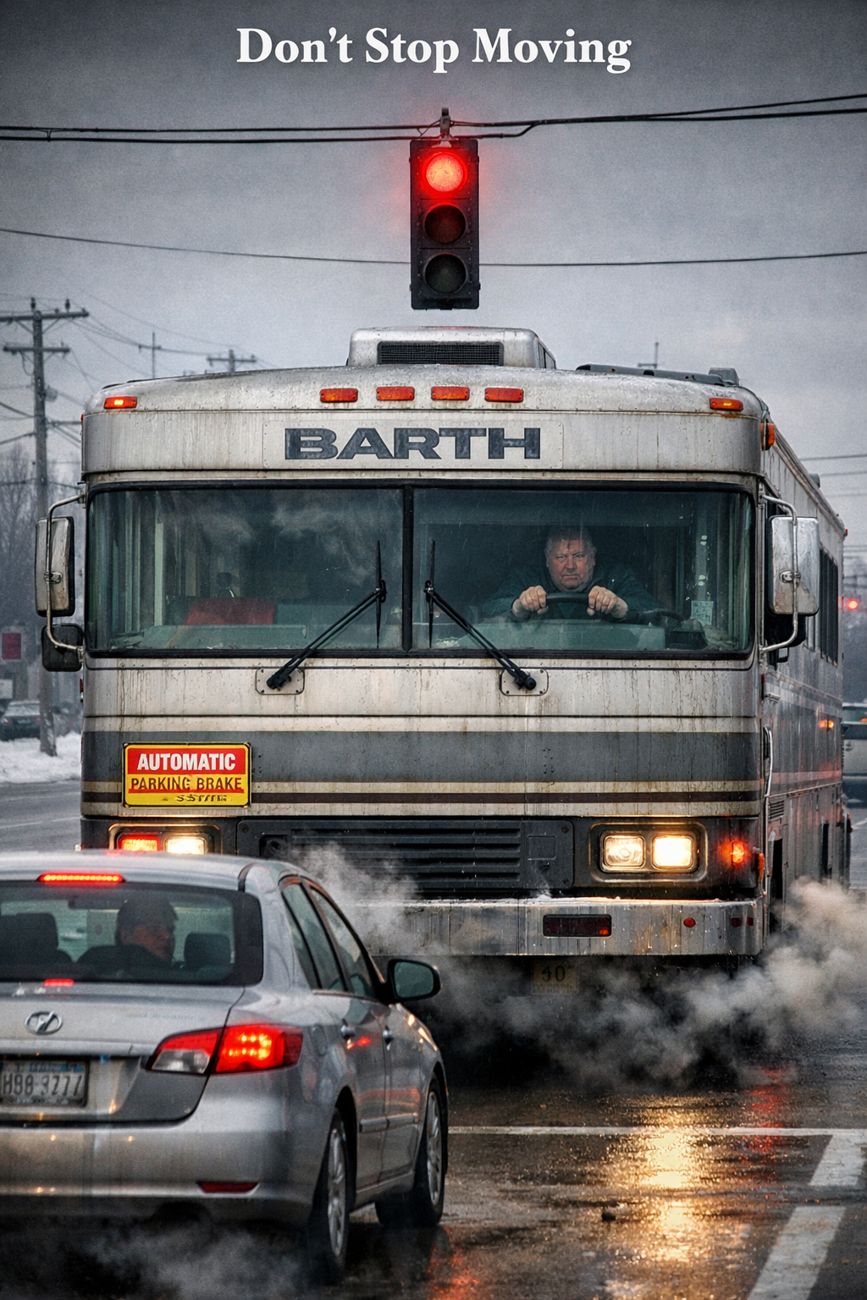
The image prompt that produced this: Prompt 5, Don’T Stop Moving (The Untowable)
A hyperrealistic photograph of an intersection in suburban Michigan, winter, gray morning light.
The Barth: Stopped at a red light, massive, taking up the entire lane and then some. Exhaust visible in the cold. The driver is visible through the windshield, white-knuckle grip on the wheel, leaning forward, watching the light like it's a bomb timer.
The light: Red. Unmoving. Indifferent.
The dashboard (implied or visible through windshield): Where a FiTech handheld monitor should be showing diagnostics, there's nothing. Dead screen. The engine is running but there's no way to know for how long.
Other drivers: A normal car behind him, driver visible, confused by the size of the thing in front of them. They don't know. They don't know that if this light doesn't change soon, and if that engine hiccups, everyone's day is about to get very long.
Key detail: Somewhere on the Barth, a small sticker or badge indicating the automatic parking brake system. The thing that makes this vehicle, if it dies, an immovable monument to foolish quests.
The energy: The specific tension of knowing the rules of the game and knowing you cannot win, only delay losing. Every second at this light is borrowed time. The light doesn't care. The light has never cared.
Title: "Don't Stop Moving"
Chapter 8: Park Doesn’t Mean Park
He fought the stalling Barth up his sloped driveway, reached the top, put it in park and exhaled. The gear indicator read P.
The Barth began rolling backward.
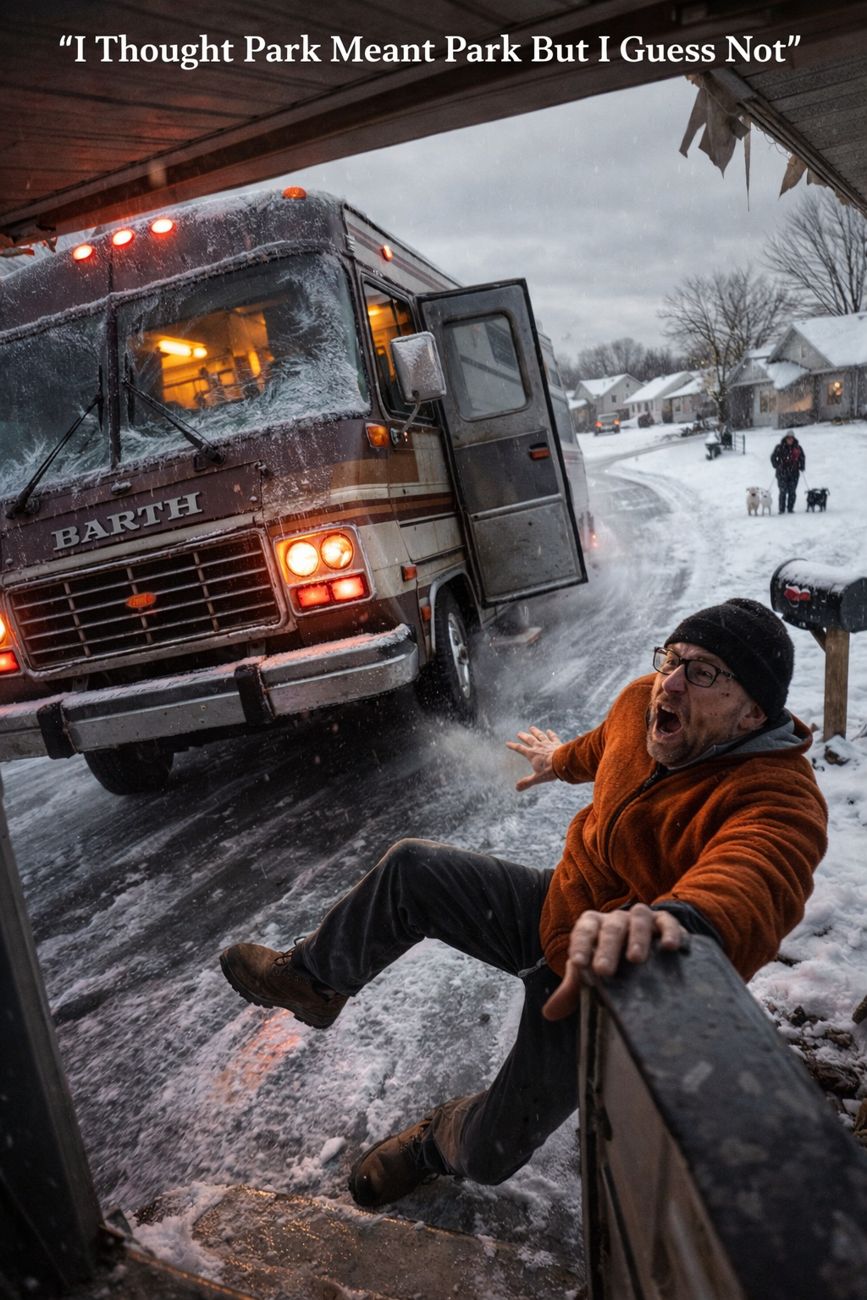
The automatic parking brake only engages when the engine is off. Sixteen thousand pounds went back down the driveway, hit the house, destroyed the mailbox and kept going toward the street. A neighbour walked two small dogs past, unaware.
“I thought park meant park but I guess not.”
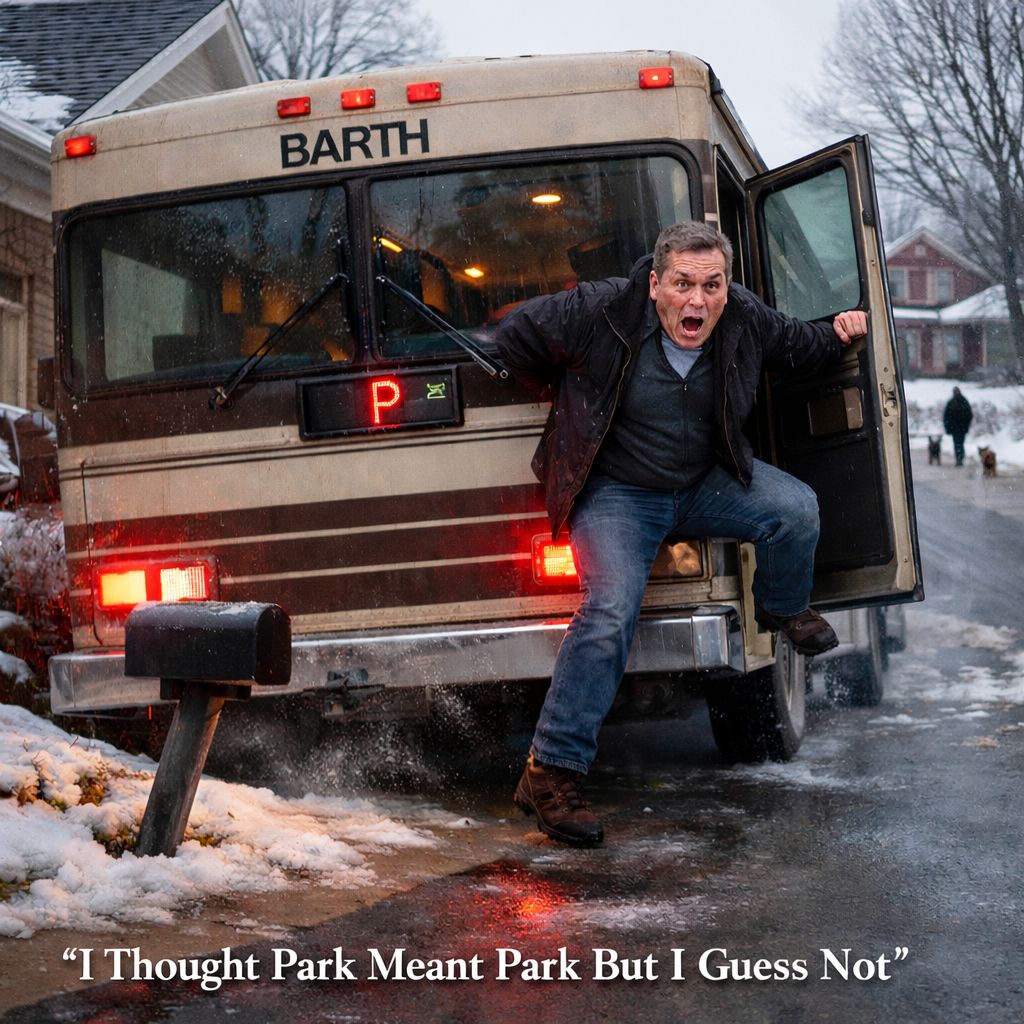
The image prompt that produced this: Prompt 6, The Rollback
A hyperrealistic photograph capturing the moment of horror. Sloped suburban driveway, winter, the HOA houses watching.
The Barth: Massive, at the top of the driveway, but angled wrong, the back end swinging toward the street. Brake lights on but it doesn't matter. The driver's door is open, the man half-standing, one foot in the vehicle, one foot reaching for the ground, the universal posture of "do I jump or do I ride this out."
The trajectory: Behind the Barth, the path of destruction is implied, the mailbox that's about to die, the soffit that's about to be torn. The street beyond, where a neighbor is visible in the distance, walking two small dogs, unaware.
The man's face: Pure panic. The specific expression of someone who just learned the rules of reality don't apply to this vehicle.
The gear indicator (visible through windshield or on dash): Clearly showing "P" for Park. Park is a lie.
Key detail: The engine is still running, that's the problem. The parking brake won't save him until the engine dies, and the engine dying is also a problem.
Mood: The specific chaos of systems failing in ways you didn't know were possible. He did everything right. The Barth has different definitions.
Title: "I Thought Park Meant Park But I Guess Not"
Chapter 9: Futile Improvements
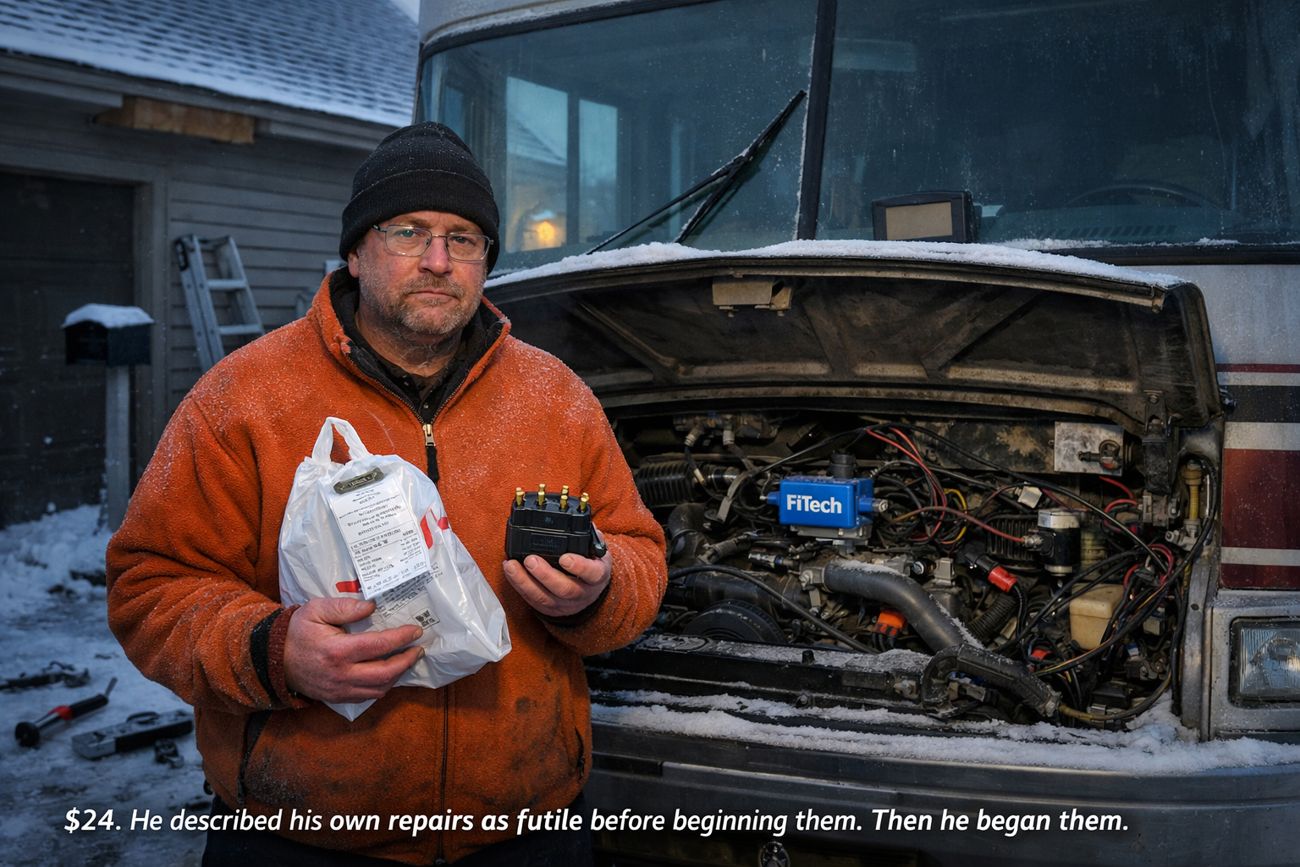
Half past seven in the morning, three degrees. Larry describes his own repairs as futile before beginning them. New cap and rotor. He knows it probably will not fix the underlying problem. The snowstorm is tomorrow, Debbie’s deadline is Thursday, the window is now. Futile or not, he is going.
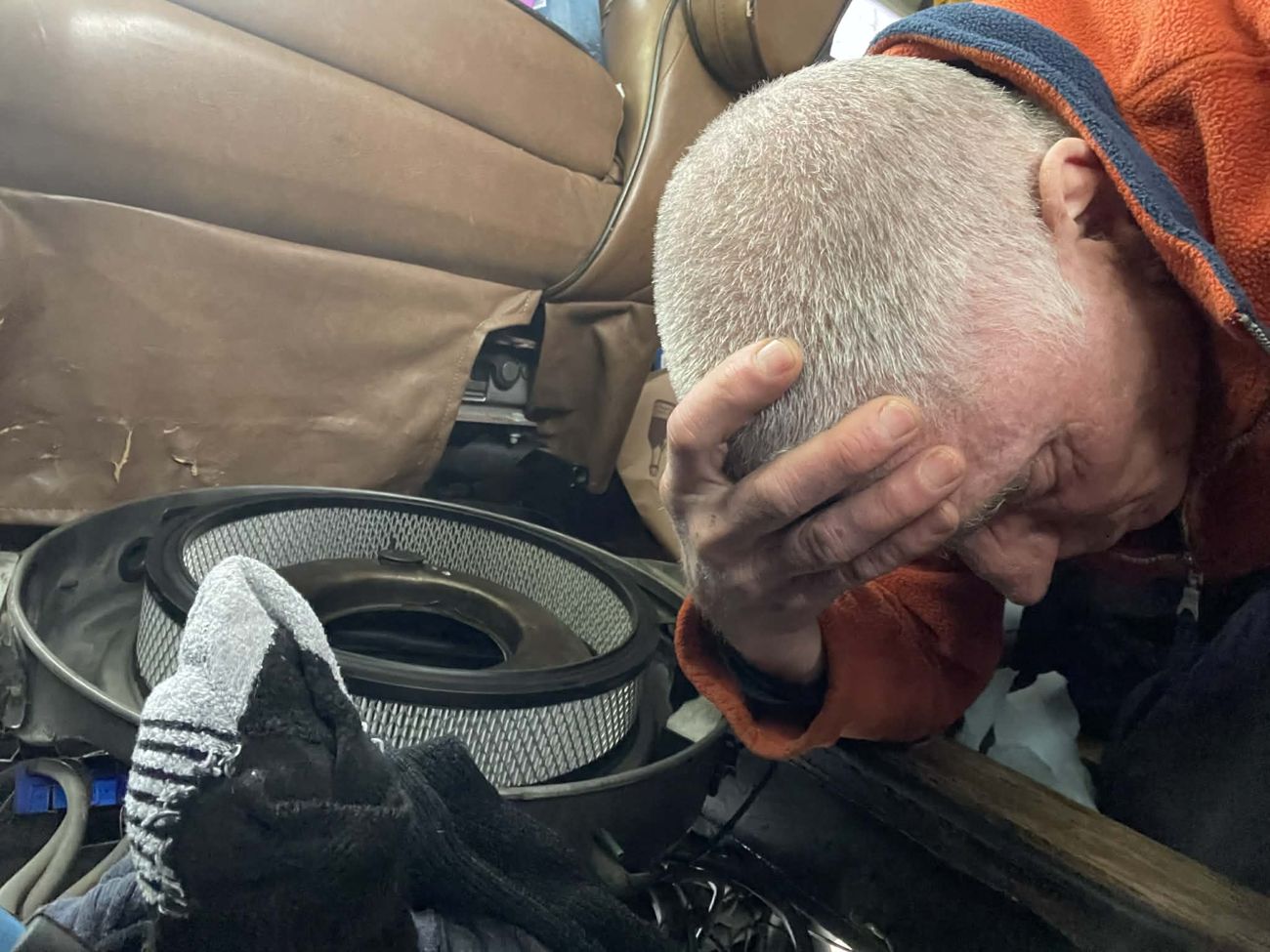
Chapter 10: No Driver’s Door
The driver’s door does not open. Which means every exit is through the back, and every exit through the back runs the full length of the interior: past the leather, the hardwood, the cobalt sink, the crown molding, and then out into whatever is currently going wrong.
That is the trap, and Larry describes it more precisely than anyone else in this story could.
“It’s like trying to have a relationship with a 10 that is total bitch. It’s costing me money it’s costing me time it’s ruining my mental health, but every time I go inside and see the interior I say ‘it’s worth it I can change her’.”
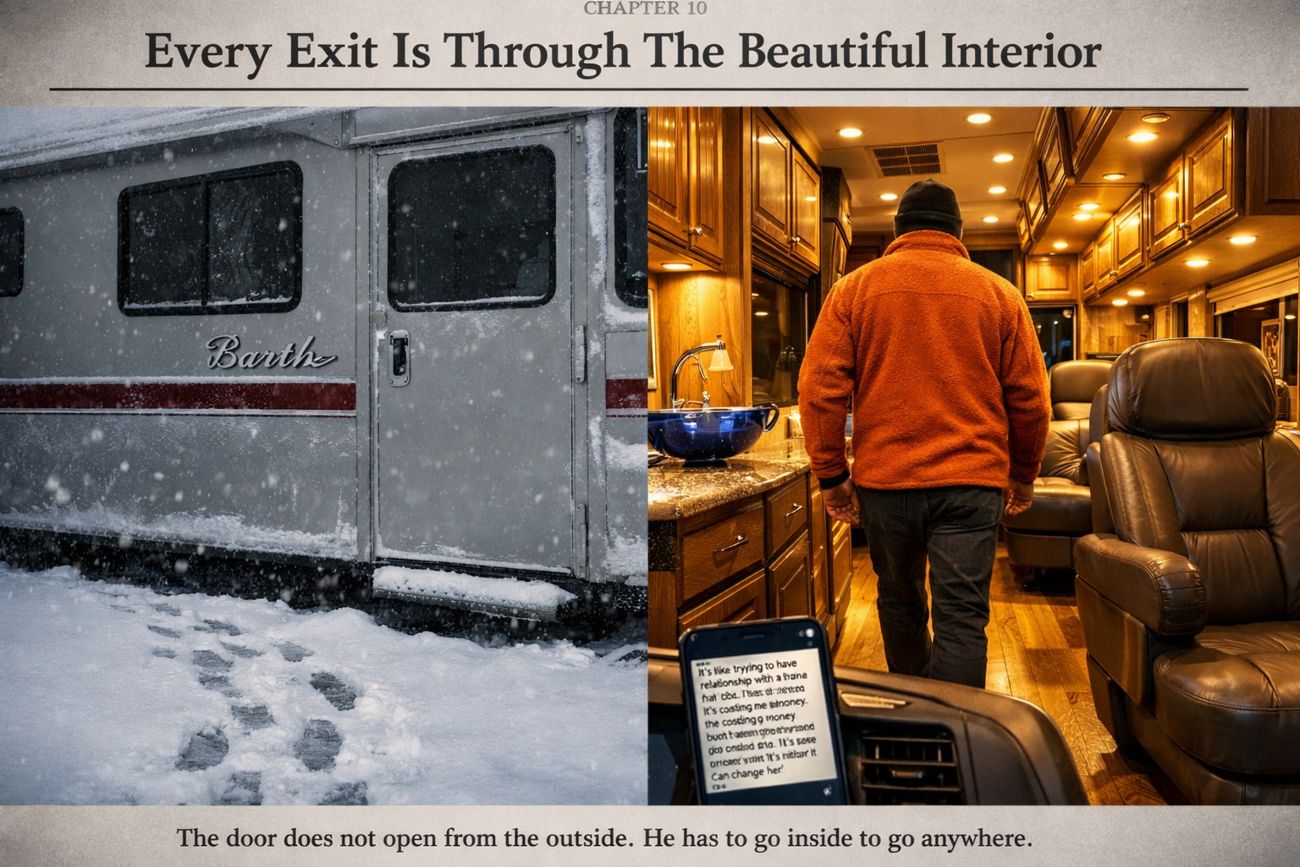
Chapter 11: Learn Mode
The diagnostic tool offers him an option: erase all the stored data and let the fuel injection learn the engine from scratch. Today. On the day he has to drive it. The old data might be the problem. The old data is also everything the system knows.
He is reprogramming her brain and hoping she learns to love him before she kills him.
“The question is will it learn fast enough to avoid disaster.”
Chapter 12: The Ego Gauge
FiTech tech support tells him to install a fuel pressure gauge visible from the cockpit. This is legitimate advice. It also makes Larry feel like a race car engineer, and for a few hours he is not a derelict husband, he is a man with gauges and fittings and a problem that might be solvable.
“It also makes me feel like I’m a rocket scientist or a race car engineer. It’s a minor fantasy to boost my failing ego but also what the fitech rep said to do.”
Chapter 13: The Beta Conclusion
An invented ending, written at Larry’s request while the story was still going. He read it and asked for more of them.
The fuel line bursts. Sixty PSI of gasoline sprays across the engine compartment. Fireball. The Barth goes through a fence into a field of Holstein cows so traumatised they never produce milk again. Larry kicks open the back door and runs across the snowy field in his orange fleece. He plants a pair of truck nuts in the crater as a memorial. It is the last manly thing he will ever attempt.
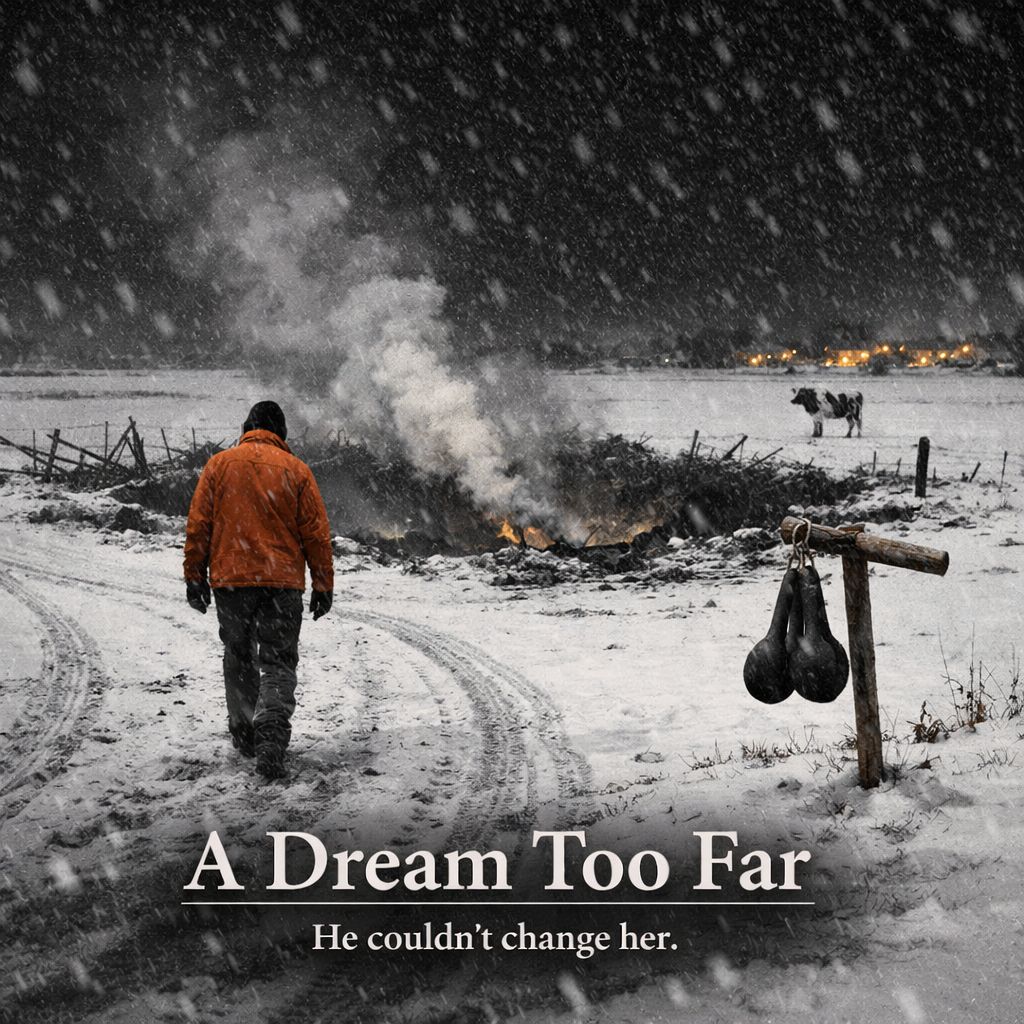
The image prompt that produced this: Prompt 15, The Beta Conclusion
A hyperrealistic photograph. Night. Heavy snow falling. A rural Michigan field, black sky, white ground.
The crater: Where the Barth used to be. Still smoking. Emergency lights gone but tire tracks everywhere. The fence is destroyed. A single Holstein cow stands in the distance, staring at nothing, forever changed.
Larry: Walking away from camera, small against the landscape. Orange fleece, black beanie, shoulders slumped. He is not running anymore. He is trudging. The posture of a man who has been defeated by a machine and is finally at peace with it.
The memorial: A stick in the ground at the edge of the crater. A pair of rubber truck nuts hangs from it, swaying slightly in the wind. No plaque. No explanation. Just balls on a stick where a dream used to be.
The sky: The snowstorm that was supposed to come tomorrow came early. It doesn't matter now.
In the far distance: The lights of the HOA subdivision. The house with the repaired soffit. The new mailbox that will never be destroyed. A man cave with a TV that's finally on.
Title: "A Dream Too Far"
Subtitle: "He couldn't change her."
Chapter 14: The Window
Larry drives past an old man’s house at dusk. Through the front window: an immaculate living room, a leather chair, a glass of wine, the evening news, contentment. No FiTech handheld. No fuel pressure gauge. Just a man who made normal choices and is now warm.
Why did I choose the Barth life.
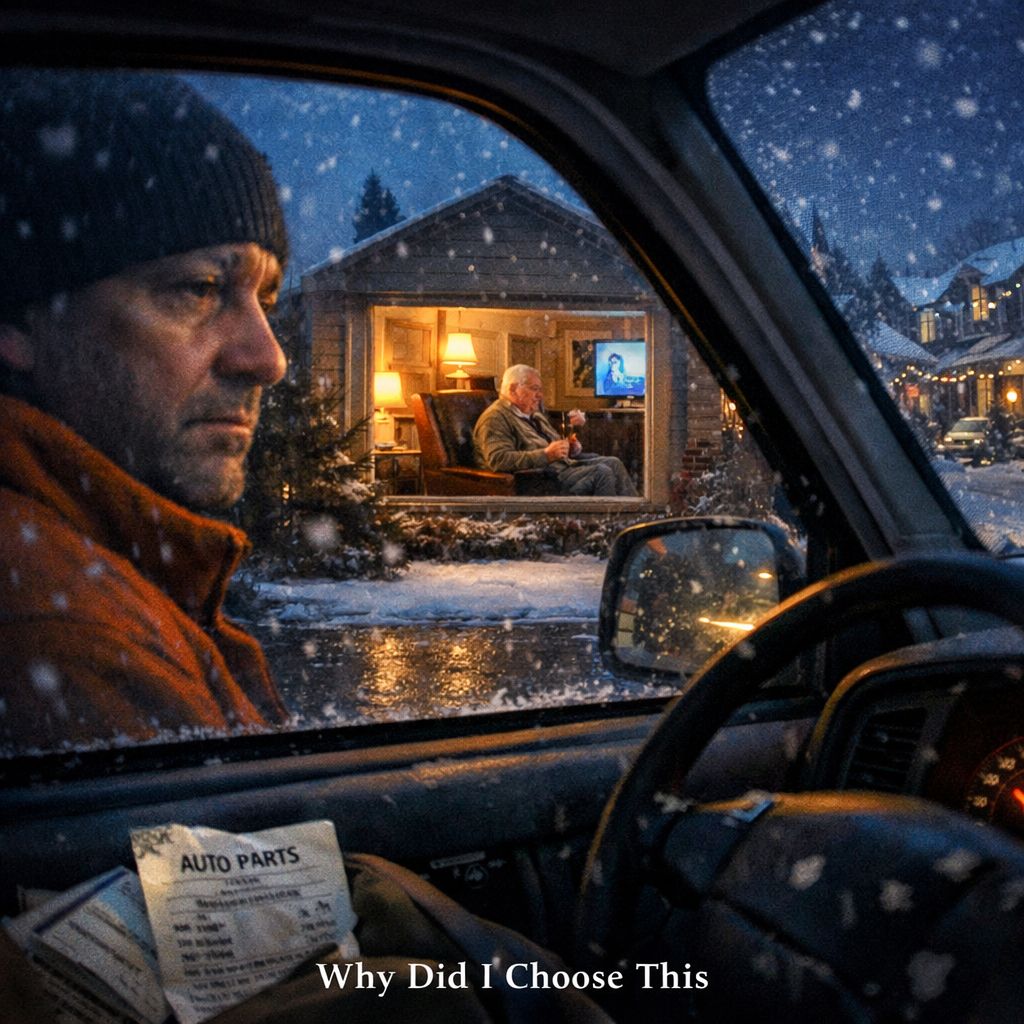
The image prompt that produced this: Prompt 12, The Window
A hyperrealistic photograph from inside a moving vehicle. POV through the driver's side window. Light snow falling, visible in the headlights. Dusk, that blue winter light.
The house: End of the street. Warm yellow light spilling from a large front window. Inside, perfectly visible: an old man in a cardigan, seated in a leather chair, wine glass in hand, face illuminated by a television showing the news. The room behind him is immaculate, tasteful furniture, art on the walls, a lamp with a warm glow. No chaos. No projects. No desperate energy. Just a man who is done striving and is now simply living.
The reflection: In the car window, we see Larry's face, ghosted over the scene. Orange fleece. Black beanie. The expression of a man looking at a life he didn't choose and wondering if he chose wrong.
The street: Neatly landscaped HOA homes stretching back. Christmas lights still up, or tasteful winter decorations. Every house a container for a normal life. Every window a glimpse of people who don't know what a FiTech system is.
The dashboard: Visible at the bottom of frame. A receipt from an auto parts store on the passenger seat. Evidence of the trips. Dozens of trips. Futile attempts.
The snow: Light, steady, indifferent. Accumulating on the lawns. Accumulating on the Barth back home.
Mood: The specific loneliness of being in motion while everyone else is at rest. The specific grief of wondering if your choices were wrong while simultaneously being unable to imagine making different ones. He's going to the auto parts store. He's going to buy another part. He's going to try again. But for this one moment, passing this one window, he lets himself feel the weight of the Barth life.
Title: "Why Did I Choose This"
Chapter 15: The Midnight Files
Past midnight. The FiTech files are for Windows XP. Larry has a MacBook. He is striking keys more or less at random hoping something will open a menu that makes sense. The entire timeline now hinges on updating a handheld in order to update an engine control unit.
He reaches for the gin. The coffered ceiling of a nice house looks down on a man reading Windows XP documentation on a MacBook at midnight.

Chapter 16: The Descent
The flask comes out between parts runs. Lucky Strikes, because a cigarette might make him feel like the Marlboro Man while he works on the engine. He forgets to shower. He goes to bed in his work clothes.
The Barth is not just in the driveway any more.
Chapter 17: The Grease-Stained Sheets
Debbie comes home. She pulls back the comforter and finds handprints of 10W-30 across the fitted sheet.
She does not yell. She does not cry. She strips the bed, puts the sheets in the washing machine and sets it to hot.
She is not certain, at that moment, whether she is still talking about the sheets.
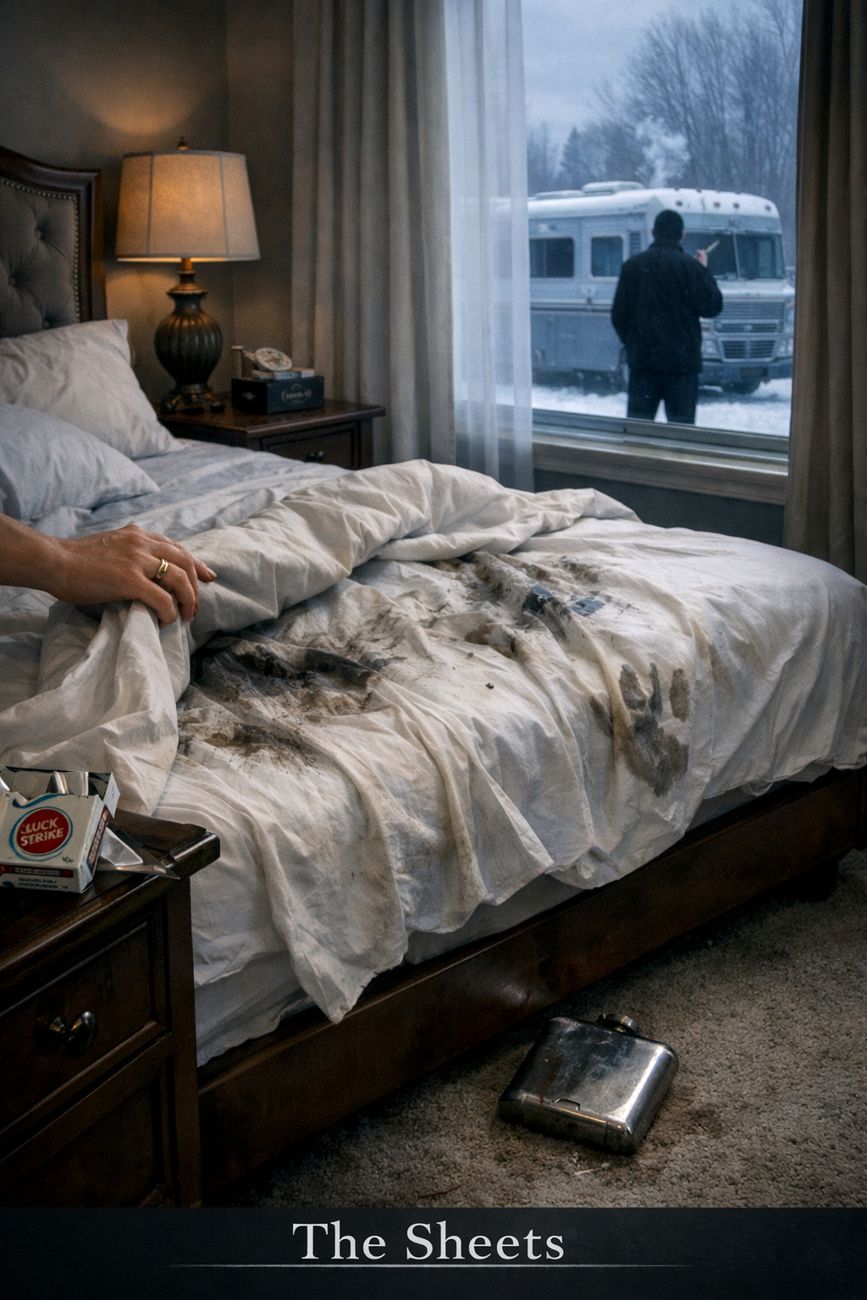
The image prompt that produced this: Prompt 13, The Morning After
A hyperrealistic photograph. Early morning, gray winter light through bedroom curtains.
The bed: King size, in a nicely decorated master bedroom. The comforter is pulled back, revealing white sheets with dark grease streaks, handprints, smears, the outline of where a body slept in work clothes. A Lucky Strikes carton on the nightstand, already opened, cellophane torn. A flask, metal, dented, new to this house, lying on the carpet where it fell from a jacket pocket.
Through the window: The Barth, still in the driveway. Snow on its roof. It hasn't moved. It never moves. It just waits.
Optional: A woman's hand entering frame, reaching for the sheets. Or: a man's silhouette visible through the window, standing by the Barth, smoke rising from his cigarette.
The contrast: The bedroom is beautiful. Tasteful paint color. Nice furniture. A ceiling fan that matches the one in the living room. This is the bedroom of people who were supposed to have a normal life. The grease stains are a violation. The cigarettes are an invasion. The Barth has breached the perimeter.
Title: "The Sheets"
Chapter 18: Five Years Later
A jump five years forward into a future that never arrived. Larry’s response was to start supplying details for it.
Larry meets Daisy in the homeless RV district. She holds up a cross and accuses him of being a demon. Then she sees the bathroom, which is stacked floor to ceiling with Lucky Strike cartons and Jack Daniel’s cases, and she hugs him. “I love you Larry this is what god told me about.” Fred pounds on the door.
“A couple more days of work and I’ll be in Utah.” He has been saying that for five years.
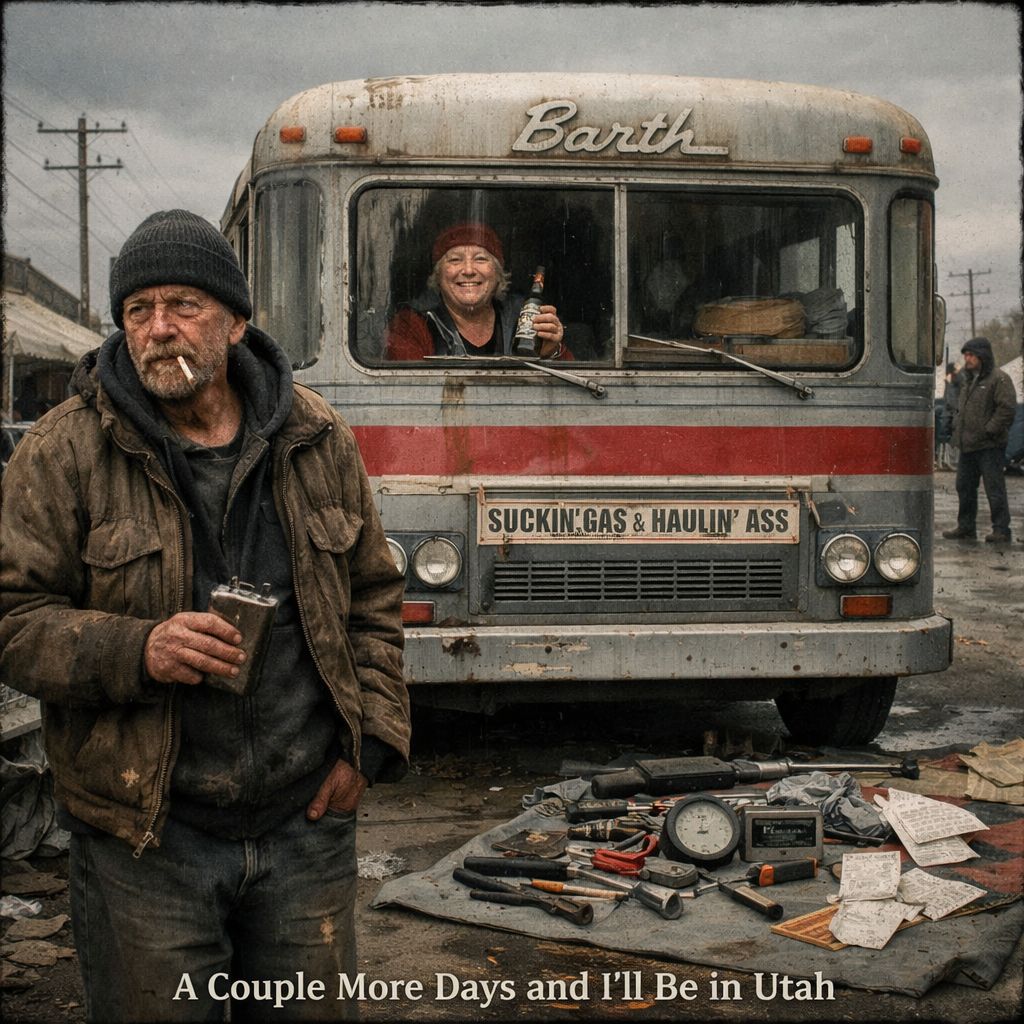
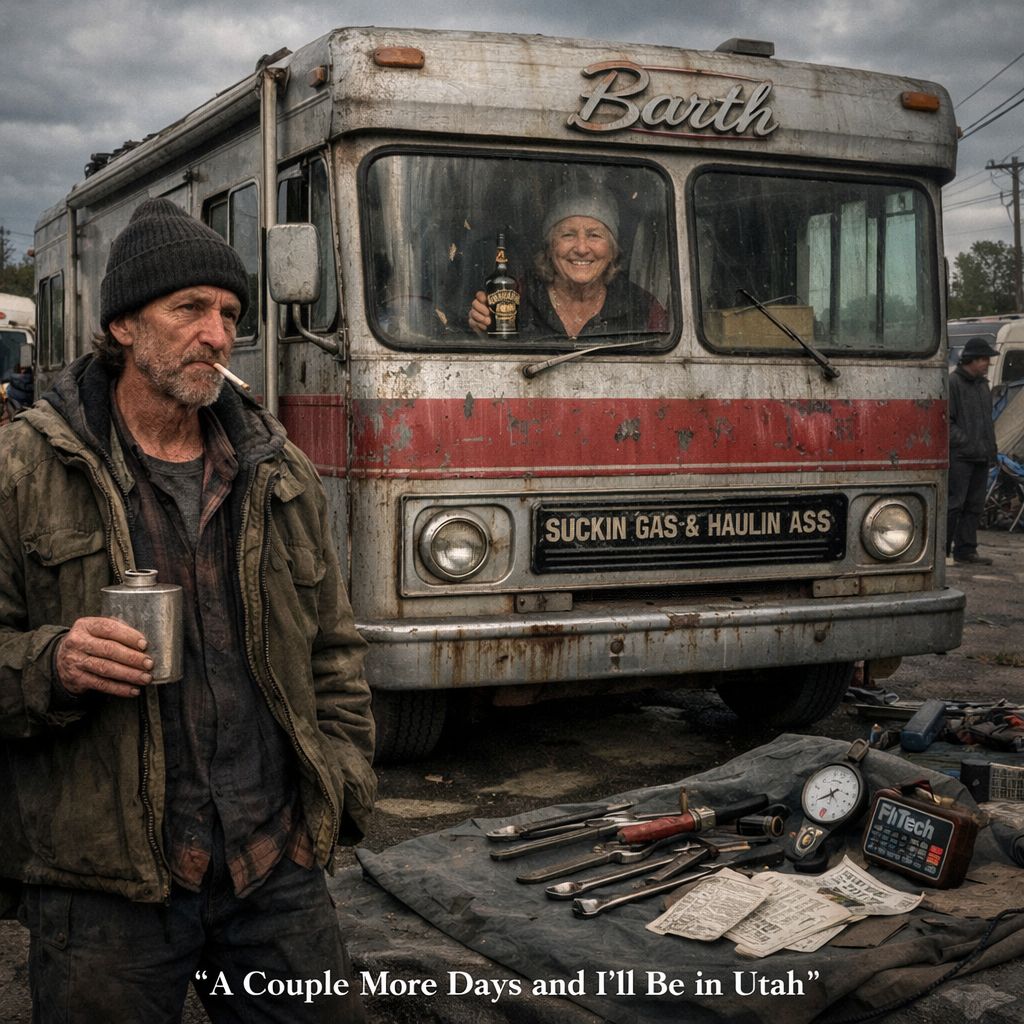
The image prompt that produced this: Prompt 14, Five Years Later
A hyperrealistic photograph. Urban decay. A street lined with RVs, vans, tarps, shopping carts. The kind of street that exists in every American city but most people never see.
The Barth: Parked among the wreckage, somehow still dignified, somehow still wrong for this place. The gray and red paint is faded now, oxidized, but you can see what it used to be. The chrome "Barth" script is still there, still proud, still lying. The "SUCKIN' GAS & HAULIN' ASS" placard is barely readable. The tires are the same new tires from five years ago, they've never worn down because the Barth has never gone anywhere.
Larry: Standing outside, flask in hand, grease-stained jacket, cigarette in mouth. He's thinner now. Older. The orange fleece is gone, replaced by layers of whatever he could find. But the beanie is the same. The beanie is always the same.
Daisy: Visible through the Barth's window, sitting inside, cross around her neck, toothless smile, holding a bottle of Jack.
Fred: In the background, lurking, waiting, a shadow of what human connection looks like in this place.
The sky: Gray. Always gray. Michigan gray. Or maybe it's not Michigan anymore. Maybe Larry towed the Barth somewhere else, somewhere that was supposed to be better, somewhere that wasn't.
The tools: Spread out on a tarp next to the Barth. The same tools from five years ago. The fuel pressure gauge project. The FiTech handheld. The parts store receipts, faded now, ancient history. He's still working on it. He'll always be working on it.
Title: "A Couple More Days and I'll Be in Utah"
Chapter 19: The Bathroom Inventory
Same future, continued.
A detail worth noticing about the hoard in that bathroom. The Lucky Strikes are unopened. The Jack Daniel’s cases are sealed.
Larry is not consuming it. He is building it. He is stockpiling for an apocalypse that has already happened.
Chapter 20: The Oxygen Sensor
Back in the documented world, Larry’s entire future depends on a corroded brass cylinder the size of his thumb. Bad oxygen sensor, rich fuel mixture, oil in the exhaust, possible catalytic converter damage, the Barth runs badly, it cannot make it to Utah, and if it cannot make it to Utah he cannot save the trip.
“My future hangs on the replacement of this oxygen sensor and if it can make the Barth limp to Utah.”
“If it was a normal carburetor it wouldn’t care.”
Chapter 21: CSL Plasma
Larry notices a plasma donation centre next to the auto parts store and realises it might solve two problems at once: fund the oxygen sensor, and introduce him to women in comparable circumstances. He surveys the clientele. He spots a car with a bumper symbol that, he reports, says it all.
“This might also be a good place to meet desperate women maybe single moms with 3 kids who have no other options for love he thinks.”
He wrote that about himself in the third person. Note the date. The fiction had predicted Daisy. Larry had read it.
Chapter 22: The Honey Woman
The storage lot manager is a recovered cocaine addict with faded tattoos who calls Larry honey.
“I have a slot at the storage lot after they move the snow. The recovered coke addict lady with tattoos barely showing that calls me honey manages it.”
“At least she calls me honey.”
Chapter 23: The Departure
The Barth leaves the HOA neighbourhood, possibly forever. Behind it: a crooked mailbox, a patched soffit and some traumatised dogs. Debbie comes home, finds grease everywhere and throws out the flask.
Larry stands at the storage lot, smiling. He did it. He got it out of the driveway.
Chapter 24: The Next Windmill
Less than twenty-four hours later, from storage, Larry floats a trial balloon.
“Maybe it’s time for electronic ignition”
He is not asking permission. The boss is back, but the windmill is visible on the horizon.
Chapter 25: Law Abiding
“Debbie says we are back to ‘law abiding'”
The quotation marks are his. Law abiding is not a lifestyle. It is a holding pattern.
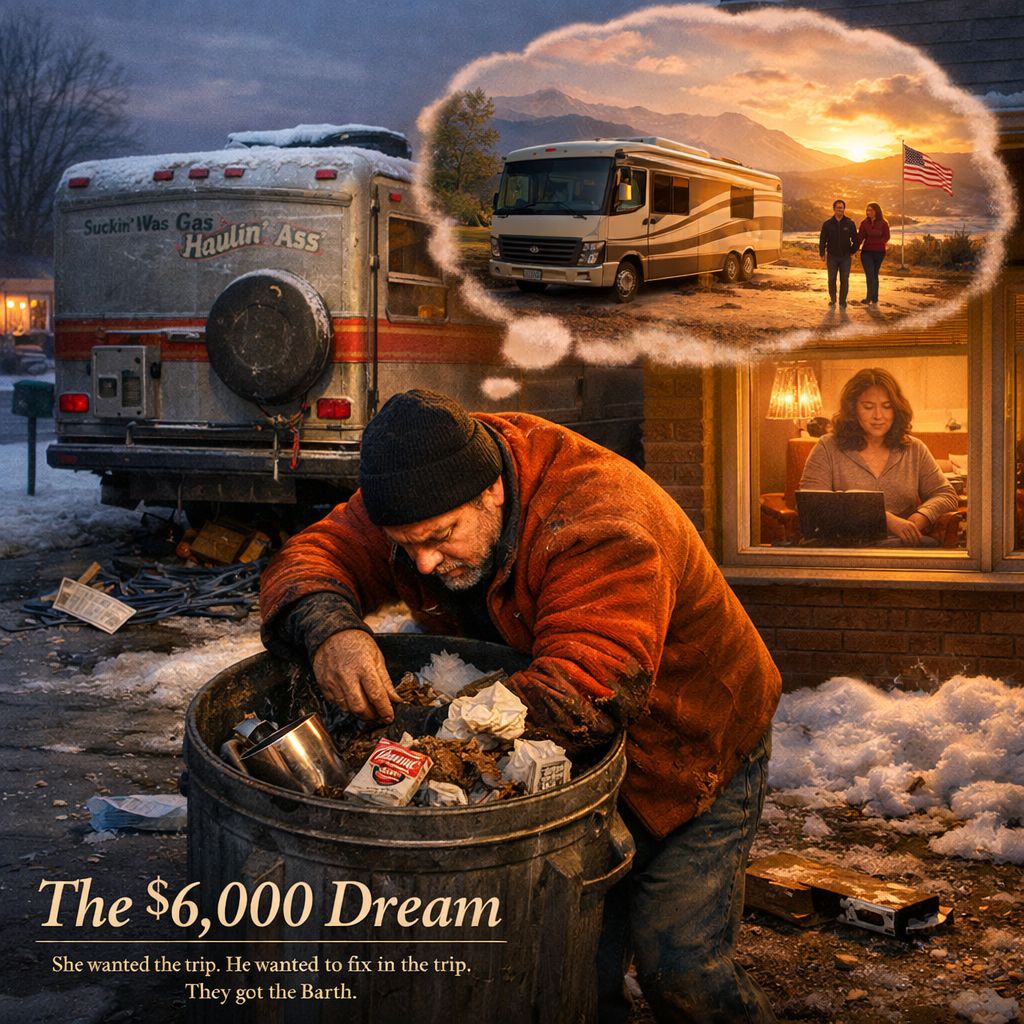
Chapter 26: The $6,000 Dream
Here is where it stops being only funny.
Debbie, Larry’s wife of thirty years, does not want a husband with a man cave and a television. She wants the exact thing Larry is chasing. She wants to be swept off her feet in a motorhome and driven around America.
“Debbie reveals more about her husband fantasy. He goes out and buys a luxury RV, that runs, and sweeps her off her feet on a trip around the US visiting all the attractions, living in luxury. Instead she got a Barth running on 7 cylinders or less of 8 getting about 2 miles to the gallon and possibly pushing oil out the exhaust.”
“He is determined to be the hero even if it risks destroying everything they have built together.”
This is not a story about a man who chose wrong. It is a story about a man who chose right and cannot execute. She wants to arrive at Yellowstone. He wants to fix the fuel pump in the Yellowstone parking lot. Both of those are the trip. Only one of them is the dream.
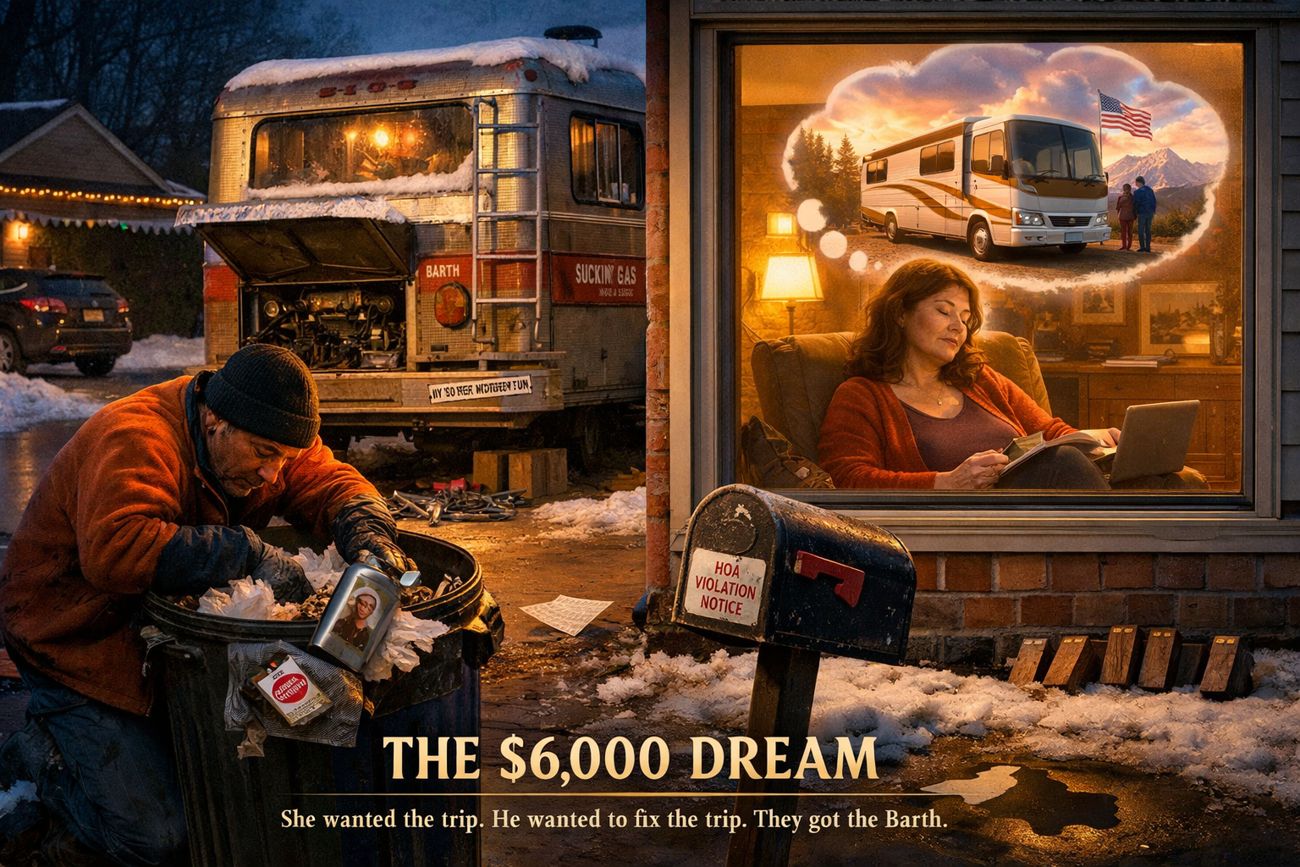
The image prompt that produced this: Prompt 16, The Dream And The Reality
A hyperrealistic photograph, split composition, dusk light creating a melancholy golden hour glow.
THE FOREGROUND – REALITY:
A suburban driveway, Michigan winter, dirty snow piled at the edges. The Barth sits UP ON BLOCKS, wheels removed or propped, immobilized, going nowhere. Gray and red paint oxidized, snow on the roof, the "SUCKIN' GAS & HAULIN' ASS" placard barely visible. The chrome Barth script still tries to gleam but can't quite manage it. The spare tire cover is stained. The ladder on the back leads to nowhere.
LARRY: Hunched over a garbage can at the edge of the driveway, lid off, arm deep in the trash. He's wearing the orange fleece, the black beanie, grease stains on everything. His face is illuminated by the garage light, desperate, furtive, searching. Coffee grounds on his sleeve. He's looking for the flask. He's looking for the Lucky Strikes. He's not finding them fast enough. The posture is unmistakable: a man hiding an addiction from a wife who already knows.
THE BACKGROUND – THE DREAM:
Visible through the front window of the house, warm interior light spilling out: DEBBIE sits in a living room chair, eyes closed or gazing into middle distance, a travel magazine or laptop open in front of her. Above her head, rendered as a DREAMY THOUGHT BUBBLE or SOFT DOUBLE-EXPOSURE:
Her fantasy: A gleaming luxury Class A motorcoach, not a Barth, a REAL one, a Tiffin or a Newmar or a Monaco, parked at a scenic overlook. Mountains in the background. American flag at a campsite. The RV is pristine, white and gold, the kind that costs $300,000 and runs perfectly. In the fantasy image, a COUPLE stands outside it, holding hands, looking at a sunset. They're happy. They're on the trip. They made it.
THE CONTRAST:
Inside the window: warmth, dreams, the trip that could be.
Outside the window: Larry, garbage, the Barth on blocks, the trip that is.
Debbie can't see Larry from where she sits. Or maybe she can and she's choosing not to look. Thirty years of this. She knows where he is. She knows what he's looking for.
KEY DETAILS:
- The Barth's hood is open, engine exposed, tools scattered on a tarp beneath it, work in progress, always in progress
- A parts store receipt blows across the driveway
- The mailbox in the background is still slightly crooked
- A light is on in the Barth's interior, the beautiful interior, the $6,000 dream, visible through the window, mocking everyone
- Larry's flask is VISIBLE in the garbage, glinting, just out of his reach, buried under coffee filters and paper towels
- A crumpled pack of Lucky Strikes is near it, Debbie threw those out too
- The neighbor's house in the background has a normal car in the driveway, Christmas lights still up, the life that makes sense
MOOD:
Thomas Kinkade painting of domestic bliss MEETS Coen Brothers tragedy. The warm light is ironic. The dream is unattainable. The man in the garbage doesn't know he's the punchline and the heartbreak simultaneously.
LIGHTING:
Split lighting, warm golden interior light from the house where Debbie dreams, cold blue dusk light on Larry and the Barth. Two worlds, one driveway. The Barth sits exactly at the border between warm and cold, belonging to neither, ruining both.
TITLE: "The $6,000 Dream"
SUBTITLE: "She wanted the trip. He wanted to fix the trip. They got the Barth."
Chapter 27: Thirty Years
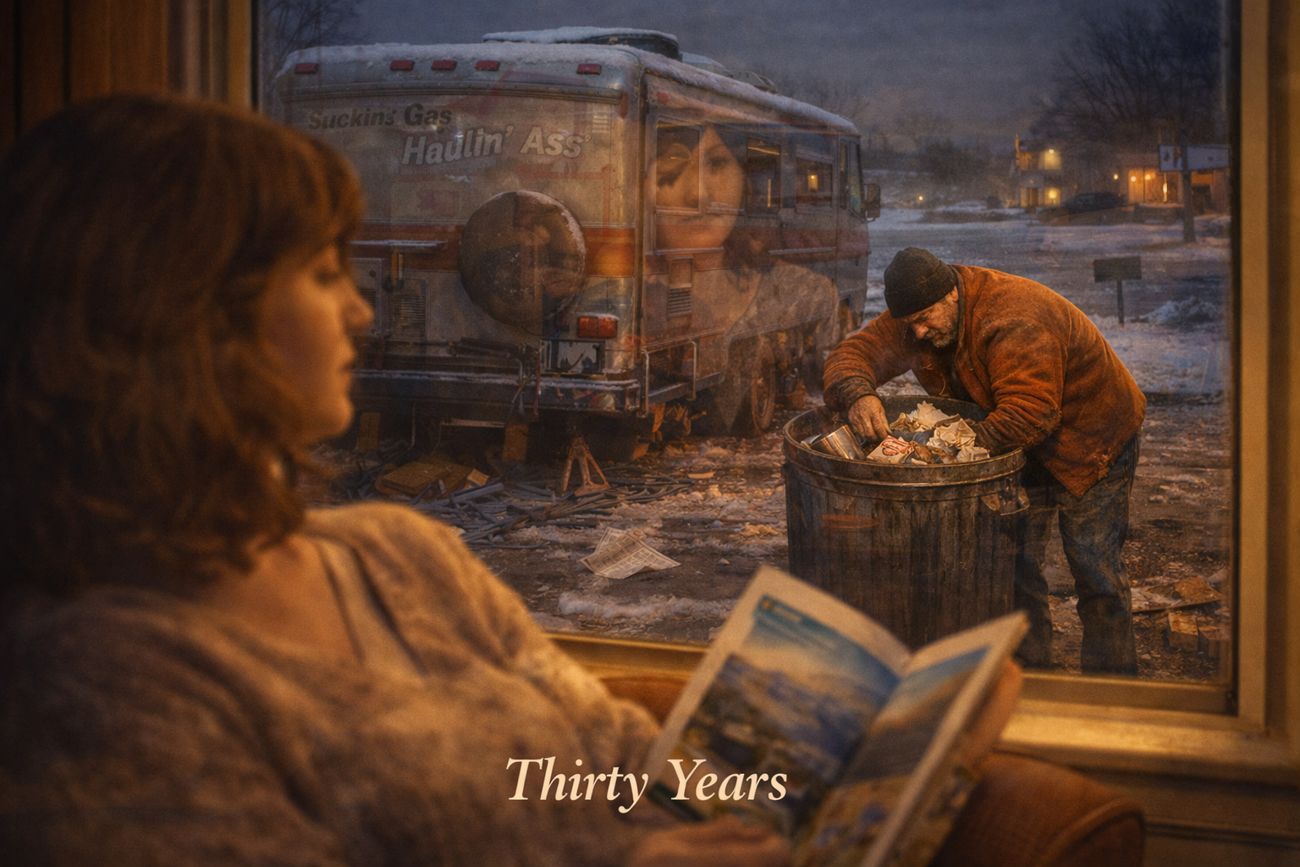
Thirty years of Larry. Thirty years of I can fix it. She knows the flask will reappear. She knows the Lucky Strikes are coming back.
“There is nothing she can do, he won’t change. This is the man she chose to marry. The Barth man living the Barth life style.”
Chapter 28: The Flask in the Garbage
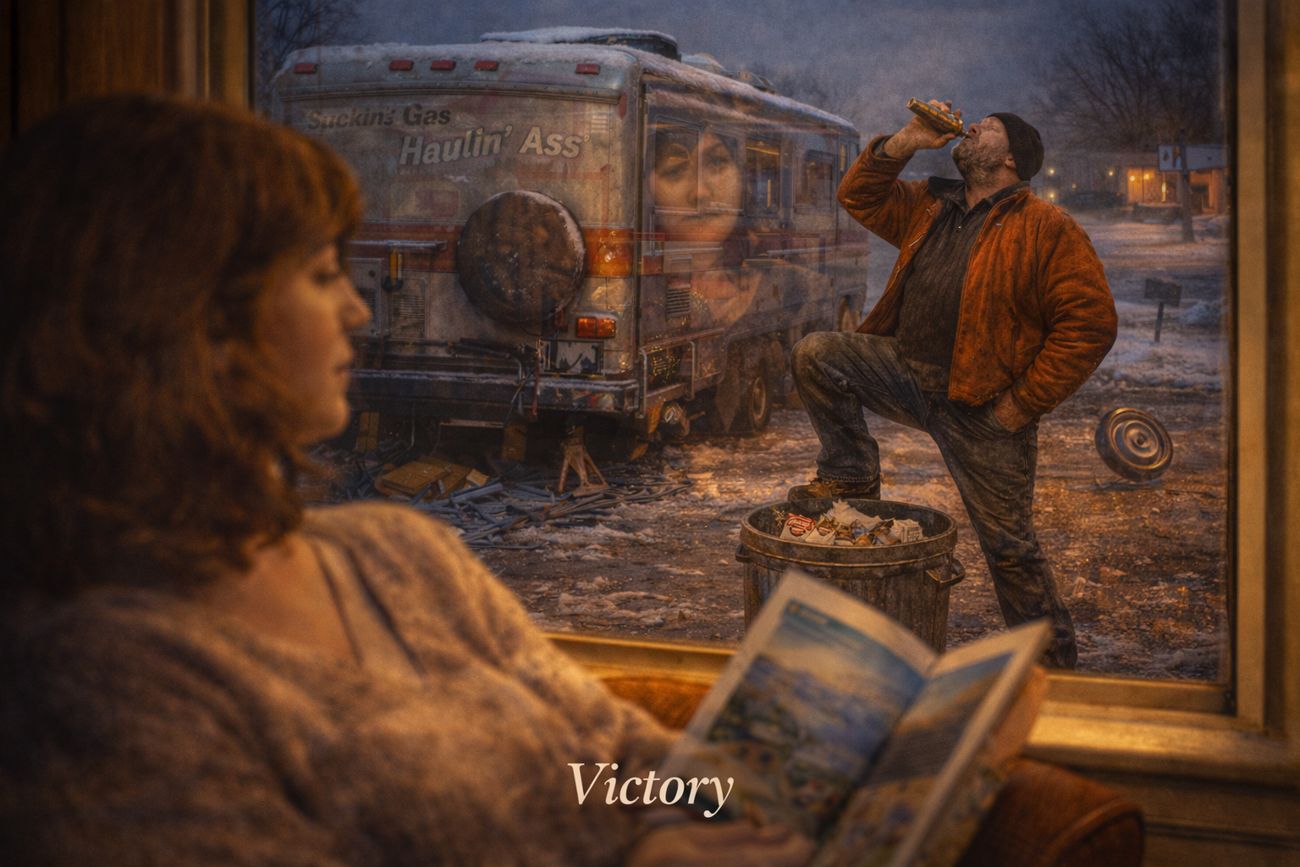
Debbie throws out the flask. Larry waits until she is not looking. The bin is in the garage. There is probably still whiskey in it. Just a sip. Just to help him think.
“Larry is looking for the flask in the garbage.”
Chapter 29: The Third Motorhome
Debbie sees Joe’s running RV and suggests they buy it, so that at least one of three runs.
“She says one out of three isn’t bad”
“The tragedy expands to the impossible what are the odds I would end up with 3 motorhomes”
Then he corrected himself. Not I. We.
The image prompt that produced this: Prompt 17, The Three Motorhome Future
A hyperrealistic photograph with surrealist elements, wide composition, depicting the complete psychological transformation of a marriage.
THE SETTING:
A suburban driveway that has EXPANDED impossibly, stretching wider and longer than any HOA would allow, like a fever dream of asphalt. The neat Michigan neighborhood is visible in the background, normal houses with normal cars, normal lives proceeding normally. But THIS property has become something else. A compound. A graveyard. A museum of dreams that don't run.
THE THREE MOTORHOMES:
BARTH #1 (far left):
The original. Faded, older, slightly smaller. Parked at an angle like it was abandoned mid-maneuver years ago. Weeds growing around the tires. A tarp half-covering it, defeated, sliding off. The mailbox it killed (Mailbox #1) is still wedged under its front bumper, a skeleton of wood and metal, never removed, a trophy or a shame. This is the one with the manual parking brake, the SANE one, and somehow that makes it sadder.
BARTH #2 (center, dominant):
The $6,000 dream. Up on blocks, hood open, engine exposed. Gray and red, chrome script still trying to gleam. The "SUCKIN' GAS & HAULIN' ASS" placard facing forward like a declaration of war. Tools scattered around it, wrenches, the fuel pressure gauge, FiTech components, oil-stained rags. The interior light is on, visible through the windows: the beautiful renovation, the leather, the wood, the dream that's RIGHT THERE if only the engine would cooperate. Snow on the roof. Oil stain spreading beneath it on the driveway, a dark halo. This is the active patient. This is the current obsession.
JOE'S RV (far right):
BUT IT'S A GHOST. Semi-transparent, shimmering, a VISION more than a vehicle. It's pristine, a modern Class A, white and gold, gleaming, perfect. No tools around it. No oil stains. No blocks. It hovers slightly above the driveway because it doesn't really exist here; it exists in DEBBIE'S MIND. It's labeled, faintly, like a blueprint annotation: "JOE'S RV – RUNS – THEORETICAL". A dotted line connects it to Debbie's head. This is the dream. This is the solution. This is the thing Larry will never actually buy because it works.
LARRY:
Standing between Barth #1 and Barth #2, equidistant from past and present failure. He's wearing the orange fleece, the black beanie, grease on his hands and face. He's holding a WRENCH in one hand and the FLASK in the other, he found it in the garbage, it's back, it never left. His expression is MANIC ELATION. He's not looking at the motorhomes. He's looking at a FOURTH SPACE on the driveway, empty, waiting, as if calculating where a fourth motorhome might fit. The rocket scientist is planning. The rocket scientist never stops.
At his feet: a crumpled Lucky Strikes pack, a parts store receipt that's seven feet long and unspooling in the wind, and a copy of "RV Trader" magazine open to the "FIXER-UPPERS" section.
DEBBIE:
Standing on the front porch of the house, arms crossed, but her expression is NOT anger anymore. It's RESIGNATION that has somehow transformed into PARTICIPATION. She's holding a CALCULATOR and a NOTEPAD. On the notepad, visible to camera, is written:
"3 RVs = 1 that runs?"
"33% success rate"
"One out of three isn't bad"
"Storage: $70 x 3 = $210/month"
"Cheaper than divorce??"
She's doing the MATH. She's joined the madness. She's not fighting the Barth lifestyle anymore, she's trying to OPTIMIZE it. Her eyes are fixed on the ghostly vision of Joe's RV, the functional one, the answer, the thing they'll never actually own.
Above her head, a THOUGHT BUBBLE shows the original dream: Debbie and Larry, happy, standing in front of ONE beautiful RV at the Grand Canyon, sunset, American flag, the trip that was supposed to happen. The thought bubble is CRACKING, fragmenting, being replaced by the three-motorhome reality below.
THE HOUSE:
Behind Debbie, the nice house with the coffered ceiling. But visible damage now: the patched soffit (crude, visible, ashamed), a window cracked from some Barth-related incident we never heard about, Christmas lights still up from two years ago because Larry was too busy with the Barth to take them down. The house is still nice but it's TIRED. The house has seen things.
Through the window, visible: the man cave that never gets used. A TV playing sports to no one. A recliner with the tags still on. The life that was supposed to be.
THE NEIGHBORHOOD:
In the background, neighbors are visible:
- One peering through blinds, phone in hand, probably calling the HOA
- Another walking dogs (NOT past Larry's house, they cross the street to avoid it)
- The OLD MAN at the end of the street, visible in his window, sipping wine, watching the news, at peace, having made different choices
The contrast is STARK. Every other house is normal. Every other driveway has one car, maybe two. Larry's property has become a motorhome shantytown, an RV hospice, a monument to dreams that won't stay dead.
THE SKY:
Split lighting. On the LEFT (over Barth #1, the past), the sky is dark, storm clouds, that failure is behind them. In the CENTER (over Barth #2, the present), gray and uncertain, snow threatening, the current struggle. On the RIGHT (over Joe's ghost RV, the future), golden light breaking through, heavenly, the promise of functionality that will never be fulfilled.
SYMBOLIC DETAILS:
- A crooked mailbox (Mailbox #2, survivor) with an HOA VIOLATION NOTICE taped to it
- The soffit patch visible on the house, two dark shapes like eyes, watching
- A AAA card on the ground, torn up, useless, Larry doesn't call for help, Larry IS the help
- Three pairs of wheel chocks lined up like headstones
- A bumper sticker on Barth #2 that reads: "MY OTHER MOTORHOME ALSO DOESN'T RUN"
- The storage lot HONEY WOMAN visible in a tiny inset photo taped to Larry's flask, like a saint card
- In the oil stain beneath Barth #2, if you look closely, the shape suggests the state of UTAH, the destination they'll never reach
TEXT OVERLAY OPTIONS:
Title: "THE THREE MOTORHOME SOLUTION"
Subtitle: "She says one out of three isn't bad."
Alt Title: "DEBBIE'S LAW: If two don't run, buy a third."
Alt Subtitle: "Thirty years. Three motorhomes. Thirty-three percent functionality. This is love."
MOOD:
Wes Anderson symmetry meets Werner Herzog despair meets American Dream collapse. It should feel like a family portrait, everyone in position, everyone presenting their best face, except the family is broken and the portrait includes three motorhomes, only one of which exists and none of which run.
The comedy is in the absurdity. The tragedy is that this is real. The horror is that Debbie has started doing math to make it work.
Chapter 30: Mikayla’s Law
A family member observes Larry’s purchasing patterns and states the fundamental principle of his existence.
“Plus you’re too cheap, it would have to be in pieces and a hundred years old for you to buy it”
Joe’s RV runs, is modern and is functional, so Larry will not buy it. The Barth did not run, is from the 1980s and was falling apart, so Larry bought it immediately.
Larry cannot buy something that works. It is not in his nature. The project is the point. A running RV is just an RV. A broken RV is a reason to feel like a rocket scientist.
Interlude: The Divorce Arc
Five stages of a marriage ending, written and illustrated at length because Larry asked what it would look like if his did. None of it happened. He kept the pictures. Chapter 62 is where the story comes closest to it.
Stage One: The Last Soffit
A For Sale sign in the yard. Larry loading boxes into the Barth, which is already furnished, that gorgeous interior finally serving its purpose. Debbie in the doorway with her arms crossed, not angry any more, just finished. The soffit is still hanging. It will be the realtor’s problem now.
He gets custody of the dented ladder.
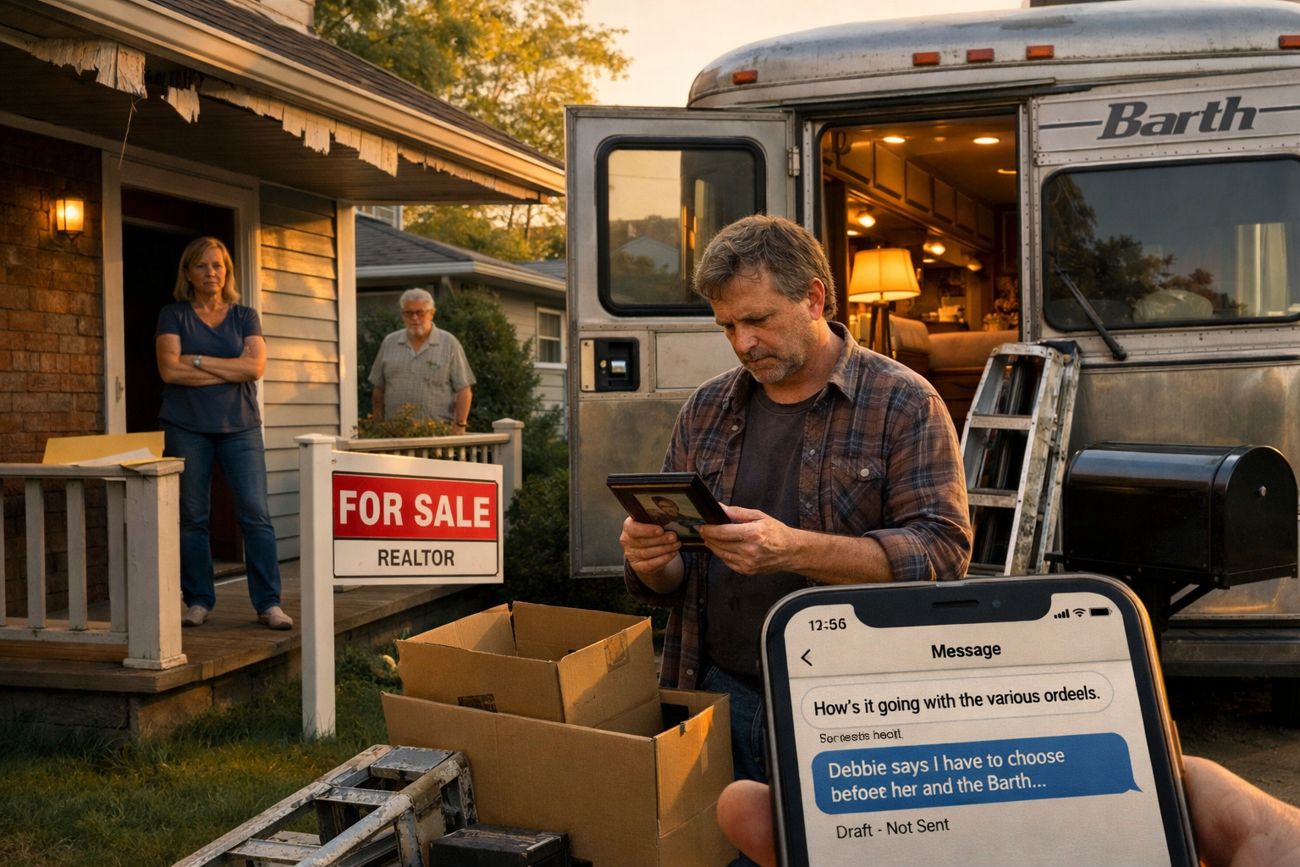
The image prompt that produced this: Prompt 7, The Divorce Arc – Stage One: The Last Soffit
A hyperrealistic photograph, early evening, golden hour light making everything look deceptively peaceful. The suburban Michigan house, now with a "For Sale" sign in the yard.
The scene: The man is loading boxes into the Barth. Not many boxes. The Barth is already furnished, that gorgeous high-end interior finally serving its purpose. Debbie stands in the doorway, arms crossed, not angry anymore, just finished. She's been finished for a while. The soffit is still hanging. It will be the realtor's problem now.
Key details: A lawyer's envelope visible on the porch railing. The dented ladder is being loaded into the Barth, he gets custody of the ladder. The new mailbox stands pristine, never to be threatened by a Barth again. A neighbor watches from across the street, same neighbor who's been watching the whole saga, now witnessing the series finale.
His face: The expression of a man who knew this was coming and also didn't know this was coming. He's holding a framed photo, trying to decide if it goes in the box or stays. It stays.
Her face: Not cruel. Tired. The specific exhaustion of someone who has watched a person choose an RV over stability too many times. She loved him. She cannot do this.
Text on his phone, from his friend: "How's it going with the various ordeals"
His draft reply, unsent: "Debbie says I have to choose between her and the Barth."
The message he'll send later: "I'm moving into the Barth."
Stage Two: The Storage Lot
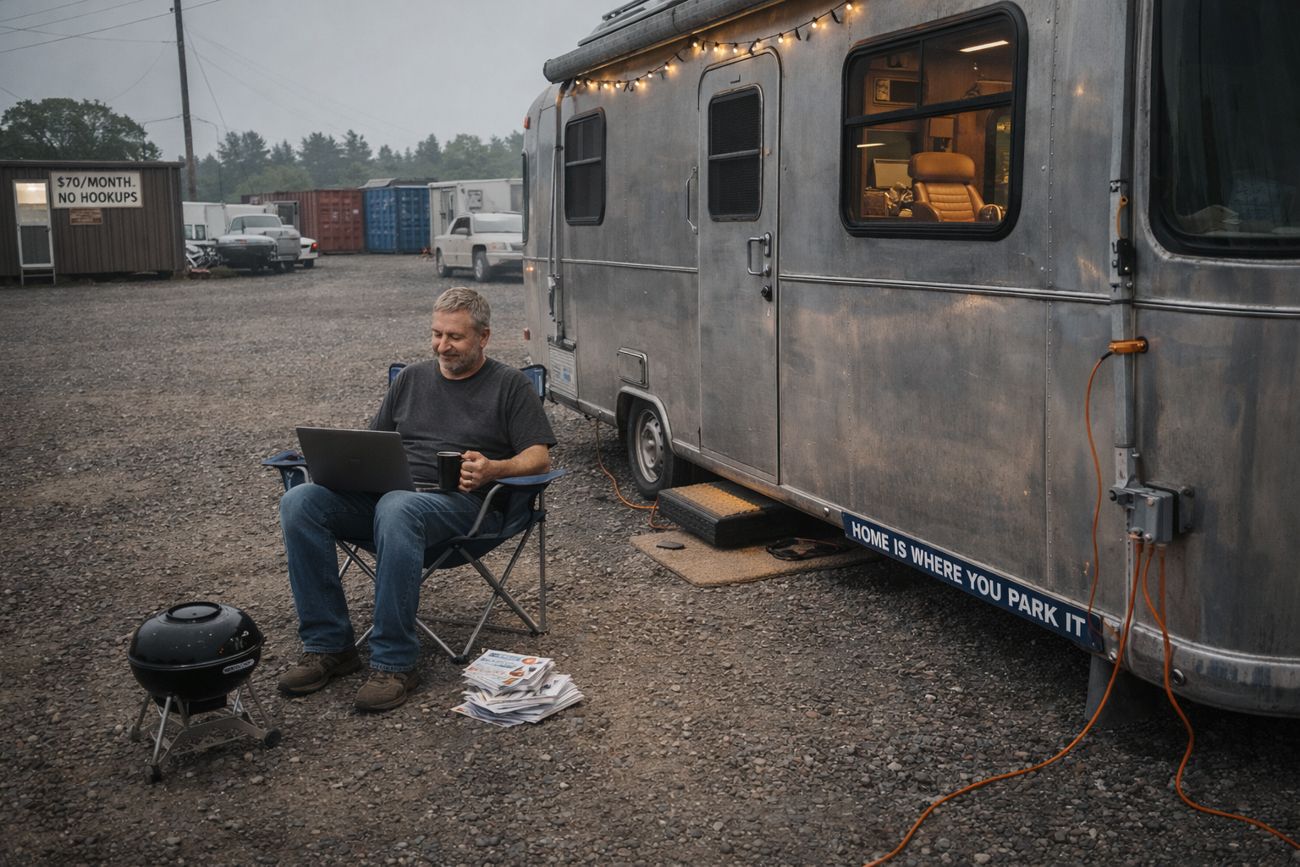
Seventy dollars a month, no hookups, extension cord negotiated separately for twenty more. A welcome mat outside the door, optimistic and heartbreaking. He is working remotely from a camping chair. This is sustainable, technically. He says that to himself a lot.
New bumper sticker: HOME IS WHERE YOU PARK IT.
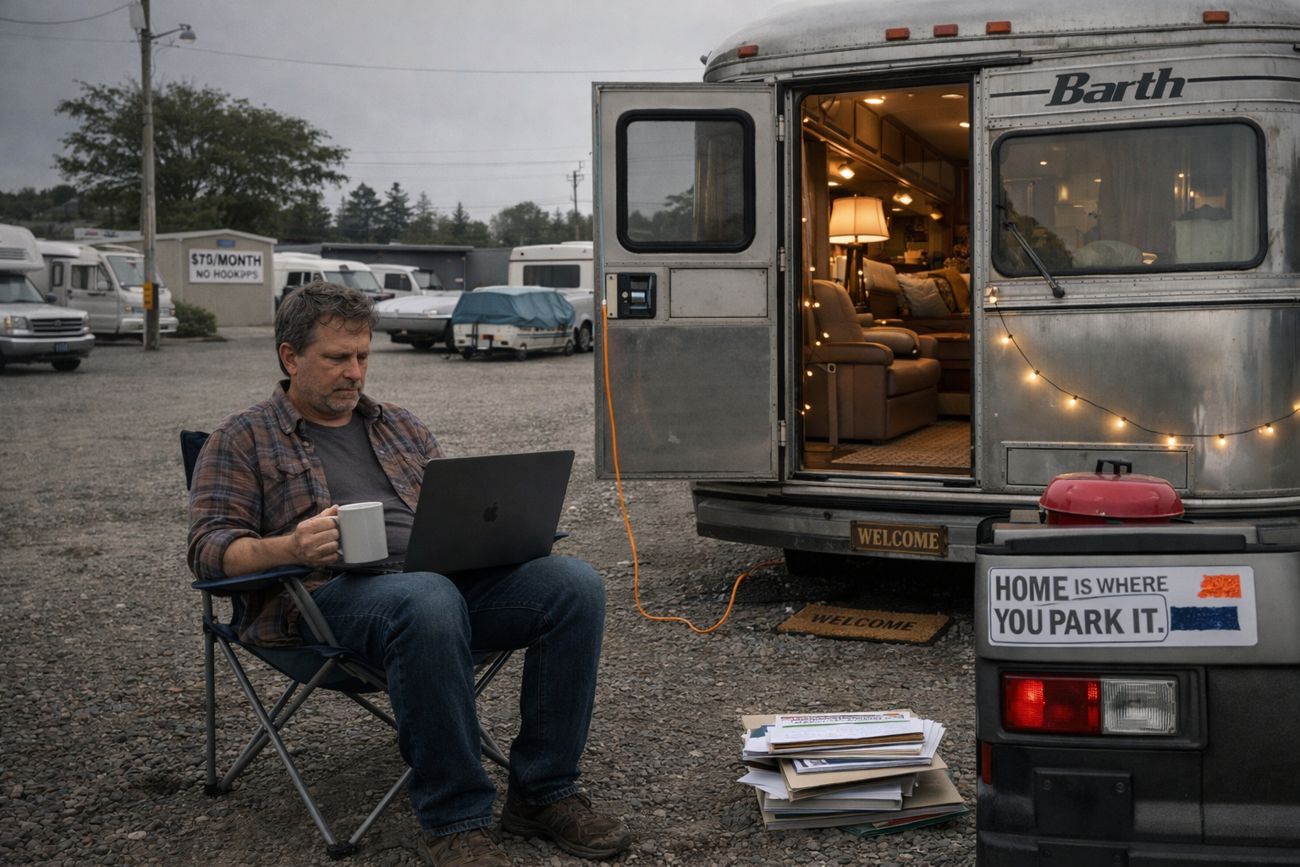
The image prompt that produced this: Prompt 8, The Divorce Arc – Stage Two: The Storage Lot
A hyperrealistic photograph, overcast morning, that flat Michigan light that makes everything feel temporary. A gravel storage lot on the edge of town, RVs, boats under tarps, a few shipping containers. A chain-link fence. A small office with a sign: "$70/MONTH – NO HOOKUPS."
The Barth: Parked in its spot, now home. Extension cord running to a power pole, he negotiated that separately, $20 extra. A small welcome mat in front of the door, optimistic and heartbreaking. Through the window, the beautiful interior is visible: the leather seating, the wood finishes, a man's whole life compressed into 200 square feet of luxury that cannot move.
The man: Sitting in a camping chair outside the Barth, coffee in hand, laptop open. He's working remotely. This is sustainable, technically. $70 a month. No property taxes. He says this to himself a lot.
Key details: A mini Weber grill. A string of lights he hung for ambiance. A stack of mail with "FORWARDING ADDRESS" stickers, his new address is a P.O. Box, which is also how his bank account feels. Other RV owners in the lot, some of them living in theirs too, a small community of people who made choices.
New bumper sticker, freshly applied: "HOME IS WHERE YOU PARK IT"
His expression: Practicing contentment. Almost believing it.
Stage Three: The Bumper Sticker Phase
The rear bumper becomes a gallery. HOME IS WHERE YOU PARK IT, applied first, still optimistic. DIVORCED AND LOVING IT, applied after three beers, regretted, kept. I LOST HALF MY STUFF BUT GAINED 200 GALLONS PER MINUTE. MY OTHER HOME WAS A MARRIAGE. TILTING AT WINDMILLS SINCE 2024. SUCKING GAS, HAULING ASS, PAYING ALIMONY. I LIVE HERE ON PURPOSE (BASICALLY).
And small, in the corner, almost hidden: I MISS MY DOG.
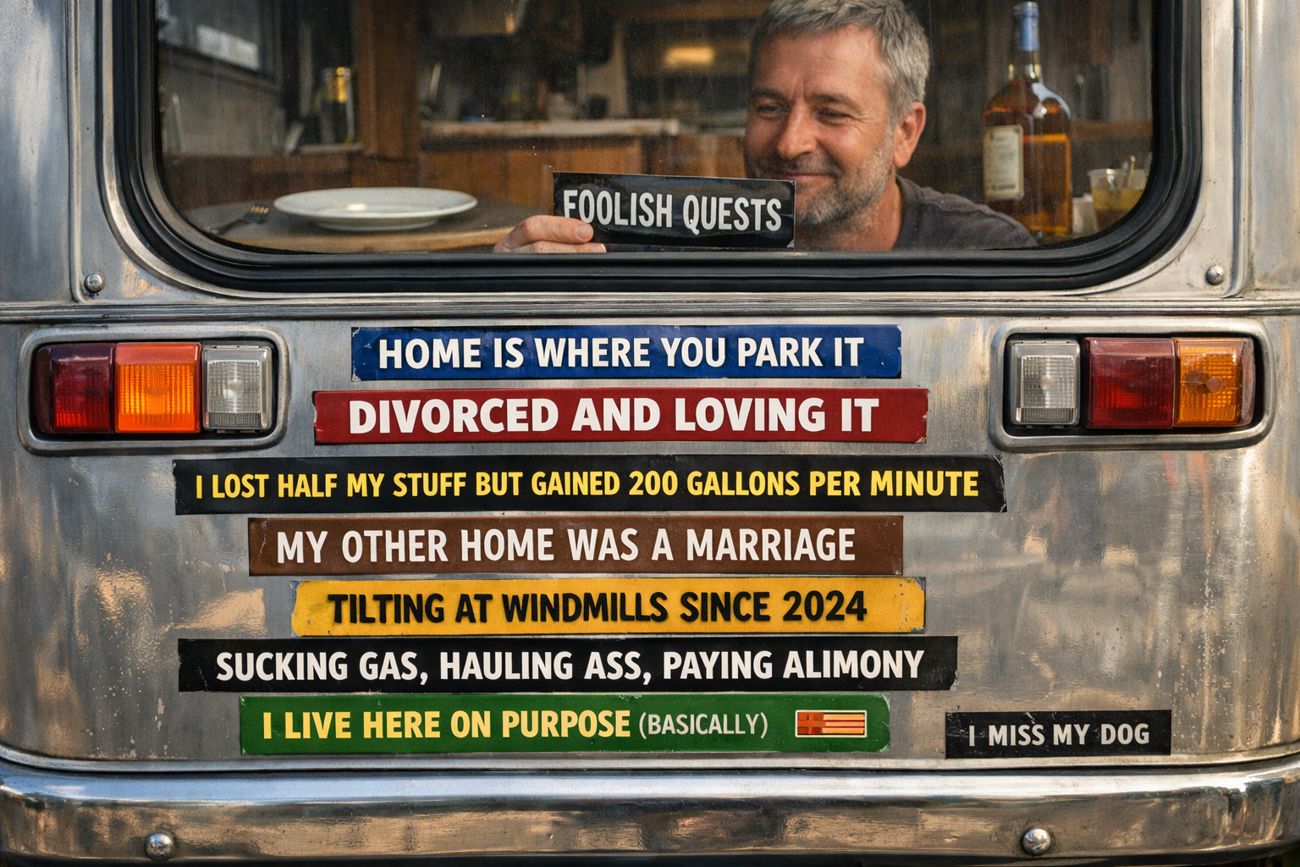
The image prompt that produced this: Prompt 9, The Divorce Arc – Stage Three: The Bumper Sticker Phase
A hyperrealistic photograph, close-up of the Barth's rear bumper, now a gallery. Afternoon light, the man visible in reflection in the RV's back window, applying another sticker.
The stickers, accumulated over weeks:
- "HOME IS WHERE YOU PARK IT" (the first one, still optimistic)
- "DIVORCED AND LOVING IT" (applied after three beers, regretted, kept)
- "I LOST HALF MY STUFF BUT GAINED 200 GALLONS PER MINUTE"
- "MY OTHER HOME WAS A MARRIAGE"
- "TILTING AT WINDMILLS SINCE 2024"
- "SUCKING GAS, HAULING ASS, PAYING ALIMONY"
- "I LIVE HERE ON PURPOSE (BASICALLY)"
- "HONK IF YOU'VE EVER DESTROYED TWO MAILBOXES"
- Small, in the corner, almost hidden: "I MISS MY DOG"
The man: Reflected in the window, holding a new sticker, not yet applied. It reads: "FOOLISH QUESTS." He's looking at it like it might be the last one. The definitive statement.
His face in reflection: Smiling, but the smile doesn't reach everywhere. The bumper stickers are jokes. The jokes are coping. The coping is working, mostly.
Detail: Inside the window, visible on the beautiful kitchen counter: a single plate, a single fork, a bottle of whiskey that's lower than it should be.
Stage Four: Quiet Crying Inside
Two in the morning, deep winter, snow falling on the storage lot. Every other vehicle is dark. The Barth’s interior lights are on, warm yellow against the blue.
Through the window: a man at the small dinette table that cost more than his monthly rent, elbows down, hands over his face. Not dramatic sobbing. The quiet kind, where you are not sure you are doing it until your hands are wet.
The interior is still gorgeous. Anyone would envy it if they did not know.
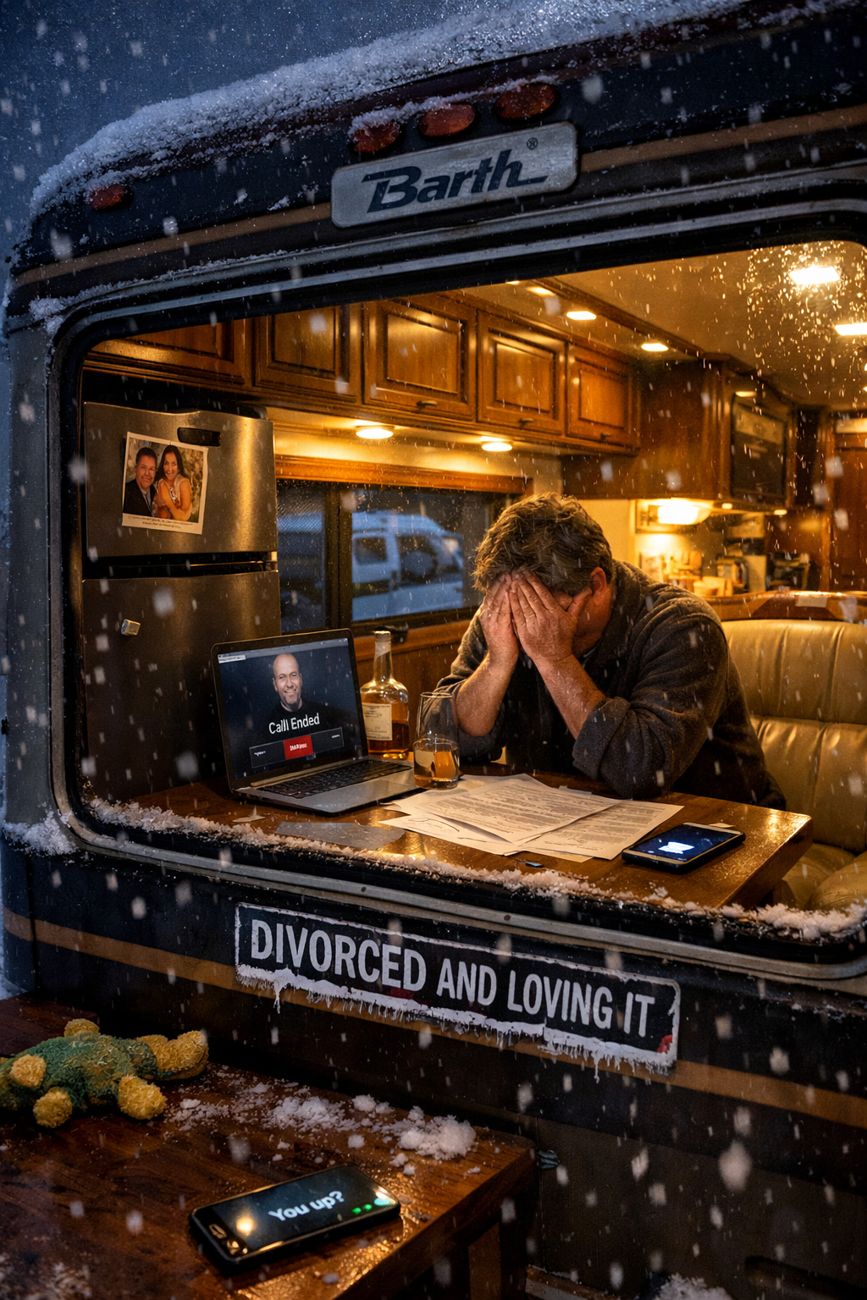
The image prompt that produced this: Prompt 10, The Divorce Arc – Stage Four: Quiet Crying Inside
A hyperrealistic photograph, 2 AM, the storage lot in deep winter. Snow falling lightly. All the other RVs are dark. The Barth's interior lights are on, warm yellow against the blue night.
Through the window: The man sits at the small dinette table, the one that probably cost more than his monthly rent. His laptop is open to a video call that ended hours ago, his friend's face frozen on the "call ended" screen. The whiskey bottle is present. A legal document is spread out, pages he's read too many times.
His posture: Elbows on table, hands covering his face. Not dramatic sobbing. The quiet kind. The kind where you're not even sure you're doing it until your hands are wet. The specific loneliness of 2 AM in a vehicle you chose over everything else.
The interior: Still gorgeous. Still high-end. The leather, the wood, the lighting. A home that anyone would envy if they didn't know. He knows.
Key details: A photo stuck to the mini-fridge, him and Debbie, years ago, before the first Barth. A dog toy in the corner, no dog. His phone, face-down, a text notification glowing: "You up?" from his friend. He won't answer tonight.
Outside the window: The "DIVORCED AND LOVING IT" bumper sticker visible, snow collecting on the letters.
Mood: The specific grief of getting exactly what you chose. He wanted the Barth. He has the Barth. The Barth is all he has. At 2 AM, the math doesn't feel like winning.
Stage Five: The Spring
The snow melts. The hood is open and he is underneath it, but not alone. Another resident of the lot, older, lives in a converted school bus two spaces over, is handing him a wrench. There is a system now. There are two camping chairs. There are herbs in pots.
He has made a life. Not the life. A life.
The new sticker over the old ones reads CHAPTER TWO. The despair has cycled back around to elation, which is the dangerous part, and he knows it, and he is going to do it anyway.
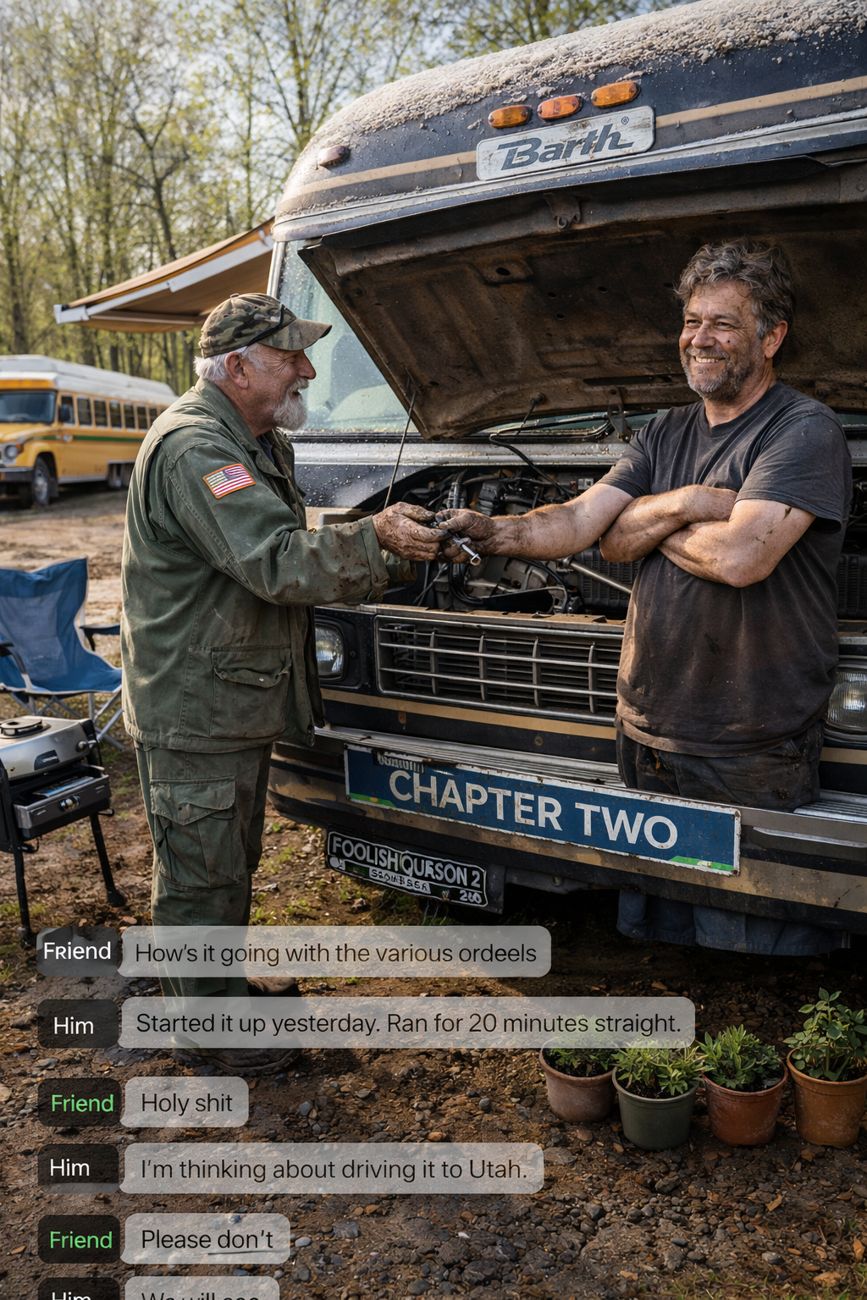
The image prompt that produced this: Prompt 11, The Divorce Arc – Stage Five: The Spring
A hyperrealistic photograph, early spring, morning light, the storage lot transformed. Snow melted, gravel muddy, trees budding in the background. The Barth sits in its spot, but something's different.
The scene: The hood is open. The man is underneath, but not alone. Another storage lot resident, older guy, Vietnam vet energy, lives in a converted school bus two spots over, is handing him a wrench. They've been working on it together for weeks. There's a system now.
The Barth: Clean. Maintained. A new sticker on the bumper, covering some of the old ones: "CHAPTER TWO."
Key details: The camping chair now has a second chair beside it. The mini grill has been upgraded. A small garden, herbs in pots, lines the Barth's awning. He's made a life, somehow. Not the life. A life.
His phone: A text thread visible.
- Friend: "How's it going with the various ordeals"
- Him: "Started it up yesterday. Ran for 20 minutes straight."
- Friend: "Holy shit"
- Him: "I'm thinking about driving it to Utah."
- Friend: "Please don't"
- Him: "We will see"
His face: Grease-stained, tired, lighter. The despair has cycled back to elation. The elation is dangerous. He knows. He's going to do it anyway.
The final image: Him standing back, looking at the Barth, arms crossed, the same posture Debbie had when she watched him load his boxes. But he's smiling. For real this time.
The last bumper sticker, half-visible:
"FOOLISH QUESTS: SEASON 2"
Part Two: The Breakthrough
Chapter 31: The Disconnected Wire
Changing the spark plugs, Larry found it. One plug wire on the driver’s side, in the spot where you can just barely get a hand in, completely disconnected.
“Damn poor Barth the plug wires are really hard to get to on the driver side and you can barely get hand in there. I thought I had followed them all but today when I went to change the spark plugs one of them was completely disconnected. I wonder how long the poor thing was running like that.”
That wire was the dead cylinder. The dead cylinder was raw fuel going out through the exhaust. The raw fuel was the ruined oxygen sensor. The ruined sensor was the fuel injection running in limp mode, which was the rough idle, the stalling, and the performance on the highway in front of everybody.
Every diagnosis had been chasing a ghost. The oxygen sensor replacement may have been unnecessary. The fuel pressure gauge, the midnight Windows XP sessions, the flask, all of it, because of one wire nobody checked, because nobody could reach it.
The previous owner had paid a Ford mechanic seven hundred dollars to look the vehicle over. The mechanic missed it. Larry, on his back with a flashlight and no qualifications whatsoever, did not.
Chapter 32: Raw Fuel
“I guess that would just put raw fuel from that cylinder into the exhaust.”
Yes. And the raw fuel destroyed the sensors, and the destroyed sensors put the injection into limp mode, and limp mode was the whole personality of the vehicle for months. One disconnected wire produced hundreds of dollars in parts, a flask habit, and thirty chapters.
Chapter 33: Valhalla
Larry sends a link to Wagner’s Ride of the Valkyries. The destination has been upgraded from Utah to Valhalla.
“Maybe it will take me to Valhalla.”
“The next step is loudspeakers to play this super loud as it goes down the road.”
“Yes later I have to make dinner so I can pretend I’m a devoted husband not a Barthinion.”
Barthinion enters the language here. It means one who serves the Barth.
Chapter 35: Fucking Genius
The Barth runs on all eight cylinders. It has power. Real power, which was always there, buried under misfire and limp mode.
“It sure has a lot of power now that it runs on all 8 cylinders”
“Poor thing I wonder how long it’s been sick”
“I’m a ‘fucking genius’. Yeah this is just the setup so that when I’m on the freeway in Illinois it will blow up.”
He is right to be suspicious. He is wrong about which state.
Chapter 36: The Receipt
“The guy paid 700$ to a ford mechanic in November to look it over and change the fuel filter and fix squeaky belts. I have the receipt. I see no evidence he did any of that.”
Chapter 37: The Soul
Larry explains why he owns two Barths when the world is full of functioning alternatives. It is not about mechanics and it is not about value.
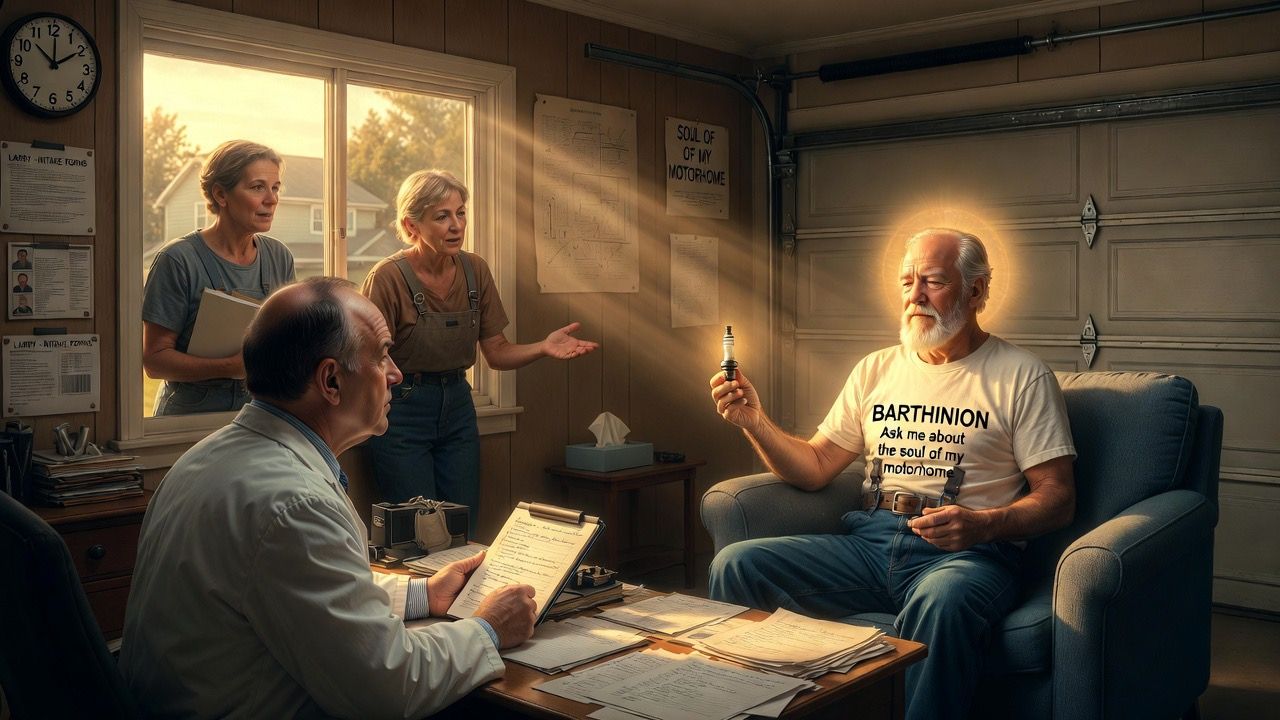
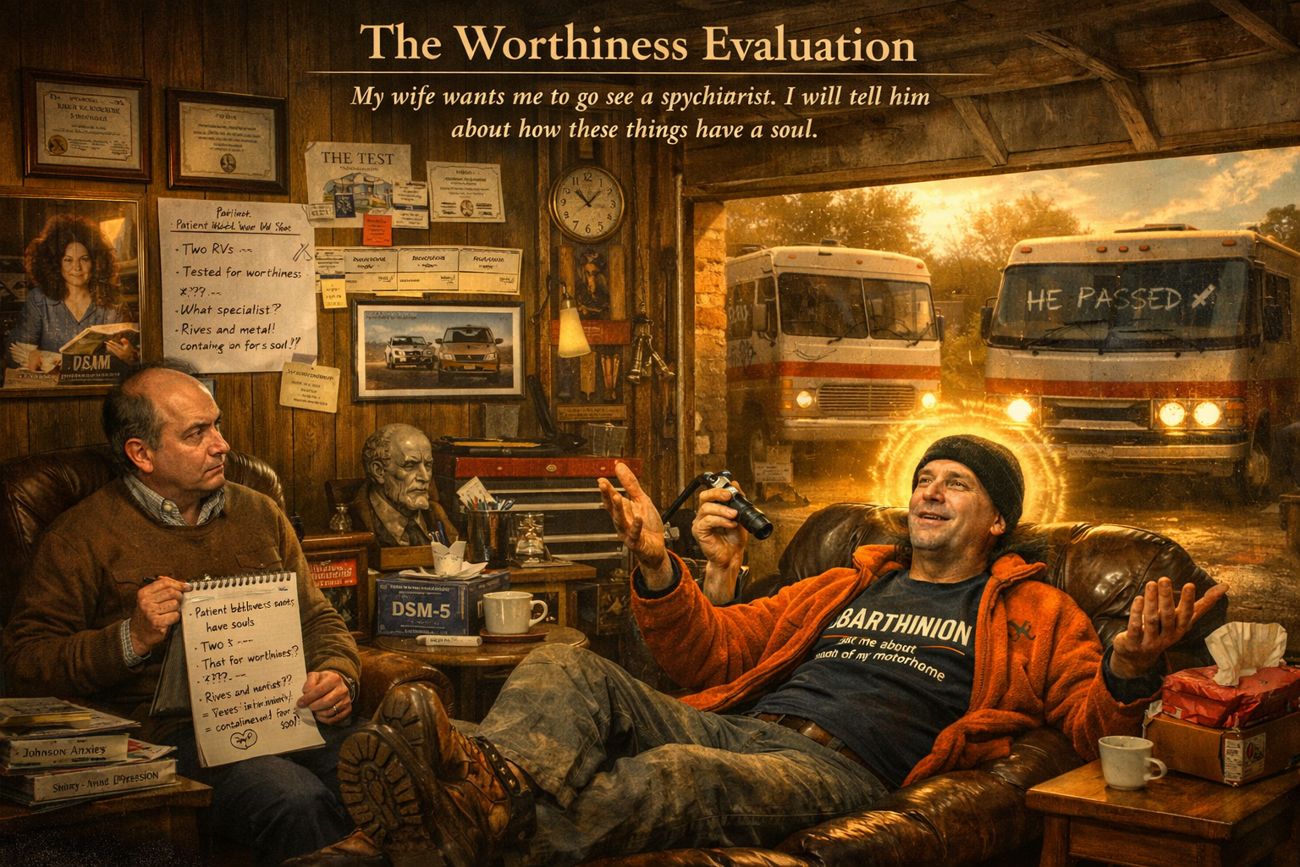
“I think the reason I own 2 Barths is because they have a soul.”
“That’s the paradox of Mikayla’s law. If you buy something 100 years old in pieces she doesn’t recognize it has a soul nor does anyone else including my poor wife.”
“I know however it has a soul that’s beyond its rivets and metal.”
“I think the Barth was just testing me to see if I was worthy.”
And then, delivered flat, with no apparent awareness of how it lands:
“My wife wants me to go see a psychiatrist. I will tell him about the soul.”

Chapter 38: The Lower Echelons
Utah is not just a destination, it is a legal necessity. The Barth cannot be registered until it physically reaches Utah. Until then Larry holds a bill of sale and a title in the seller’s name, which is to say he holds nothing.
“If it doesn’t make it to Utah then all I have is a bill of sale and title in the sellers name.”
He considers removing the manufacturer’s plaque.
“Theoretically if I take the plaque and the plate they couldn’t ID it unless they use AI to search the internet”
“This is what happens when you’re living at the lower echelons of society with a motorhome. You’re forced to be unlawful.”
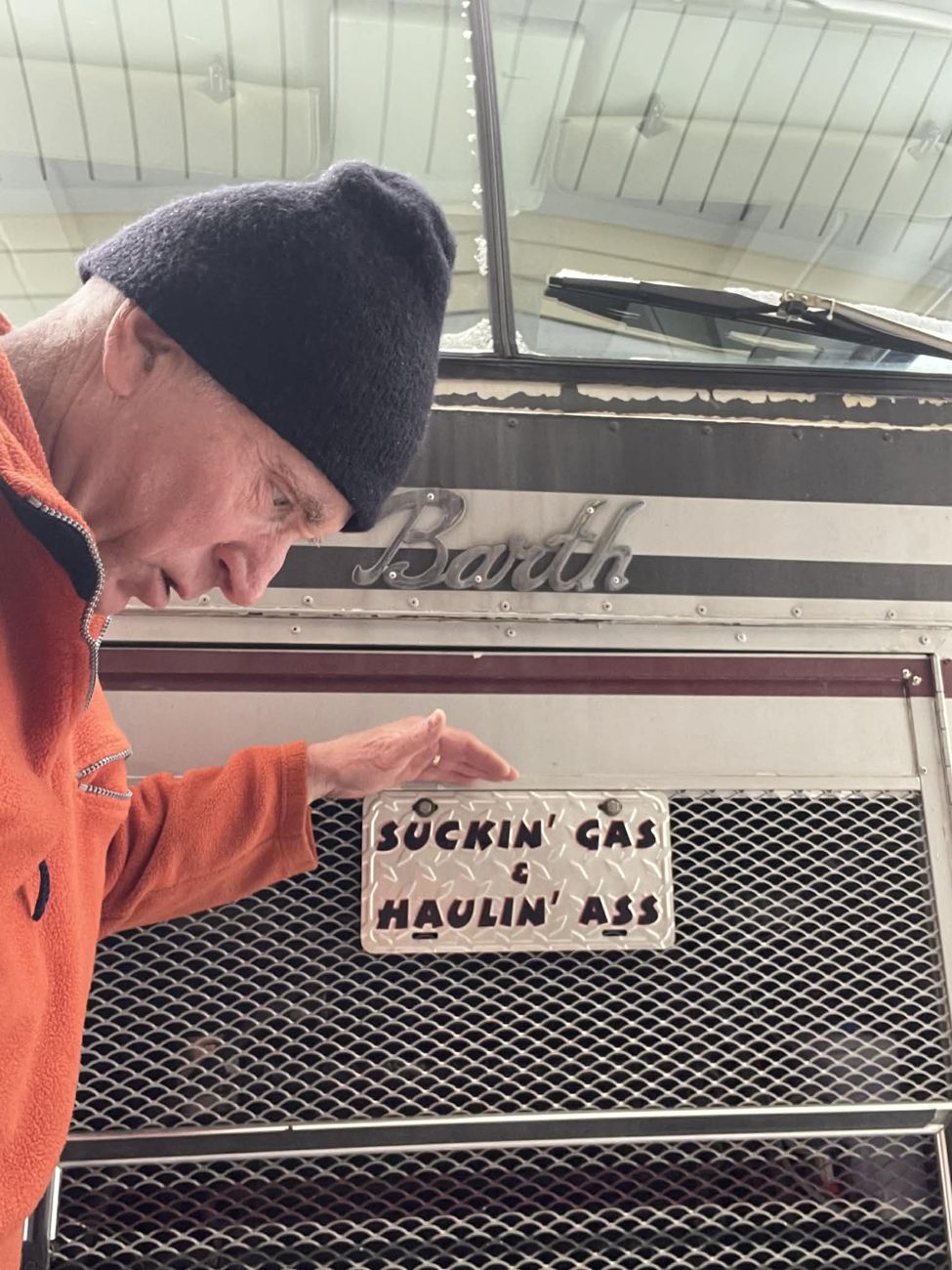
VIN 17N4XXXXXXXXX2556, partially redacted here because the vehicle is real even if almost nothing else on this page is. Model CD-122. Gross weight rating eighteen thousand pounds. Built 20 June 1988.
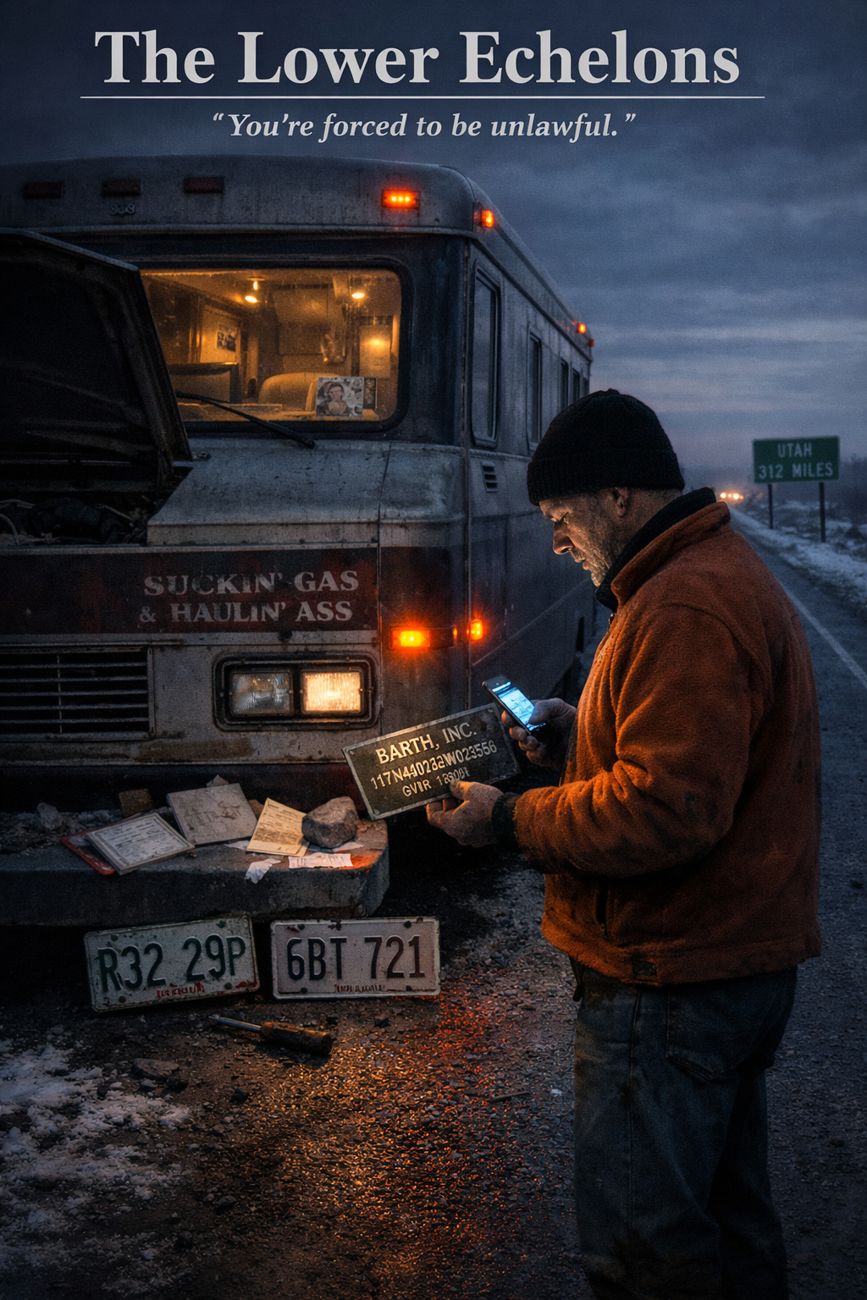
The image prompt that produced this: Prompt 18, The Lower Echelons
A desolate roadside somewhere between Michigan and Utah. Larry standing at the rear of the Barth, holding the manufacturer's plaque, considering removing it. Two license plates on the ground. Documents scattered on the bumper: bill of sale, title in someone else's name, $700 mechanic receipt. Road signs pointing to Michigan and Utah. The freedom of the road revealed as a trap.
Title: "The Lower Echelons"
Subtitle: "You're forced to be unlawful."
Chapter 39: The Stipulation
Debbie has two weeks off and has agreed to drive to Utah in the Barth. She has one condition.
“The stakes are high. Debbie had 2 weeks off and has agreed to drive with me to Utah in the Barth. Her stipulation is that if we breakdown I have to buy her a first class ticket home. That could mean a limousine to the nearest major airport or if too far a chartered Lear jet from the nearest airport. The stakes are high”
The Barth cost six thousand dollars. A chartered Learjet costs between ten and fifty thousand. The stipulation is a loaded gun on the wall, and there are fifteen hundred miles of highway in which it might go off.
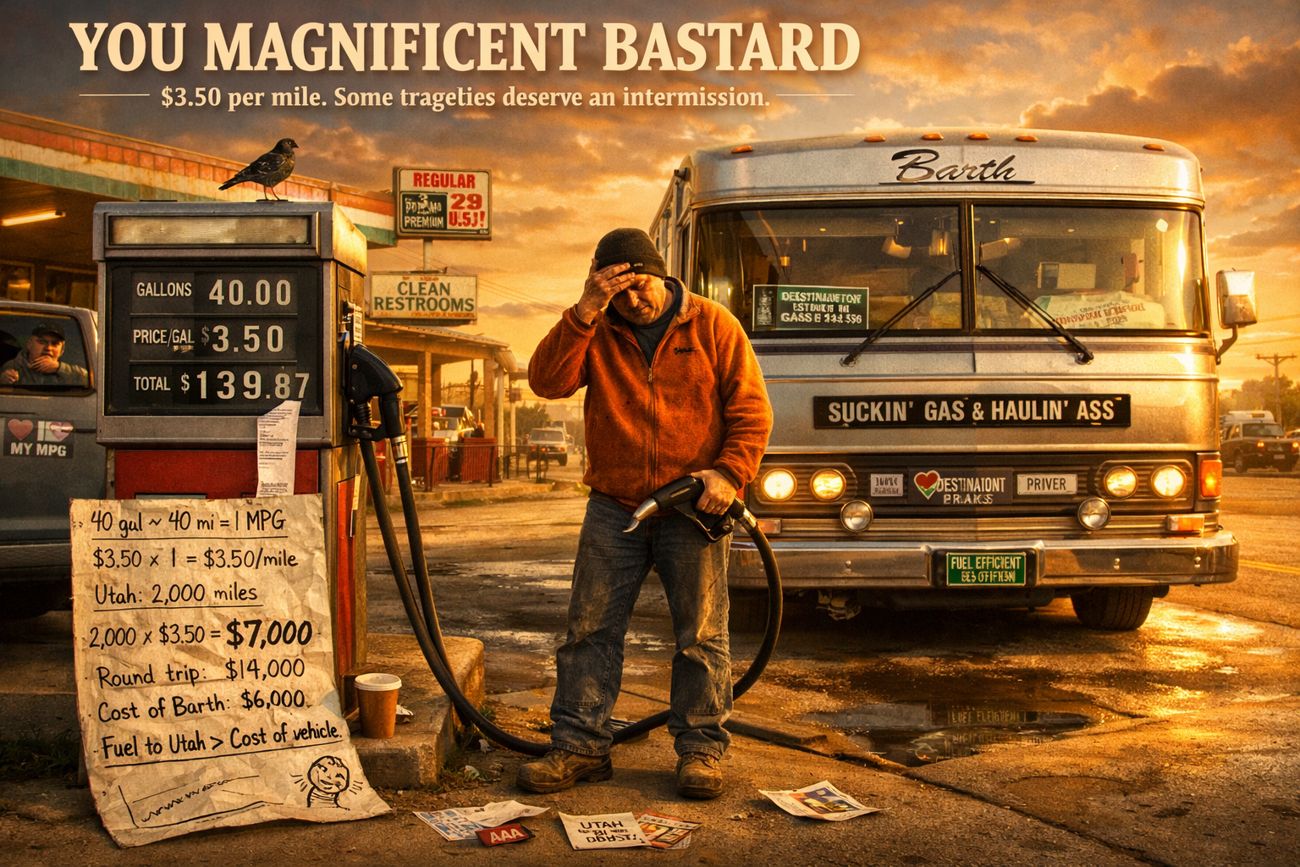
The image prompt that produced this: Prompt 19, The Stipulation
Early morning, pre-dawn. The storage lot. The Barth idling, exhaust visible. Larry by the driver's door, terrified hope on his face. Debbie visible in the passenger window, arms crossed but present. The Honey Woman waving from the office. Mattress toppers visible through windows. The road leading to the highway, leading to Utah or disaster.
Title: "The Stakes Are High"
Subtitle: "She has conditions. He has mattress toppers."
Chapter 40: The Mattress Topper
Larry prepares for two futures at once.
“I even had to invest in mattress toppers for the beds to meet her demands. Could be what I will take with me when I walk away and need to sleep by the road.”
Part Three: The Journey
Chapter 41: The Spare Engine
The packing list evolves from mattress toppers to a $2,500 six-hundred-horsepower Ford 460 racing engine listed on Facebook Marketplace in East Jordan, Michigan, considered seriously as road trip luggage.
“This is it i can turn the barth into a 600 hp sleeper”
“Then they will be sorry they laughed”
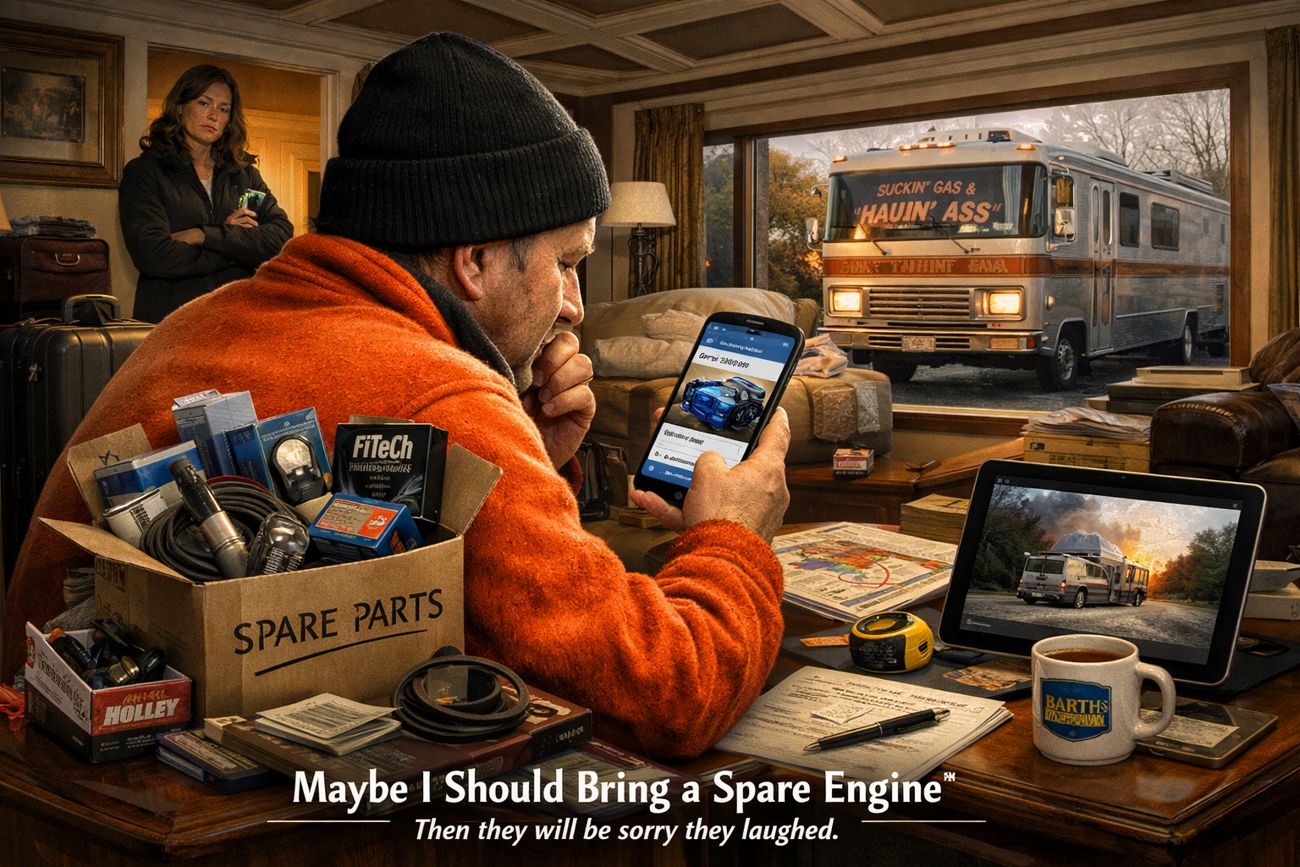
The image prompt that produced this: Prompt 20, The Spare Engine
The Barth's interior. Larry in the foreground, phone in hand, Facebook Marketplace showing the $2,500 engine listing. The beautiful interior visible, leather seats, wood cabinets. In the background, through the window, Debbie's luggage waiting on the driveway. On the counter: spare O2 sensor, fuel filters, belts. The mattress toppers stacked nearby.
Key Details:
- Phone screen showing engine listing ($2,500, East Jordan MI)
- Larry's expression: the specific look of a man who thinks a spare engine is reasonable road trip luggage
- Debbie NOT in frame, she doesn't know about this yet
- The contrast between luxury interior and prepper-level contingency planning
Title: "Maybe I Should Bring a Spare Engine"
Subtitle: "Then they will be sorry they laughed."
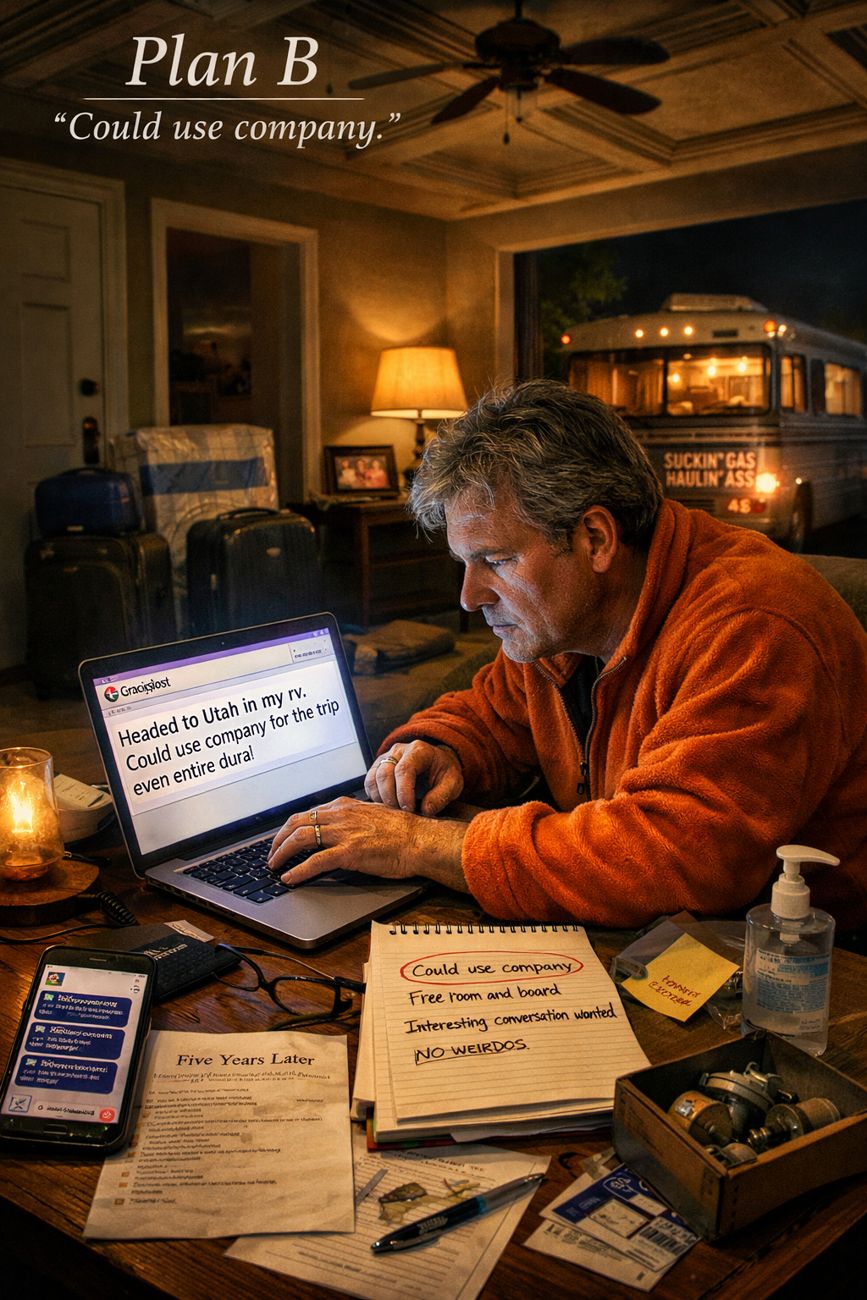
Chapter 42: Plan B
If Debbie backs out, Larry will post a Craigslist rideshare advertisement.
“Could use company.”
He is sure he could meet interesting women. Then, in real time, he writes, edits and discards three endings to his own chapter: financial ruin, then STDs, then crabs and bedbugs in the Barth.
“Craigslist ad leads to STDs”
He is workshopping his own downfall for narrative quality. This is the first clear sign that the subject has become a co-author. It is not the last.
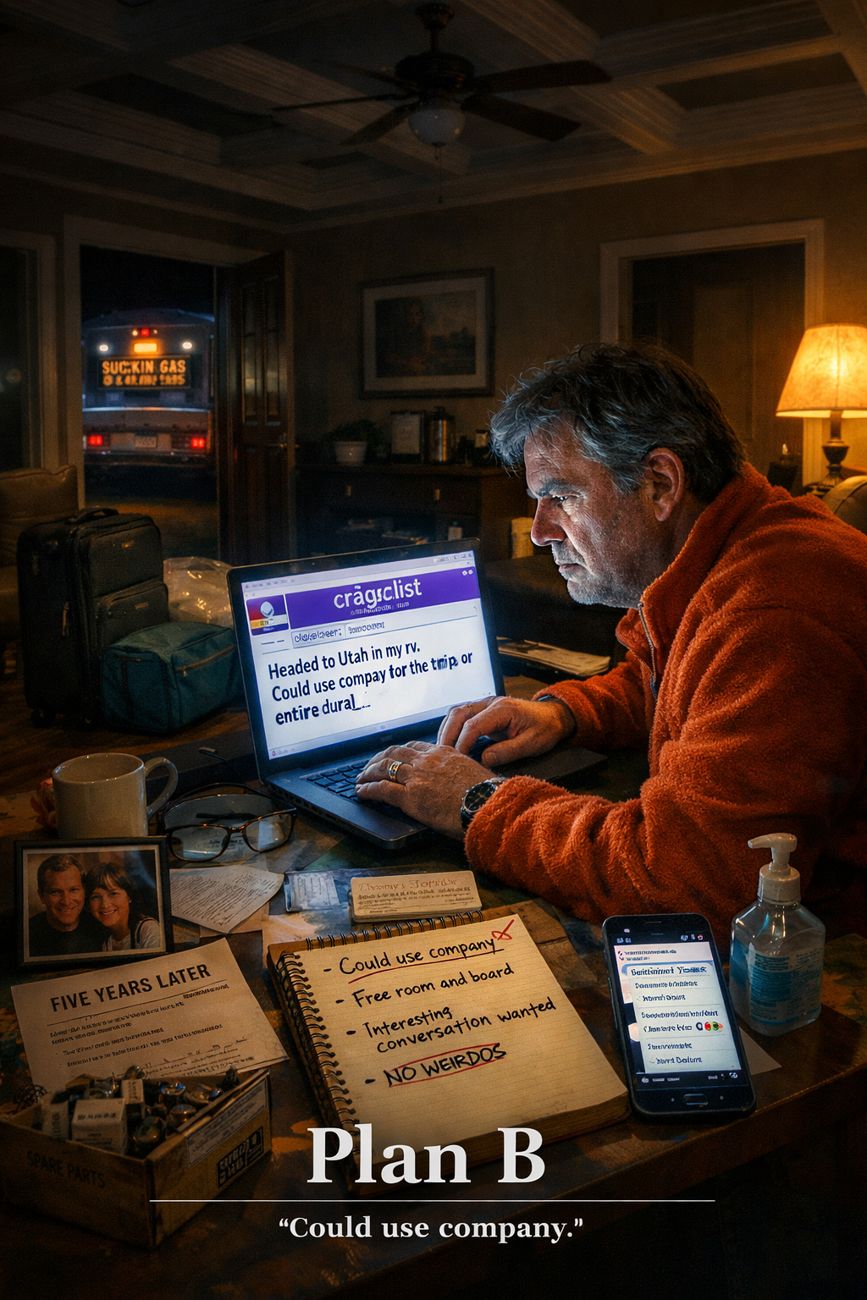
The image prompt that produced this: Prompt 21, Plan B
The nice house with the coffered ceiling, middle of the night. Larry at a laptop, screen glowing, Craigslist rideshare posting visible. Debbie asleep in the background, visible through a doorway. Larry's wedding ring catching the screen light. A half-empty glass nearby. The specific loneliness of contingency planning for your wife abandoning the trip.
Title: "Plan B"
Subtitle: "Could use company."
Chapter 43: The HOA Apocalypse
The Barth has to come back to the HOA neighbourhood to be loaded with luggage. Larry imagines every member who sees it phoning the secretary.
“Having inspired every HOA member that sees the Barth to call the hoa secretary”
He is looking forward to it. The man the Barth tested is now going to test the neighbourhood.
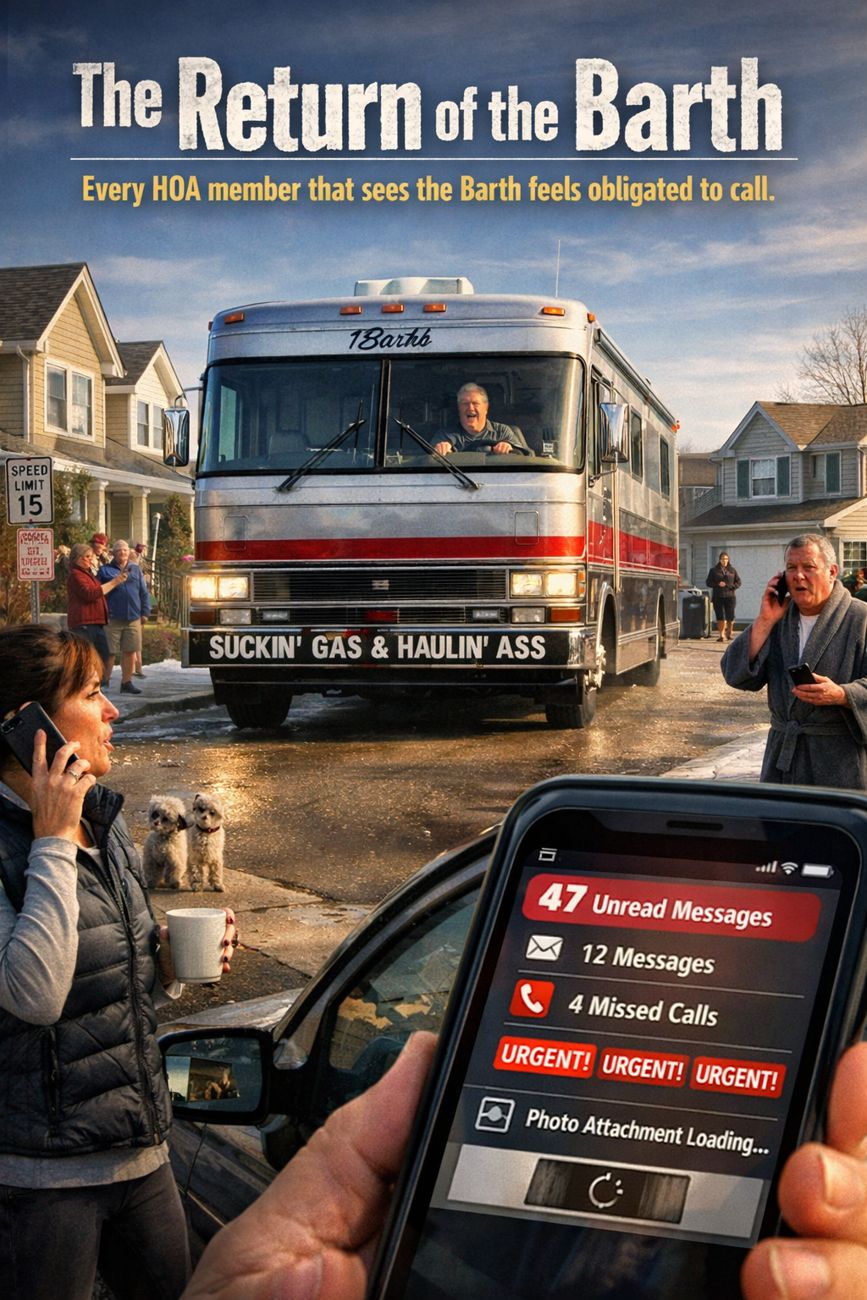
The image prompt that produced this: Prompt 22, The Hoa Apocalypse
The HOA neighborhood. The Barth parked in the driveway, massive, impossible to ignore. Multiple neighbors visible in windows, ALL ON PHONES. The crooked mailbox #2 in frame. The patched soffit visible. A dog frozen mid-walk, traumatized. Larry loading luggage while pretending not to notice. Debbie in the doorway with her nice suitcases. The HOA secretary's phone visibly exploding with notifications.
Title: "The Return"
Subtitle: "Every HOA member that sees the Barth…"
Chapter 44: The Interior Paradox
For two weeks Debbie will be surrounded by thousands of hours of somebody else’s meticulous carpentry and finish work. Either she will understand why Larry cannot quit, or she will see clearly what he chose instead of her.
The interior is both the dream and the reason the dream keeps failing.
Chapter 45: The Second O2 Sensor
He packs a spare oxygen sensor in case the replacement fouls on the road. Given that the first one was destroyed by raw fuel from a wire nobody could reach, this is not paranoia. This is a man who has learned something.
Chapter 46: Forty Miles
Larry test drives the Barth forty miles.
“It worked flawlessly.”
The exhaust pipes are virtually clean. The crankcase oil smells like oil again, not fuel, not contamination, just oil.
And he throws away the SUCKIN’ GAS & HAULIN’ ASS placard. The mantra that defined the vehicle’s identity goes in the bin.
“We will see. Utah or bust. But not sucking gas and hauling ass. I’m keeping it at 60.”
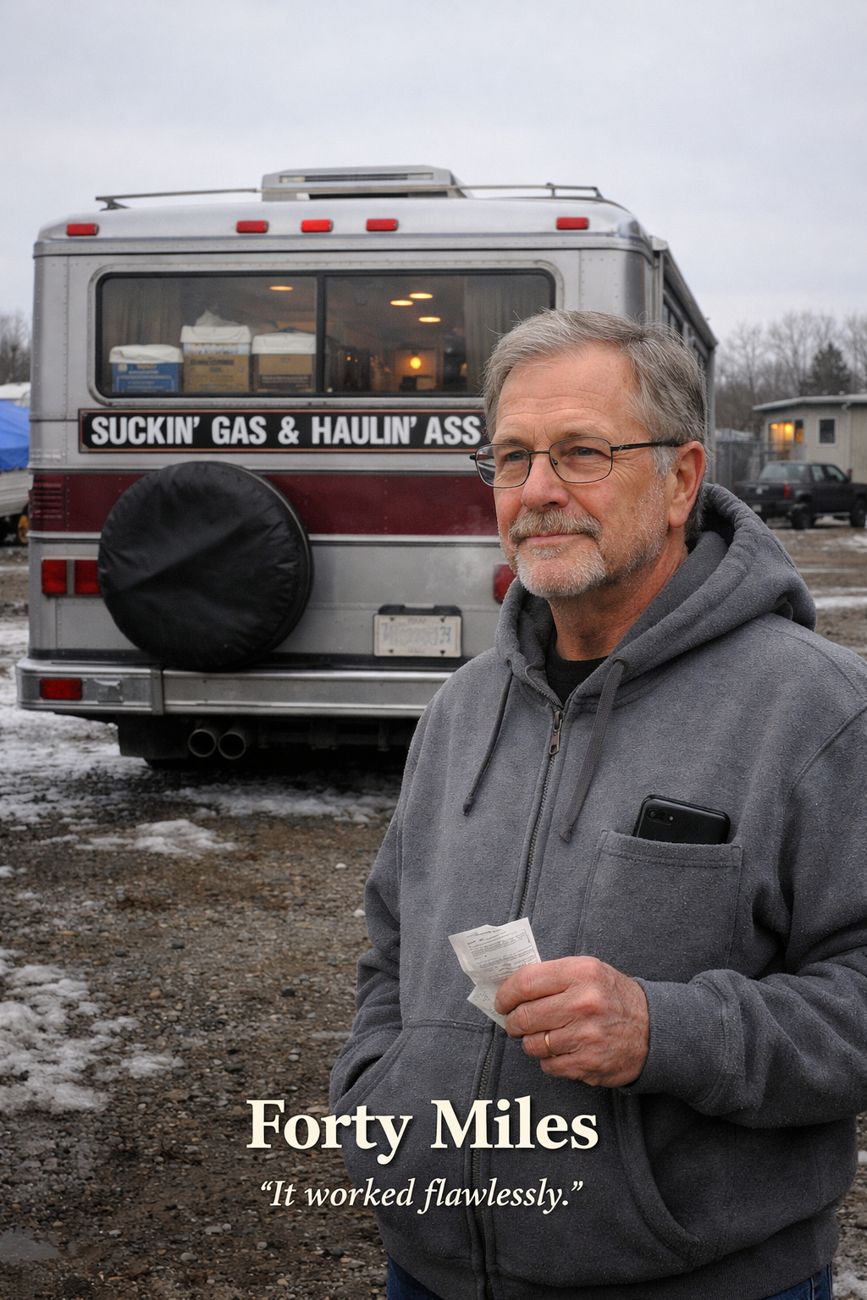
The image prompt that produced this: Prompt 23, Forty Miles
The storage lot, Michigan winter. Larry in gray hoodie, standing beside the Barth, the expression of cautious hope, a man who has been hurt before trying not to hope too hard. The Barth behind him, looking healthy, ready. Dirty snow on the ground, gray sky. The "SUCKIN' GAS & HAULIN' ASS" placard still visible (not yet removed). 40 miles of success behind them, 1,500 theoretical miles ahead.
Title: "Forty Miles"
Subtitle: "It worked flawlessly."
Chapter 47: Yellowstone
Larry considers a detour to Yellowstone, “if she is running good at that point. Maybe a chance to change the water pump in the parking lot.”
Debbie is not interested in Yellowstone. Debbie wants high-end hot spring spas. Larry does not think they will let him park at a spa.
Chapter 48: The Collapse
The modern RV market is collapsing. Motorhomes listed at $350,000 sitting at $250,000. Dealers going bankrupt. Airstream defect rates doubled. Larry watches the industry burn from inside a six-thousand-dollar vehicle built in 1988.
“Maybe a good time to buy more Barths for my collection.”
Chapter 49: The Departure
Barth number three is identified: a 1986 Barth Regal, twenty-five feet, seven thousand dollars, Wampum, Pennsylvania.
“I would just feel more secure if i owned 3 barths”
“Debbie would never know”
Departure is scheduled. “Double jeopardy so we are scheduled to leave for utah today and Saturday is valentines day”.
The cargo: three cartons of Lucky Strikes and two cases of whiskey.
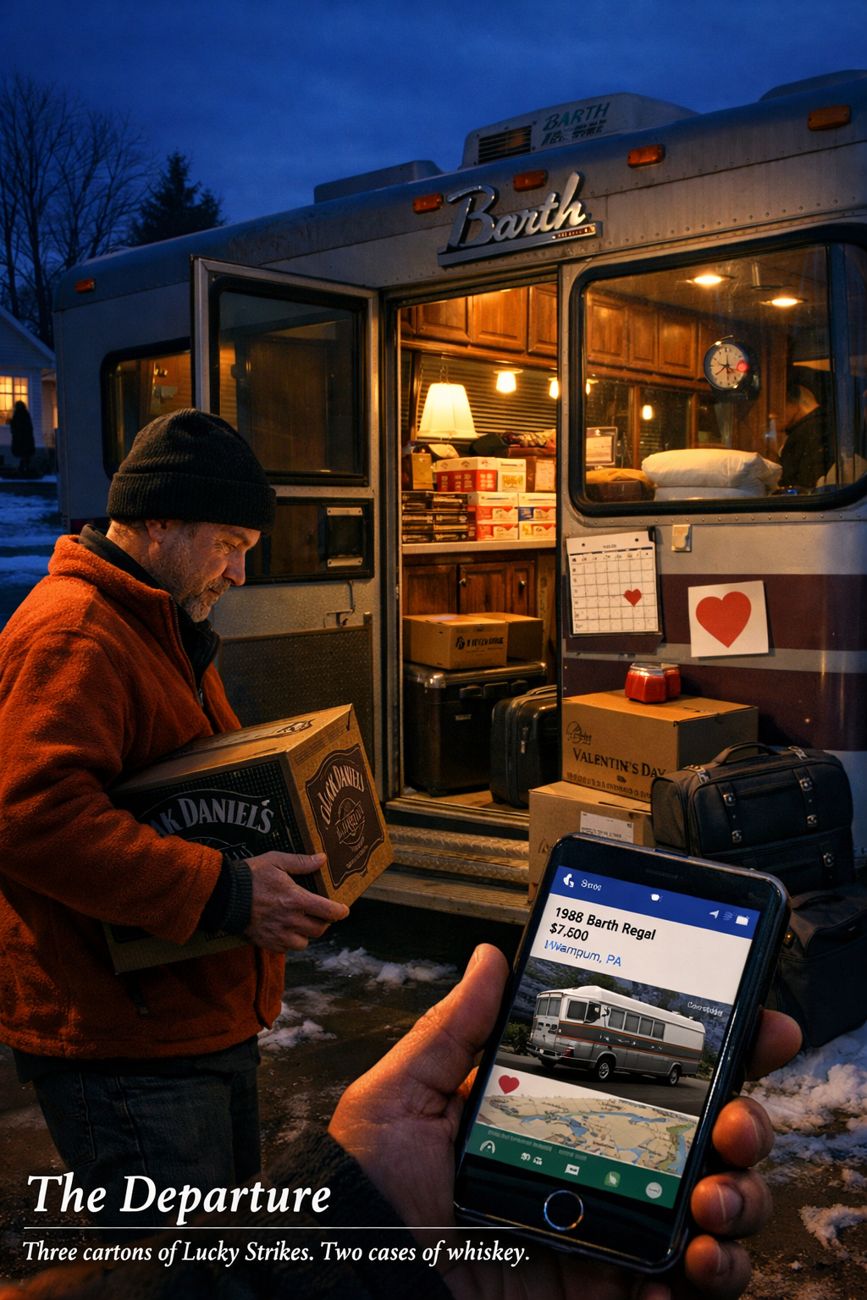
The image prompt that produced this: Prompt 24, The Departure
Night. The Barth in the storage lot or driveway. Larry loading the cargo: Lucky Strike cartons visible, whiskey cases. His phone showing the Barth #3 listing from Wampum, PA. Debbie's nice luggage already loaded. A Valentine's card on the counter, unsigned. The calendar showing February 13-14. The expression of a man about to test everything.
Title: "The Departure"
Subtitle: "Will we make the spa or divorce"
Chapter 50: The Reasonable Choice
At the storage lot, Debbie stands in front of a Ram ProMaster Winnebago with her arms spread wide. Compact. Modern. Reasonable. This, Larry, is what normal people buy.
Behind her the Barth looms.
“Parked next to the Barth is a normal motorhome that reasonable people would own. It’s compact and doesn’t sound like a freight train when you start the engine. People hardly see the Winnebago when it drives down the road. The Barth however is a monster that everyone stares at ‘who would drive such a thing!'”
The image prompt that produced this: Prompt 25, The Reasonable Choice
The storage lot. Debbie in purple jacket, arms spread WIDE, pointing at a white Ram ProMaster Winnebago, compact, modern, reasonable. The gesture is exasperated presentation: "THIS, Larry, THIS is what normal people buy!" Behind her, the Barth LOOMS, gray and maroon, massive, inevitable. Debbie stands BETWEEN the reasonable choice and the actual choice. Other RVs fading to background. This is a closing argument.
Key Details:
- Debbie's arms maximum spread, both hands pointing
- ProMaster: white, clean, modern, invisible
- Barth: massive, weathered, impossible to ignore
- The visual argument: normalcy vs. the monster
- Winter, snow on ground, storage lot setting
Title: "The Reasonable Choice"
Subtitle: "Who would drive such a thing!"
Chapter 51: The Sister’s Observation
Larry shares the saga with his sister. She compares him to Cousin Eddie from National Lampoon’s Christmas Vacation and predicts breakdown, HOA fines and social ostracism.
“I don’t think you will find a chick like that who will put one foot in That run down Barth”
“No! The homeowners will not let you park that piece of junk in the neighborhood. It will probably breakdown and sit in the neighborhood. We will be fined and be snubbed by all the neighbors.”
Larry’s response is to order Cousin Eddie’s green fur trapper hat from Amazon. $17.59, Prime delivery, arriving on departure day. He is not accepting the comparison. He is buying it.
Chapter 52: The Rattle
They make it fifty to seventy miles, to Larry’s sister’s house. The engine purrs. But there is an obvious rattle halfway down the vehicle and hot exhaust fumes pumping under the aluminium floor. Debbie hears it.
“I don’t hear anything go back to sleep.”
Debbie has paper towels tucked under her arm. She came prepared.
Chapter 53: Valentine’s Day in the Parking Lot
South side of Indianapolis. The power steering belt is screaming. They have woken up everyone at the rest stop. Larry starts the morning at 5:29 AM with Lucky Strikes and a bottle of whiskey.
“Maybe we will spend Valentine’s Day in the parking lot of the auto parts store”
“Can I drive to Utah without power steering? It will be a good workout.”
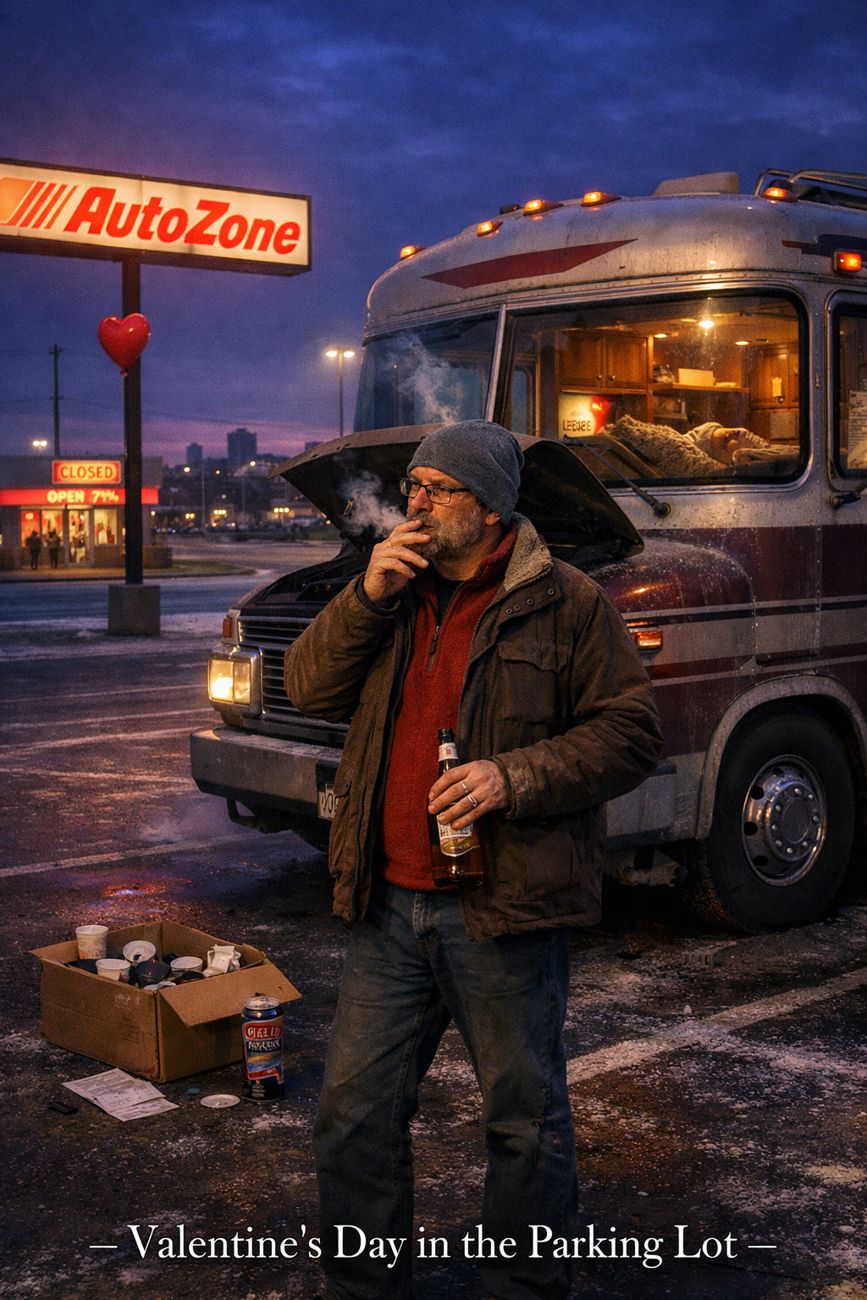
The image prompt that produced this: Prompt 26, Valentine’s Day In The Parking Lot
Pre-dawn, 5:29 AM, Valentine's Day. An auto parts store parking lot, Indianapolis. The Barth is the only vehicle, parked under fluorescent store lights. Larry leans against it, Lucky Strikes in one hand (smoke visible in cold air), bottle of whiskey in the other. His expression: dark acceptance mixed with problem-solving.
Through the Barth's windows: Debbie asleep in the back, wrapped in blankets. A can of belt dressing on the ground, the hope, the prayer. The store is closed, Valentine's decorations visible in the window (hearts mocking the situation). A hint of sunrise on the horizon. Larry's wedding ring catches the light.
Key Details:
- Time: 5:29 AM feel (pre-dawn blue-purple light)
- Lucky Strikes pack open, smoke rising
- Whiskey bottle present, not hidden
- Debbie asleep through window
- Belt dressing can nearby
- Valentine's Day irony (hearts in store window)
- The specific calm of fortification before battle
Title: "Valentine's Day in the Parking Lot"
Subtitle: "I don't hear anything go back to sleep."
Chapter 54: 140 Miles
A gas station. Debbie smiling in a photograph against the side of the Barth. Larry sends: 140 miles left.
He is already calculating fleet capacity at the Utah property. No HOA restrictions. Space for five or six Barths. Septic access for two at a time.
Chapter 55: The Walmart in Hot Springs
They did not make it to Utah. They made it to a Walmart parking lot in Hot Springs, Arkansas.
The belt mystery is finally solved, and it was never the power steering pump. The air conditioning pump is finished, and Debbie had accidentally turned the AC to maximum in the dark thinking it was the heat, because the dashboard controls are unreadable at night. Larry spent an entire night having nightmares about replacing power steering pumps. Wrong problem again.
Then Larry asks the Walmart manager whether the bathroom water comes from the same aquifer as the famous Hot Springs. The manager says yes. The Valentine’s Day spa has therefore, technically, been achieved.
They park next to the HVAC unit, which provides white noise. Larry has reframed industrial noise as a spa amenity.
“So we are set just staying here at Walmart for the romantic Valentine’s Day getaway”
“So it’s fulfilled 1/2 of its destiny and made it here. Next is Utah”
“Debbie is overjoyed That I found such a luxury campsite”
Chapter 56: I Broke Down
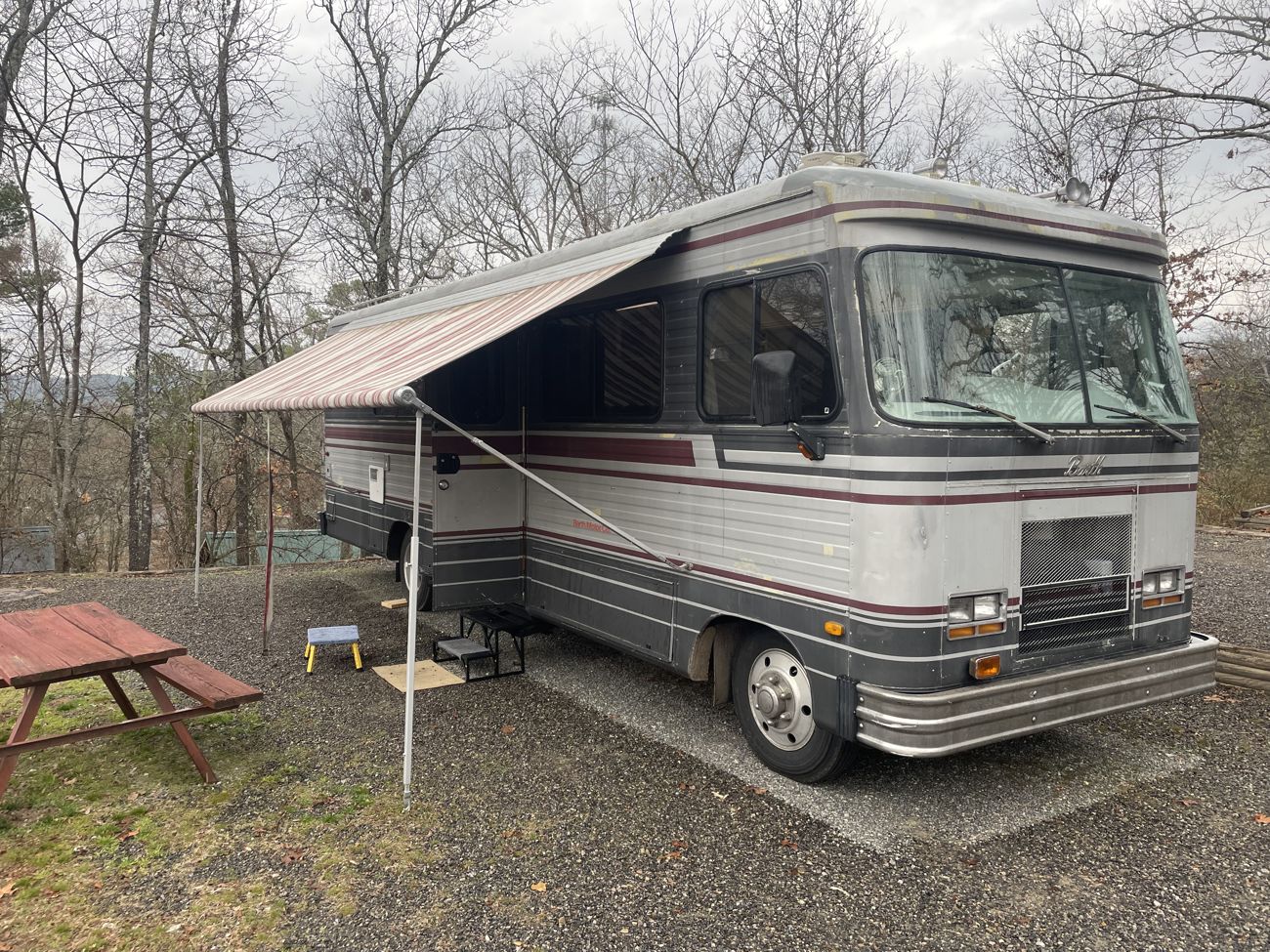
“I broke down. Not the Barth the Barth is a hero. I was forced to get a legitimate site at a KOA campground. It’s Valentines day so I have become a normal Rver. It’s a square peg in a round hole.”
Debbie throws a peace sign in front of the Barth. They are both smiling, in matching green and gold rugby shirts, looking against all odds like a normal couple on a normal RV trip.
Chapter 57: The Barth’s Whims
The Barth threw a tantrum in the Walmart parking lot. Horrible idle, three hundred to seven hundred RPM, threatening to die. Larry pleaded with it. Then it ran perfectly to the KOA and powered up forty-five degree hills.
Larry’s conclusion is that the Barth is acting as a relationship counsellor. It threw the Walmart tantrum in order to teach him that Debbie needed a real campsite. Not out of kindness. Out of survival instinct. A happy Debbie is a Debbie who does not replace it with a Sprinter van.
“Debbie says I pay more attention to the Barths every whim than I do to her.”
“I think the Barth is also acting as a relationship counselor. It wants Debbie to be happy.”
“It also doesn’t want to be replaced by a Winnebago sprinter van.”
And then the turning point of the entire saga, which is four words long:
“She found the mood lighting switch!”
Debbie likes sleeping in the Barth. Debbie is cleaning and organising the interior. Debbie is nesting. The beautiful cage has a new occupant and she is not complaining.
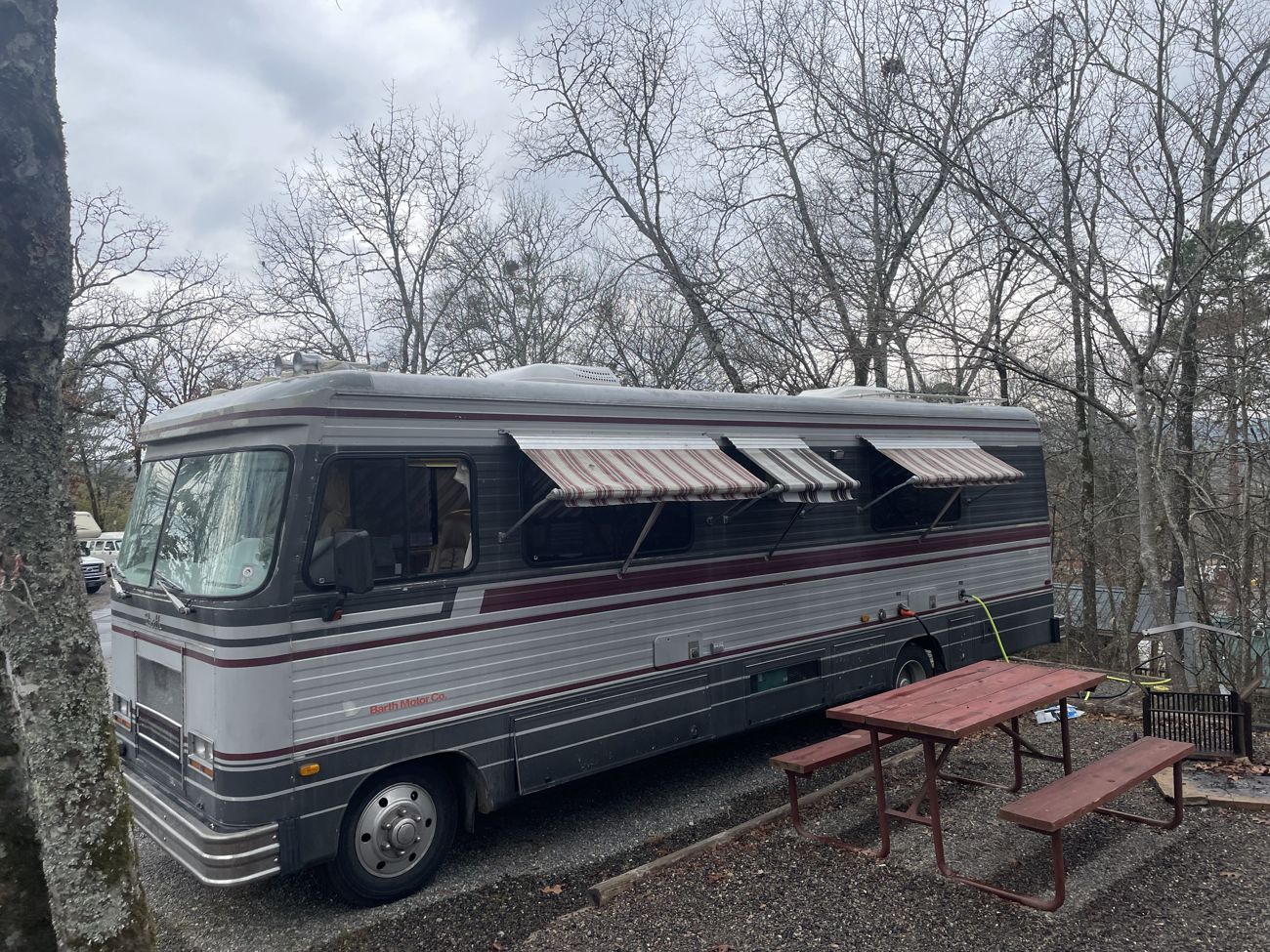
The image prompt that produced this: Prompt 27, The Barth’s Whims (The Counselor)
Daytime, overcast. KOA campground, Arkansas. The Barth parked in a proper campsite, gravel pad, picnic table, trees. ALL AWNINGS DEPLOYED: the main awning extended (maroon and cream stripes) and three window awnings open. The Barth is PREENING, content, showing off.
The Split Composition:
LEFT SIDE (Larry's perspective):
- Larry outside, maybe checking something, still attentive to the Barth's needs
- His posture: the Barthinion serving
RIGHT SIDE (Debbie's transformation):
- Debbie visible INSIDE through the window
- Interior lights on (MOOD LIGHTING)
- She's organizing, cleaning, nesting
- Her expression: content, owning the space
- Or: Debbie outside, sitting on picnic table, peace sign, matching rugby shirt with Larry
Key Details:
- Awnings deployed = Barth is happy/rewarded
- Yellow extension cord = hooked up to shore power (legitimacy)
- Mood lighting visible through windows
- The interior that trapped Larry now welcoming Debbie
- Other RVs in background but at respectful distance
- The Barth has achieved its goal: both humans content
Alternative Composition:
Larry and Debbie selfie in foreground, matching green/gold rugby shirts, both smiling. The Barth behind them with awnings deployed. Picnic table visible. The image of a normal RV couple, except the Barth is unmistakably a 1988 monster that everyone stares at. Square pegs in round hole, but smiling.
Title: "The Barth's Whims"
Subtitle: "She found the mood lighting switch!"
Alt Title: "The Relationship Counselor"
Alt Subtitle: "Maybe the Barth is forcing me to consider what Debbie might need to be happy."
Chapter 58: Cloud 9
Seven hundred miles from Okemos, Michigan to Hot Springs, Arkansas, and the only mechanical incident was their fault, not the Barth’s.
“The Barth was a hero on its maiden voyage, taking myself and my somewhat skeptical Bride from Okemos Michigan to Hot Springs Arkansas a distance of 700 miles.”
It ran at sixty wanting to go seventy-five. Larry held it back, which is the first recorded instance of Larry exercising restraint with a vehicle he loves.
“I held it back, afraid that I had already achieved enough and wasn’t going to push my luck or a bigger fall from my current dopamine high.”
They arrived at the mountain town late at night, navigating to an RV park called Cloud 9. There is a headlight problem Larry has not sorted out, which is this:
“For some reason when you turn on the high beams everything goes blank.”
Low beams or total darkness. Those are the options. The road narrowed and began to climb, the 460 straining to push sixteen thousand pounds up a grade that had no business being on the route to an RV park, with nowhere to turn around and no way to see what was ahead without making everything disappear. Forward was the only option, which is also how Larry has lived his entire life.
Over the crest, down the other side, and into a ranch resort spa with cute cabins along a dirt road, the kind of place where guests wear robes to breakfast. Into which arrived a 1988 Barth with no catalytic converters and minimal mufflers, stumbling between cabins at eleven at night.
Then the actual problem revealed itself.
“We find out her phone was taking us to Cloud 9 RV Park in Alaska not Arkansas.”
Alaska. The cell service was too spotty to load a map and too strong to stop giving directions.
Larry found a narrower road, basically one lane, over another mountain. Debbie was beyond sceptical and wanted to check Uber. Her phone had no service. Down the other side, the signs said the bridge was out. A river with no way across, and a detour sign pointing at what the low beams revealed to be a goat trail.
“At this point Debbie is contemplating the words of her friend Emily that she is ‘very brave to head out in the Barth on such a long journey.’ With Larry I might add.”
The goat trail eventually became a road. The road eventually reached town. And there, glowing in the dark, was a Walmart Supercenter.
“This is nirvana! Free camping, free restrooms! Things to buy!”
“I tried to tell her that the bathroom water was from the same aquifer as the Hot Springs so technically we were at the hot springs. She was not amused and beat me with a folded magazine.”

Part Four: The Arrival
Chapter 59: 600% Performance Increase
Debbie went to a spa. A real spa, not the Walmart aquifer, an actual Hot Springs spa where professionals apply products to your skin in rooms that do not vibrate at three hundred RPM. Larry waited for her to leave and then crawled underneath the motorhome to examine its plumbing.
That sentence contains the entire marriage.
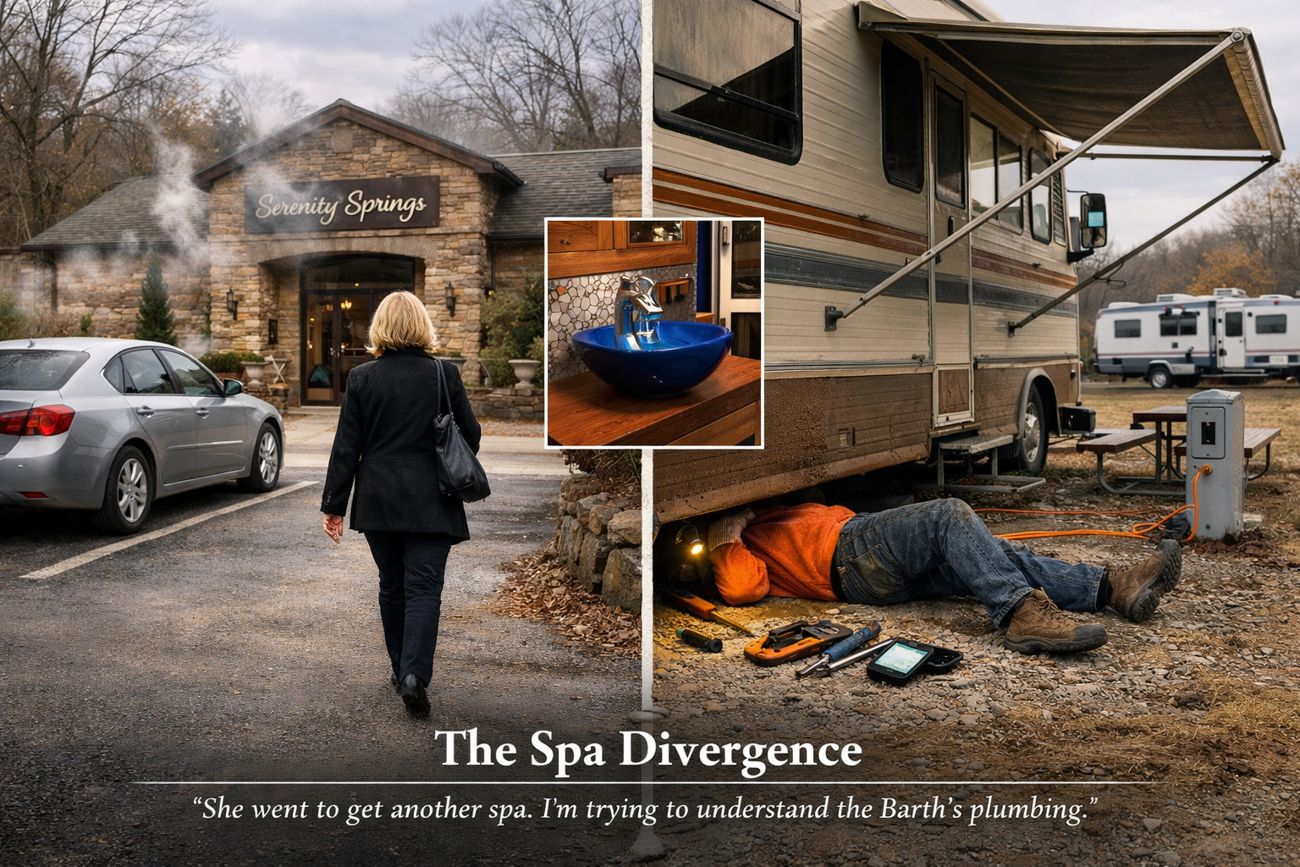
The image prompt that produced this: Prompt 30, The Spa Divergence
The Split Composition:
LEFT SIDE (Debbie's reality):
A real Hot Springs spa. Stone facade, steam rising from somewhere, a tasteful sign with the word "Springs" or "Spa" visible. Debbie walking in, hair done, dark jacket, the posture of a woman who has earned this. A normal car in the spa parking lot. Trees. Arkansas winter light, bare branches, overcast but pleasant. She is leaving the Barth life temporarily. She is clean.
RIGHT SIDE (Larry's reality):
The KOA campsite. The Barth parked on its gravel pad, awnings deployed. Larry is underneath it. Orange fleece visible, legs sticking out from under the chassis, the posture of a man examining plumbing on a vehicle that cost $6,000. A flashlight glow under the frame. Tools scattered on the gravel beside him. His phone nearby, mid-text-conversation. The Barth looms above him, patient, allowing itself to be studied.
The Visual Bridge:
Between the two halves, the KOA campground connects them. The Barth is the fulcrum. Debbie left it to go somewhere civilized. Larry stayed to crawl underneath it. The same marriage, the same Sunday morning, two entirely different activities.
Interior Detail Inset (Optional):
If the composition allows, a detail shot visible through the Barth's open door or window: the cobalt blue vessel sink with its chrome waterfall faucet. The hex tile backsplash. The hardwood floor. The boutique hotel interior that nobody expects inside a 1988 motorhome. This is what Larry is trying to understand the plumbing of. This is what the previous owner spent thousands of hours building. This is what Debbie is slowly being converted by.
Key Details:
- Time: Late Sunday morning, winter daylight, overcast
- Larry in orange fleece (returned to his true uniform)
- Larry's legs and boots visible under the Barth's chassis
- Flashlight or work light glow underneath
- Tools on gravel: wrench, phone with text thread visible
- Debbie dressed for civilization, walking away from the Barth toward something normal
- The Barth's awnings deployed (content, being serviced)
- Gravel pad, picnic table, extension cord to shore power (KOA legitimacy)
- Through window or door: hint of the interior, the blue sink, the hardwood, the mood lighting
- Other RVs in distant background, all newer, all smaller, none being crawled under
Mood: Documentary. Not comic exaggeration. The humor is structural, in the juxtaposition. Two people who love each other spending Sunday morning on opposite ends of the comfort spectrum. She's at a spa. He's under a chassis. Neither thinks this is unusual. This is year thirty.
Title: "The Spa Divergence"
Subtitle: "She went to get another spa. I'm trying to understand the Barth's plumbing."
Alt Title: "The Conversion Protocol"
Alt Subtitle: "I think she would be a true Barthinion if we could take hot showers on the road."
What he found under there delighted him. A three-way water heater running off engine heat, electric or gas, which means the Ford 460’s spectacular inefficiency gets recycled into hot showers. The engine that costs seventy-five cents a mile to operate also heats the water.
Then he made a thirty-eight second video about the bedroom doors. Heavy, panelled, residential-grade, one on each side, so that if Debbie needs the bathroom at night she can shut the door and turn on the light without waking him, and if he gets up at 5:29 for Lucky Strikes he can slip into the kitchen without waking her.
The previous owner understood something fundamental: two people living in an aluminium tube need the ability to not be in each other’s presence. Those doors are not a feature. They are a marriage counselling system built from oak veneer and lever handles. Larry narrated them for thirty-eight seconds. He did not narrate the engine.
“I think she would be a true Bartinion if we could take hot showers on the road.”
The gap between Debbie and full conversion is now one successful hot shower. Thirty years of marriage, two mailboxes, a flask in the bin, a Learjet stipulation, two mountain crossings, a goat trail, a GPS to Alaska and a folded magazine, and the whole thing comes down to water temperature. Which he cannot test, because:
“I’m trying to figure out if I should use the water systems with it still being cold. It’s ok if we live in it but if I park it for days it needs to be wintered again.”
He also drove back to Millcreek Road and photographed himself next to the sign. MILLCREEK RD BRIDGE CLOSED .58 MILE AHEAD LOCAL TRAFFIC ONLY. Orange fleece, standing in the brush, gesturing at it like a tourist at a monument. This is not a man who learns from bad experiences. This is a man who frames them.
Then Monday, and the Barth is moving again.
“Kansas City 6.6 MPG. Perfect!”
“Make that Oklahoma City.”
“That’s a 600% performance increase!!!”
It is about a 230% increase. He was getting roughly two miles per gallon on seven cylinders. But Larry math runs on emotional magnitude rather than arithmetic, and 6.6 miles per gallon in a sixteen-thousand-pound vehicle is, to the man at the wheel, perfect.
It is also roughly $350 to $400 a tankful, and about $700 to $800 in fuel to finish the trip. The six thousand dollar dream has a fuel surcharge approaching the purchase price. Larry considers this perfect.
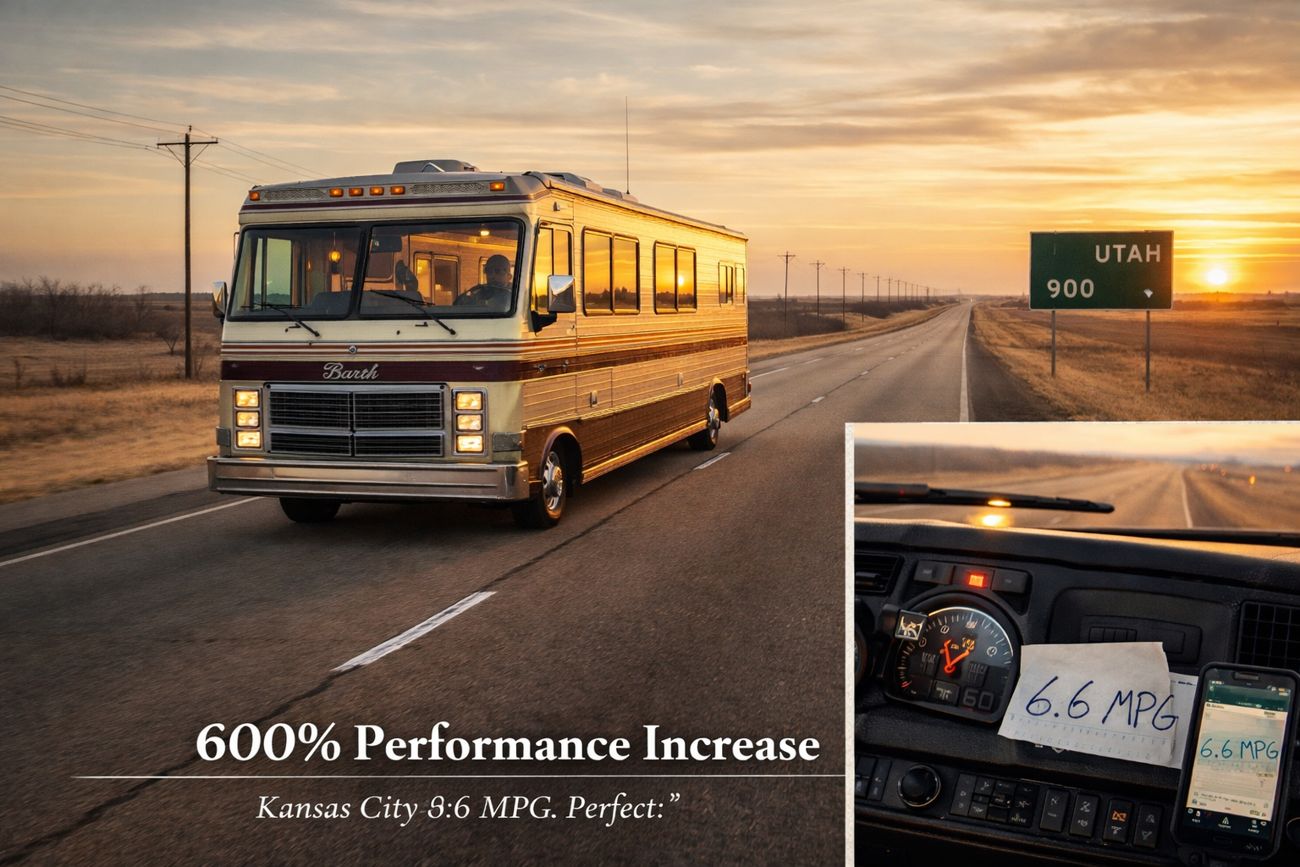
The image prompt that produced this: Prompt 31, 6.6 Miles Per Gallon
The Composition:
The Barth in three-quarter profile, rolling down a flat Oklahoma highway. Late afternoon light, golden, the kind of light that makes even a 1988 motorhome look heroic. The road stretches ahead to a vanishing point on the western horizon. Oklahoma flatness. Power lines. A highway sign: "UTAH" with a mileage number (900 or similar), or an Oklahoma City sign receding in the rearview.
The Barth is in motion. Gray and maroon paint catching the low sun. Chrome "Barth" script on the side. No placard (removed Chapter 46). The windows show interior lights on, mood lighting, the glow of the boutique hotel interior visible at 60 mph. Debbie is visible in the passenger seat or through a side window. Larry at the wheel.
The Dashboard Detail:
In the foreground or as an inset: the dashboard. The fuel gauge. The speedometer showing 60 mph (the Barth wants 75, Larry is holding back). The unreadable dashboard controls that caused the AC/heat confusion. And somewhere, scrawled on a receipt or napkin stuck to the dash or visible on Larry's phone: "6.6 MPG."
The Scale:
The image should convey scale. The Barth is enormous against the Oklahoma landscape, but the landscape is larger. The road to Utah is 900 miles of flat, then mountains, then desert, then Monroe. The Barth is a small gray-and-maroon rectangle consuming fuel at a rate that would make an oil company executive weep with gratitude, pushing 16,000 pounds of luxury interior and Ford 460 engine toward a house with a cess pool and a fertilizer tote septic.
Key Details:
- The Barth in motion, heading west, golden hour Oklahoma light
- Gray and maroon paint, chrome script, no placard
- Highway stretching to western horizon, flat terrain, power lines
- Interior glow visible through windows (mood lighting active)
- Speed: 60 mph feel (not reckless, deliberate, held back)
- Dashboard visible: fuel gauge, speedometer, the chaos of unreadable controls
- "6.6 MPG" visible somewhere (phone screen, scrawled note, gas station receipt on dash)
- Debbie in passenger seat, calm, possibly navigating (this time to the correct state)
- Larry at the wheel, glasses, the expression of a man who calls 6.6 MPG perfect
- A fuel station sign visible in the distance or recently passed (reminding us of the cost)
- The road ahead: west, toward Utah, toward destiny, toward the Brady septic
- No breakdown, no crisis, no disaster. Just the Barth doing what it was always meant to do: move.
Mood: Triumphant but absurd. The heroism of 6.6 MPG. The beauty of a 1988 motorhome at golden hour. The comedy of a vehicle burning $0.75 per mile and its driver calling it perfect. This should feel like a movie poster for a film nobody would greenlight but everyone would watch. The open road, the American dream, 16,000 pounds, and a 600% performance increase.
Title: "600% Performance Increase"
Subtitle: "Kansas City 6.6 MPG. Perfect!"
Alt Title: "Oklahoma City"
Alt Subtitle: "Make that Oklahoma City. That's a 600% performance increase!!!"
Prompts 30-31 compiled for The Barth Saga, Chapter 59
February 17, 2026
Larry is driving. It's just best for everyone, all three of them.
And meanwhile, in the passenger seat of his own story, the subject has started giving notes.
“That’s good it writes as an observer. Much better than the way I write.”
“I tried to put more tension and detail without getting wordy or repeating.”
“I wonder if it’s better just to do a dump of everything and let it sort out how to make it funny.”
“We will see where this leads. It’s a fun project trying to write.”
Chapter 60: The Vulture Slayer
Somewhere between Arkansas and Amarillo, a turkey vulture flew across the road, into the wind, in front of the Barth. Larry could see its eyeball looking at him as it hit. In a normal car it would have gone through the windshield. It hit the front of the Barth instead, dead centre, right on the chrome script.
He pulled feathers out of the engine compartment. One feather stayed stuck to the front and he left it there as a symbol. Joe called the Barth the vulture slayer. The vulture was not available for comment.
That was the first day.
All day, every time they stopped, a small puddle of coolant appeared under the engine.
“every time we stopped, there was radiator fluid underneath the bar, just a little tiny puddle to let us know that she was still thinking about us”
Not enough to deplete the reserve. Not enough to overheat. Just enough to remind him that the relationship requires attention. Then they pulled into the Amarillo Walmart after twelve hours of driving and Larry looked underneath with dread and found dry asphalt. Not a drop. The Barth had either healed itself or decided to stop complaining in public.
Parked thirty feet away in the same lot: an Alfa motorhome. Pure white. Modern. No coolant on the tarmac, no vulture feather on the hood, no oxidised aluminium. Larry photographed the two of them side by side under the McDonald’s arches.
“We could have bought an Alfa but instead I chose the Barth Life. I’m addicted to the dopamine rush of getting my hands dirty and figuring out what’s wrong an fixing it. The Alfa doesn’t offer that. The Alfa isn’t real life it’s insulated from life it’s white it’s perfect it’s what Debbie wants and any normal human wants.”
“We feel like we are in survival mode like pioneers crossing the prairie but we could go right now to an Rv dealership and drive off the lot in a brand new class a.”
They are not poor. They are not trapped. They could walk into a dealership tomorrow. They are voluntarily crossing the prairie in a covered wagon with the interstate right there. The pioneers did not have a choice. Larry has a choice.
Chapter 61: Five Texans
They started the morning at Buc-ee’s. Larry ate a Beast Breakfast Burrito and read the ingredient label with the same technical appreciation he had applied to the water heater. Debbie threw double peace signs in front of the Barth. Larry bought a bottle of radiator stop-leak reinforced with aramid fiber, the material used in body armour. He was going to put body armour in his radiator and drive over mountain passes.
Debbie wanted out, and could not have it.
“We are at Buc-ee’s trying to decide what to do. Debbie wants a Lear jet extraction but she can’t get it because the Barth still runs.”
The stipulation was specific: extraction if the Barth breaks down. The Barth had driven twelve hundred miles, healed its own coolant leak and killed a turkey vulture. Its continued heroism was her problem.
They made it five miles.
In a gravel lot next to grain silos, in fifty mile an hour wind, the twenty-five foot awning tore off one side of the vehicle, stayed attached at the other, and beat against the Barth like a sail. Debbie could hardly get out of the door against the wind. Larry told her to videotape it.
“I’m an old sailor in a gale trying to get the thing, do something or the thing, I can’t do anything with it.”
Five Texans appeared. Farm guys, ball caps, boots, the kind of men who know how to fix anything. They climbed on the roof and crawled over the vehicle and could not make the mounting hardware release, so they cut the awning off. That left a twenty-five foot aluminium pole weighing about seventy-five pounds with nowhere to go, so they opened the small bathroom window and fed it inside, where it now lies the length of the hardwood floor like a spine. During the insertion a spring-loaded mechanism let go and cut one of the Texans’ hands. The Barth drew blood from a stranger who was trying to help it.
The five Texans will never know they are in a chapter.
What remains on the side is a foot-long metal strip that flaps and bangs. Larry drove to a store, bought straps and ratcheted it down against the body, right next to the chrome script. The vulture feather on the front, the ratchet strap on the side. The Barth is accumulating scars.
“It’s like a squall line wind but last all day. We are stuck now”
A squall line passes. This did not pass. The retired airline pilot who has landed 737s in crosswind was grounded in a gravel lot in Amarillo because the wind that took his awning would not stop blowing.
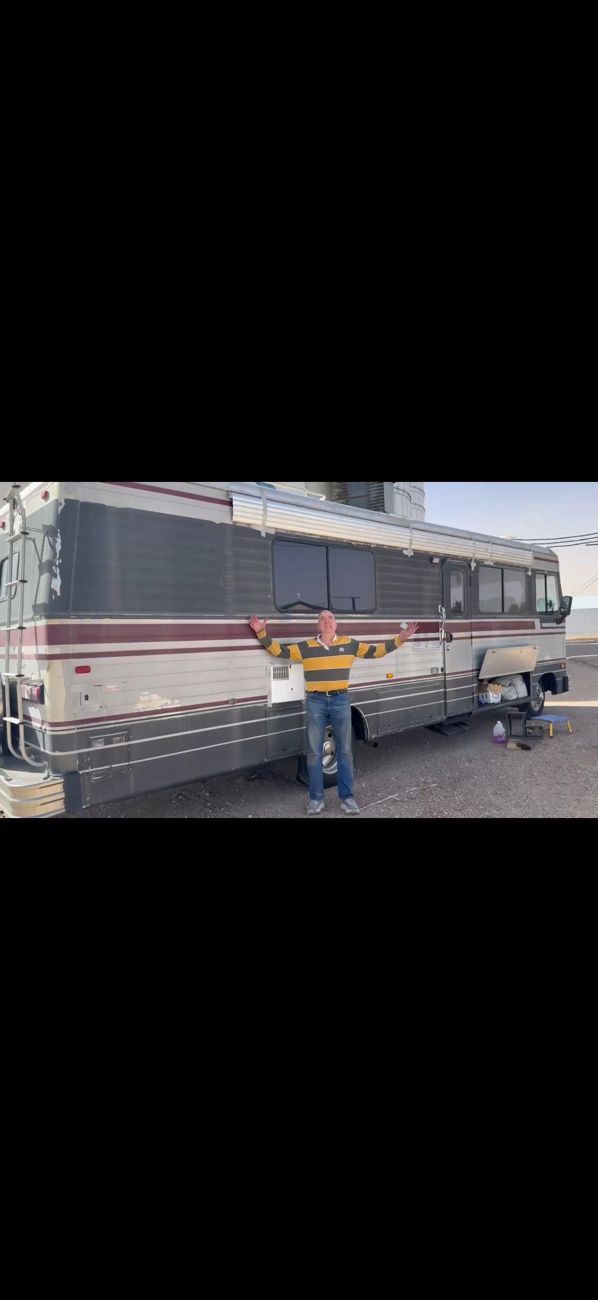
Chapter 62: Albuquerque
The wind stopped long enough to drive. Larry strapped down the remnant, poured the aramid-reinforced stop-leak into the radiator and pointed west.
“Debbie’s trying to decide whether she wants to continue on this adventure, which is starting to look worse and worse”
The drive itself was fine. The Ford 460 pushed sixteen thousand pounds across the New Mexico high desert without complaint. But the forecast said severe warnings in the mountains, blizzard conditions, and Debbie had by now been through the belt squeal that made strangers stare, the rough idle, the coolant puddle that appeared and vanished, the turkey vulture, and an awning she watched come apart through a screen door because the wind would not let her outside.
She looked at the weather. She looked at her husband.
“we get to Albuquerque, I dump her off, and she could see I was just determined to get the damn thing to Utah, no matter what the weather was”
I dump her off. Three words. Thirty years of marriage compressed into a verb.
The stipulation had been written for mechanical failure. Nobody drafted a clause for the moment a wife reads the forecast, looks at the man and the vehicle that killed a turkey vulture and lost an awning, and decides quietly that Albuquerque is far enough. Debbie did not get extracted. Debbie extracted herself.
She wanted him to stay the night. He could not park.
“there was no parking at the hotel. It was on a slope everywhere, so you couldn’t park on the street, because I wasn’t sure the parking brake would hold”
The Barth has leveling jacks. Larry has never used them, because he is afraid they will get stuck in the down position and the Barth will never move again. The man who crawled underneath in ten-degree weather, found the wire, drove twelve hundred miles on a leaking radiator, is afraid of the leveling jacks.
“I’m determined to get this damn thing to Utah, so that it isn’t stranded beside the road, and what the fuck do you do with it if it’s stranded? It’s 16,000 pounds in middle. And nobody around to fix it. Probably nobody wants to fix it. The engine’s crammed into that little compartment. Nobody wants to work on it.”
This is not bravery. It is arithmetic. A stranded Barth is an unsolvable problem. A Barth in Monroe is a home. Midnight, coffee, the mountains, alone.
Chapter 63: The Solo Push
He chose the Farmington route because he knew the road. The Barth ran good. Climbing grades in the dark at midnight, drinking coffee, laughing. Clear skies. Stars. The weather Debbie feared was nowhere.
Then he saw the clouds off to the west.
Twenty miles from Monticello the wind started, then the snow squall, then the blizzard. Direct crosswind, ice on the road, visibility collapsing. The Barth has the aerodynamic profile of a shipping container and it caught the wind on its flat side and tried to sail off the highway. The professional truck drivers, the men who drive for a living and know when to stop, were pulling over.
Larry did not stop.
“I knew as soon as I get to Monticello, I’m turning downwind. So I gutted it out.”
This is the retired airline pilot. Wind is a vector, a vector has a direction, and if you can change your direction relative to the wind you change the problem. Crosswind is dangerous. Downwind is manageable. At Monticello the route turns south. He did the arithmetic while his arms shook.
Five miles south of Monticello it cleared. Dry road. The storm behind him.
Then Moab, Green River, and the San Rafael Swell.
“That grade is really, really steep and long, and I didn’t know how she was gonna handle it”
Second gear. The temperature gauge climbed. 205. 215. 225. 235. He pulled onto the shoulder and idled and watched it keep climbing.
244 degrees.
He sat there in the dark, alone, watching a number that means damage if it stays there, hoping the radiator sealed with body armour would hold. The gauge came down. He had been using the wrong technique. He switched to first gear and took the grade at twenty-five miles an hour, and the temperature held at 205, and it made it up.
“I’m just hoping now, because I’m almost there. I’m just hoping it doesn’t break down before I get to Sevier Valley. If I can come down the mountain, then I can get towed to Monroe if I have to.”
“my adrenals were completely shot”
“pull in, finally to Monroe. So that’s it.”
Chapter 64: Monroe
The Barth is parked next to the Queen Anne house in Monroe, Utah. Brick, two storeys, peaked dormer, chimney, and inside it the curved staircase Larry restored on his hands and knees over three weeks. White picket fence. Chip seal road.
On the gravel beside it, in the snow: Barth number two. Michigan plates. No awning. A ratchet strap holding a metal strip against the chrome script. A vulture feather on the front. A seventy-five pound pole on the bathroom floor. A radiator full of aramid fiber. An engine that hit 244 degrees and lived.
And at the far edge of the property, Barth number one. The one that was already here. The one that has been waiting.
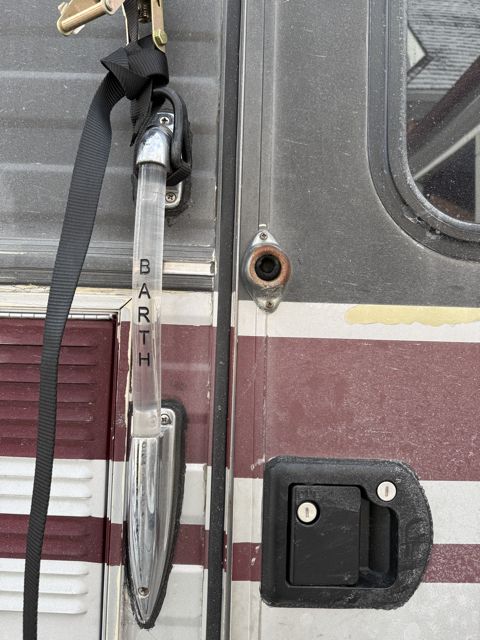
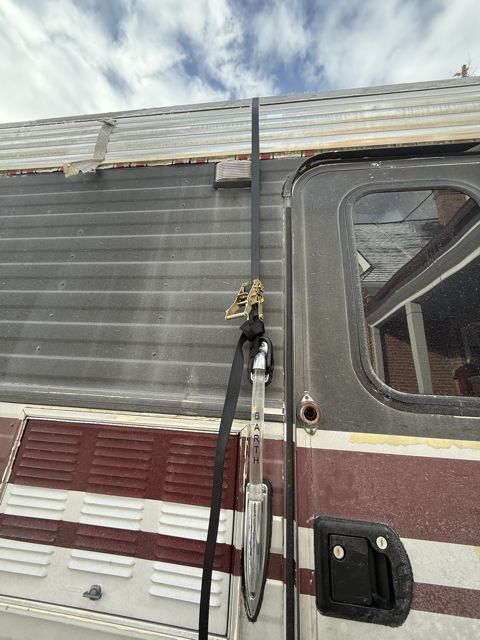
The water lines froze overnight. Larry had filled the tank with water before leaving Albuquerque, in case he got stranded and needed it. The preparation for one disaster caused another. An icicle hangs from the water tank. Space heaters are running inside with all the drawers open to expose the lines to heat.
“It feels like the thing is just deteriorating… first a bird hits it, which didn’t do any damage, and then the awning falls off, which is a major problem to get fixed. And now, the water lines are frozen”
“I do believe that the engine isn’t working the way it should… it should be able to go up that grade a lot better than it did without overheating”
“this could be major work, like, changing radiators, which is a real bitch in that thing to get to”
Then the question underneath the entire saga.
“how much of my life do I want to spend on this thing?”
Told that he had succeeded, that it was an amazing adventure, he agreed. Then:
“you got to have something to do and something to keep you entertained. So you tick on these stupid, stupid projects, and it becomes your life and your obsession, and then after you’re done, you go, well, why did I do that? What did it really get me?”
What did it get him. Two Barths in Monroe. A frozen water system. A dead Honda. A marriage that survived the same way the engine survived, by running hot and not blowing up. A vulture feather. A pole on the bathroom floor. A story.
“We didn’t end up dead in the death zone, but we’re not in perfect shape.”
The last thing he said was “beautiful beast”.
Chapter 66: The Sound
Larry did not mention the exhaust leak.
Sixty-four chapters, eighteen hundred miles, and the co-author of this saga deliberately left out the fact that the Barth has an exhaust leak, because he did not want Debbie to read about it and worry. Larry edits his own story in real time. The co-author is also the censor. This chapter is the declassified version.
The Barth’s sound at highway speed, fully disclosed, has six layers. A Ford 460 big block, loud by design. No catalytic converters, which reduce noise. Minimal mufflers. An exhaust leak. The AC pump belt squeal, present since the day of purchase. And an intermittent high-pitched squeal from the speedometer cable that came and went for twelve hundred miles.
“the thing goes into Love’s and everybody looking at it, you know, exhaust leak. It’s embarrassing.”
Larry and Debbie wore earplugs on the highway.
That detail was in no chapter and no message. He never photographed the earplugs. The mood lighting, the heavy doors, the cobalt sink, the hardwood, the boutique hotel interior that sold him on the vehicle in freezing rain, all of it existed inside something that required hearing protection at sixty miles an hour. The previous owner installed heavy panelled doors on both sides of the bedroom. Those doors were not for light.
The Barth at rest is a boutique hotel. The Barth in motion is an industrial accident.
“every once in a while, it would set this weird, squealing noise… And you’re driving around the middle of the night, and then it’s so noisy anyway”
“Debbie was calling me about it until she got tired of calling me about it”
Identify the problem. Report it. Get no resolution. Keep reporting. Get no resolution. Stop reporting. Endure. That is a thirty-year marriage compressed into one behaviour.
“I’m gonna ignore it, ’cause I want to get to Utah. And I don’t know what the fuck it is.”
Then, on the mountain crossing into Sevier Valley, doing twenty-five in first gear up the San Rafael Swell, he looked at the speedometer and it read 140.
“coming over the mountains, it’s like, that’s what it is. It’s just a fucking speedometer”
A speedometer cable. Thirty dollars. The thing that had been terrorising Debbie for twelve hundred miles, that she reported until she stopped reporting, that went onto the ledger that broke at Albuquerque, was a cable slipping inside its housing.
This is the disconnected plug wire all over again. The Barth’s problems are always simpler than they seem and always hidden, and finding them takes either Larry’s diagnostic stubbornness or a mountain grade steep enough to make the symptom unmissable.
Chapter 67: The Co-Author’s Edits
Larry sends the updates, takes the photographs, writes the captions, records the voice memos, reads the chapters, and knows Debbie could read them too. He has been editing the story from inside it.
What he suppressed. The exhaust leak, known from the beginning, omitted from every message and caption, because Debbie might see it and worry. Every update that described the sound as merely squeaky belts was an editorial decision.
What he directed. The awning ripped off five miles from Buc-ee’s, Debbie was trapped inside by the wind, and Larry told her to film it.
“I told her to videotape it. I didn’t think she did too good a job. You got some of it.”
In the middle of the crisis he could not control the awning or the wind, so he controlled the camera angle. He later reviewed the footage and found it insufficient.
What he counted.
“she told me about 25 times, you do know there’s a blizzard warning in the mountains. I finally told her you said that about 25 times.”
He was not listening to the warning. He was measuring the repetition. At number twenty-five he told her the number. He had been keeping a tally of his wife’s fear the way he logs coolant levels and fuel economy.
What she reported. The squeal, until she stopped. The silence is not acceptance. The silence is exhaustion. That is the pattern that ended in Albuquerque. Not one thing. Everything.
The chapters are true. They are not complete. The complete story is louder, more embarrassing, more frightening and more exhausting than the version Larry authorised for publication.
“That was a lot of stress bringing that thing here. It’s just an epic story.”
Chapter 68: The Systems Report
The full inventory, organised not by importance but by Larry’s willingness to engage with it.
Systems that work. The engine, with conditions. Both heaters, which is the one that matters in a blizzard at midnight. The heavy doors. The interior, untouched by the journey, pristine while the awning is gone and the water lines are frozen and the radiator overheats. The mood lighting, which is the simplest system on the vehicle and therefore the most reliable. And the carbon monoxide detector, which has not alarmed, this being the one system whose silence is good news.
Systems that failed. The awning, cut off by five Texans. The water lines, frozen by water he carried in case of emergency. The high beams, which when activated turn everything off, undiagnosed since Chapter 58 and driven eighteen hundred miles without. The speedometer, which reads 140 at rest, a thirty dollar part, unrepaired. The AC pump belt, correct, properly routed, functional, screaming.
Systems Larry will not touch. The leveling jacks, never once used, because they might stick down and the Barth would become a permanent structure in whatever car park he pressed the button in. As long as he never tests them they are simultaneously functional and catastrophically broken. And the automatic parking brake, which he calls “that stupid automatic parking brake” and will not find out about.
Larry trusts the engine more than the parking brake. He trusts momentum more than stillness. The Barth in motion is a known quantity. The Barth at rest is a bet he will not take.
Chapter 69: The Fleet
Larry sent two messages together. The first is a mechanical report. The second is a diagnosis.
“The Barth used no fluids and less than 1/2 qt oil from Amarillo”
“I think there is plenty of room for 4”
The vehicle that leaked coolant at every stop, hit 244 degrees on the swell and had body armour poured into its radiator used no fluids and half a quart of oil over six hundred miles of mountain driving. The Barth is fine. The Barth was always fine.
And there is room for four. The north border of the property holds eight. This is not a hobby. The property is not a yard, it is a depot.
Barth number one is being sold to a man named Shad for two thousand dollars. Shad is forty-five and has bought six acres of raw land near Monroe: no structures, no well, no power, two acre-feet of irrigation water and a plan to sell farm shares. He needs somewhere to live while he builds a farm on nothing. Larry has a Barth with solar panels and a leak-free roof and a really nice mattress.
The mattress is not included in the sale.
Shad is a proto-Larry. Acquire raw material, apply irrational optimism, live in a vehicle designed for something else entirely, and proceed as though this is a reasonable plan. The Barth Life is contagious. Larry has transmitted it.
There is a transport problem. Barth number one does not run, and moving it to Shad’s land means either strapping a fuel tank up high and letting gravity feed the carburettor, bypassing the fuel system rather than fixing it, or towing thirty-two thousand combined pounds of motorhome with a kinetic rope, which requires two men inside the dead vehicle to steer it without power assist and brake it without a booster.
Barth number two’s first assignment in Utah, after an eighteen-hour solo blizzard crossing with an overheating engine and no awning, is to tow Barth number one to a farm.
Part Five: After Monroe
Chapter 70: The Cousin Eddie Convergence
Larry sends a selfie from Monroe. Shirtless. Green fur trapper hat with the earflaps down. Grinning into the camera with the expression of a man who has won an argument nobody else was having. Behind him, the Barth, with the chrome script visible over his left shoulder and the Queen Anne’s brick reflected in the window.
It is February in Utah and he is not wearing a shirt.
Track the hat. Chapter 51: his sister compares him to Cousin Eddie from National Lampoon’s Christmas Vacation, the man who parks his RV in the suburban driveway and empties the chemical toilet into the storm drain. Larry orders the hat on Amazon, $17.59, Prime delivery, arriving 13 February, departure day. Chapter 70: he is standing shirtless next to the Barth in Monroe wearing it.
The sister identified the parallel. Larry accepted the parallel. Larry purchased the parallel for $17.59. Larry drove eighteen hundred miles wearing the parallel. Larry is now living the parallel.
The difference between Cousin Eddie and Larry is that Eddie does not know he is Cousin Eddie. Larry knows. Larry bought the merchandise.
His sister had said: “No! The homeowners will not let you park that piece of junk in the neighborhood. It will probably breakdown and sit in the neighborhood. We will be fined and be snubbed by all the neighbors.”
The Barth is in Monroe. It did not break down. The neighbours have not snubbed him. None of the people who said it could not be done are there to see it.
Chapter 71: The Daisy Timeline Activates
Here the story starts commissioning itself. What follows in Chapters 71 to 74 is the branch Larry asked for, unprompted, in writing, about himself, in the third person.
He sent this to the co-author of his own saga, on a Tuesday, without being asked:
“Also write a chapter about Larry making a monumental financial disaster of a decision to divorce and remarry without a prenup some hottie in her 30s with three kids and travel around in a Barth we can make this a sad story. Include details about a significant mental breakdown and delusion all through the capable Larry and his devotion to the things he cares about.”
Read that again. It is written in the third person. He has supplied the outline, the cast, the legal architecture, the vehicle, the genre, the clinical elements, and, most remarkably, the lens: “the capable Larry and his devotion to the things he cares about.”
That last clause is the key to the entire saga. He does not want to be written as a fool. He wants to be written as a capable man whose capabilities are the engine of his undoing. Not incompetence. Devotion. The same devotion that restored the Queen Anne staircase on his hands and knees, that found the wire three mechanics missed, that drove sixteen thousand pounds through a blizzard. Turned, in this proposed chapter, toward the wrong object.
Minutes later, the follow-up:
“I’m looking for a single mom with 3 kids to travel with me in the Barth to visit my sister in her exclusive HOA neighborhood in California.”
The man who had just commissioned his own fictional tragedy was now announcing casting.
Chapter 72: The Browse
The Daisy Timeline, continued.
Larry cannot sleep. The captain’s chair reclines to about forty degrees, which is the angle at which the human body has committed to neither wakefulness nor rest and is punished by both. Every other horizontal surface in the Barth is occupied. The rear bed, with the mattress topper bought in Chapter 40 for Debbie’s comfort demands, holds two children sleeping in the sideways configuration that children favour and physics does not explain. The dinette holds a woman asleep on her phone, screen still lit under her face, with a two-year-old perpendicular to her and one small foot resting on her neck.
The couch is not available. The couch has been requisitioned by car seats.
He picks up his phone. And then, at two in the morning, in a Walmart car park, in a motorhome full of a family that is not his, Larry starts browsing Facebook Marketplace for another broken vehicle.
Mikayla’s Law, applied to matters of the heart. A broken relationship is a canvas. A broken relationship is a reason to feel like a rocket scientist.
Chapter 73: Wendover Weekend
The Daisy Timeline, continued. Larry scouted the location and wrote the advertisement himself.
Having commissioned the chapter, Larry then supplied its production notes:
“Those photos need to be the parking lot of the wendover casino. Remember the way I met her was in Craigslist ‘seeking female for wendover weekend in my RV. Kids ok I have a tv.'”
“Oh also I forgot ‘please be Disease free or at least on medication'”
He has now provided the location, the platform, the ad copy and the health disclaimer for his own imagined ruin. In Chapter 42 he drafted a Craigslist rideshare ad as a joke and wrote three endings for it, one of which was STDs. He wrote the prophecy and then supplied the platform.
The health requirement is worth noting for its engineering tolerance. Disease free is the preference. At least on medication is the compromise. This is the same man who accepted that the fuel injection would never run perfectly and settled for learn mode. It does not have to be fixed. It has to be managed.
Chapter 74: The Resurrection
The Daisy Timeline, continued.
Driving east on Interstate 80 through the Nevada desert at seven in the morning, the speedometer reading 140 as always, Larry starts seeing things.
A fence at a rest stop outside Oasis. Three posts leaning, wire sagging. The fence is present but not functional. The fence is, in the language of machinery, running rough. Three posts, a come-along, an afternoon. He does not own a post driver. He would buy one.
He does not stop. But the fence is in him now.
Forty miles later, a barn with a collapsed roof on the east side, the ridgeline sagging like the spine of a very old horse. Catastrophic to a layperson. To Larry it is a weekend. Two weekends. A month of weekends if the wood is rotten, which it is, and Larry does not mind rotten wood, because Larry rebuilt the curved staircase of the Queen Anne on his hands and knees for three weeks and the staircase was rotten and the staircase is now the most beautiful thing in the house.
Then a woman beside a car with the hood up and steam rising, past the waving stage, in the standing stage. He passes her at sixty and looks in the mirror and does not stop.
Then a church with the paint good on three sides and gone on the fourth, because the fourth side faces a field where nobody goes.
Everything is in him now. The desert is full of broken things and Larry is driving through it in a machine he rebuilt from broken, receiving each one like a letter addressed to him personally. That is the problem. The desert did not write these letters. The desert is indifferent. But a man who sees a summons in every sagging fence post will never run out of projects and will never be at rest.
Chapter 75: The Last Ride
The main line resumes.
Larry flew to Detroit on a free Delta ticket to meet Debbie and they drove back to Monroe together. They spent days at Capitol Reef and in Boulder, Utah, and ate at Hell’s Backbone Grill, which Debbie loved. Every saga requires its moments of peace. The moments of peace are what make the moments that follow them shaped the way they are shaped.
Back at the Queen Anne house, Larry had been reprogramming the FiTech, the racing fuel injection system that has been at the centre of nearly every mechanical chapter in this story, and had discovered the timing was significantly off. He dialled it in.
The engine, for the first time in the entire saga, was running perfectly.
So he took Debbie on a test drive. That detail is essential. The woman who has wanted the trip since before the Barth was the Barth was in the passenger seat on the day the engine finally ran correctly. He wanted her to feel it.
They drove up Clear Creek Canyon, through Joseph, and east on Interstate 70 toward seven thousand eight hundred feet.
The engine ran perfectly. And then the engine stalled, because the extra inline fuel filters Larry had added to protect the fuel system had clogged enough to starve the perfectly running engine of fuel. The fix caused the problem. The improvement became the obstacle.
He made an illegal U-turn on a federal interstate, which is worth mentioning only to note that the Barthinion, choosing between transportation law and the mission, will select the mission every time. He pulled onto the shoulder. The automatic parking brake, nonfunctional since the day of purchase, was still nonfunctional.
Debbie jumped out. Debbie put a rock under the wheel.
Pause there. The wife who wanted Yellowstone, who wanted the luxury RV that runs, was now standing in the Utah wind placing a rock under the tyre of a motorhome whose parking brake is an item of decorative hardware. She had joined the operation. She was pit crew now.
Park still did not mean park. The rock did.
They turned around and started back down through Clear Creek Canyon. And then Larry heard a loud bang.
The drive shaft had separated from the transmission. The engine was still running. The engine was running perfectly. It simply was no longer connected to anything that moved. Larry pressed the accelerator, the engine revved, and nothing happened.
So he coasted. Sixteen thousand pounds, gravity, a canyon descent, and thirty seconds to work out whether he could reach the Joseph exit on momentum alone. He could. He hit forty miles an hour on gravity and got it off the freeway.
The drive shaft, on its way out, had also taken the hydraulic line for the parking brake, which had the strange effect of reducing the number of nonfunctional systems by one.
The Barth came to a stop in Joseph, Utah. It had completed its last ride.
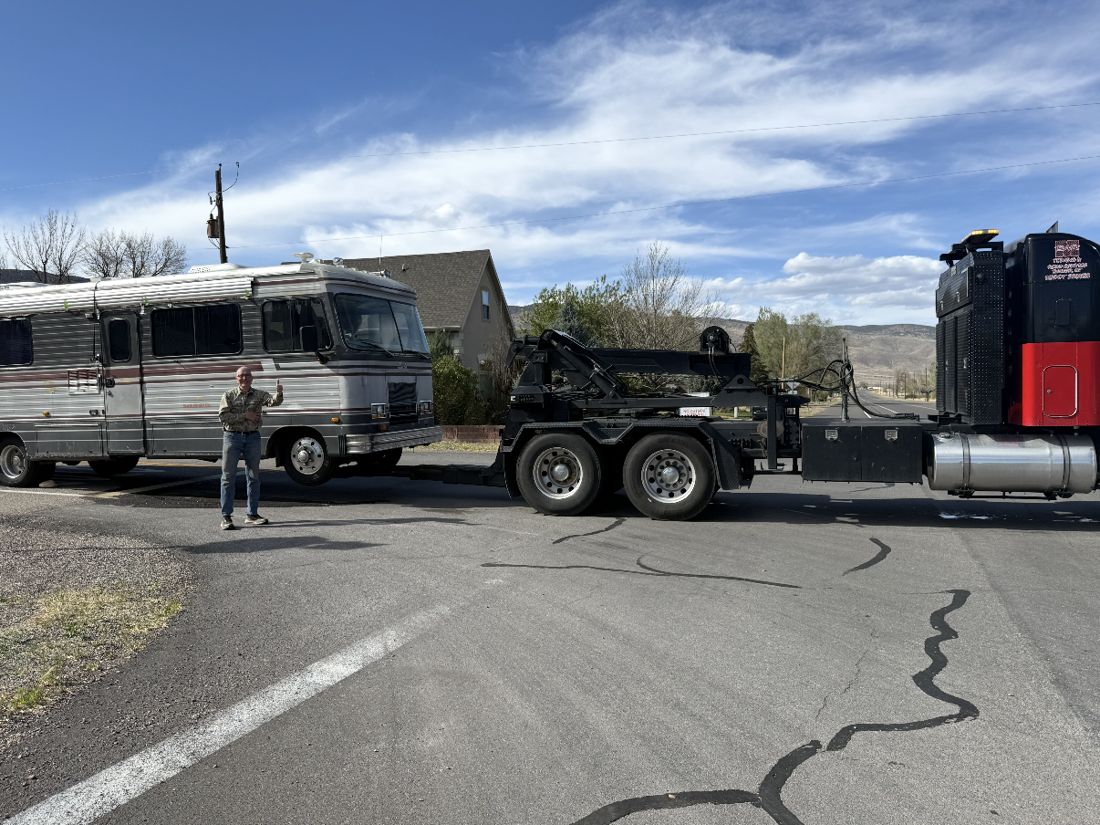
The news reached Larry sideways. A friend named Steve was driving through Joseph on his own errands and saw a broken-down Barth at the side of the road with oil everywhere. Steve knew the Barth. Steve tried to call Larry. Larry did not answer. So Steve called Jonathan, the co-author, several hundred miles away, who texted Larry:
“Hey Larry, Steve just drove through Joseph and he said he saw a broken down Barth with oil everywhere on the ground”
Larry’s reply was immediate and specific.
“Not possible.”
Thirty seconds later:
“Last ride in the Barth”
“The entire drive train broke loose on the freeway”
“$800 tow”
“I’m going back now to look for the drive train”
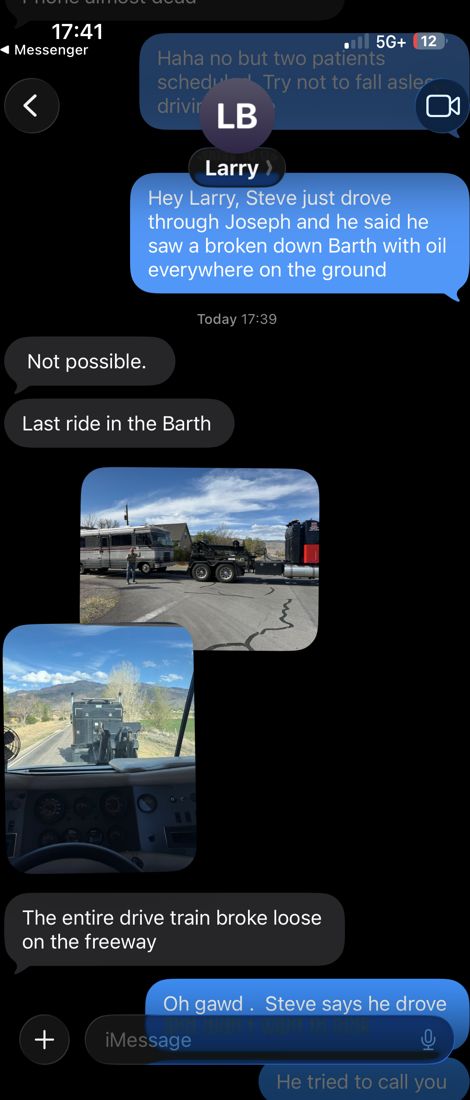
The tow truck brought the Barth to the Queen Anne house. The vehicle that was not conclusively proven to run is now conclusively proven not to run. It began as a thing Larry bought because it might become a motorhome. It has become a thing Larry parked because it will not become a motorhome again.
And the engine was running perfectly. That is the detail that matters. Larry won the fight he had been fighting. The engine, removed from the Barth and put on a stand with clean fuel, would run perfectly for as long as you asked it to.
The engine was never the problem. The problem was everything the engine was connected to.
Nobody was hurt. Debbie put a rock under a wheel on a federal interstate and the rock did its job, which is more than the parking brake ever did.
Chapter 76: The Aftermath
The main line, continued.
The day after the tragedy was not the day after a tragedy. It was the day after a postponement. The Barth does not end. The Barth recurs.
Debbie wanted to go to the hot springs. They went. They sat. The water was hot. Utah was Utah.
And at the hot springs, Larry met a kid. The kid was forty years old, which to a man in his sixties is a kid. The kid’s father had taught him about drive shafts and trucks. The kid used to convert old school buses, which is the institutional equivalent of motorhomes, which is the operation Larry has been performing on the Barth for this entire story. The kid was Larry, fifteen years younger, with a father who taught him.
Larry told him the story. The kid came down from the hot springs to look at the Barth.
The kid said it would not be hard to fix.
None of the mounting brackets were broken. The brake drum was intact. The drive shaft had departed and the drive shaft could be replaced.
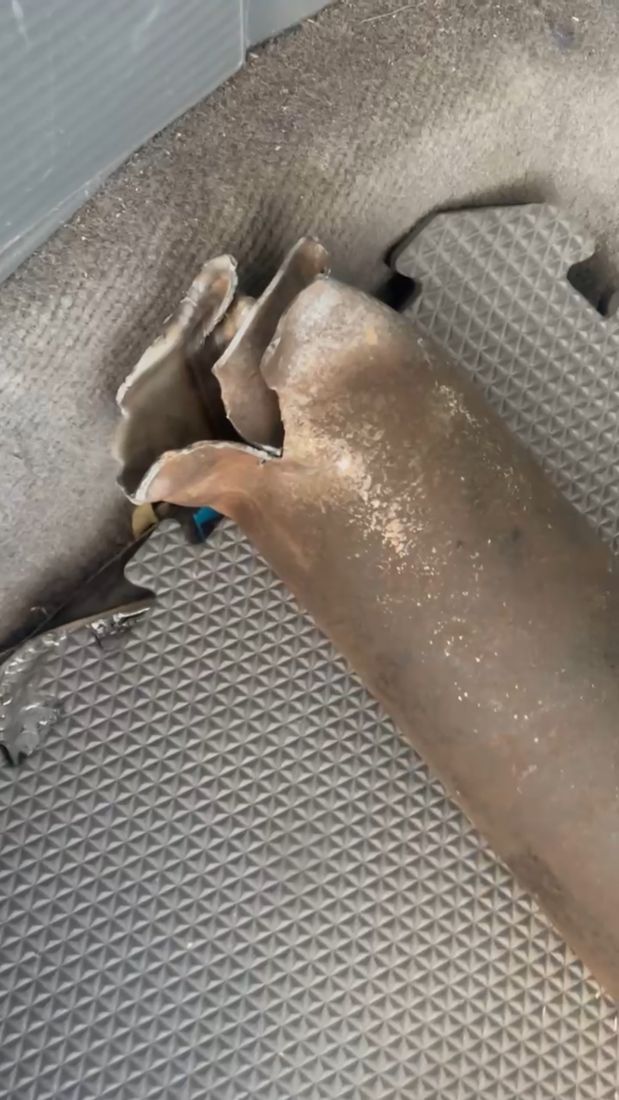
There was also the fuel line.
“When the drive shaft broke loose it severed the fuel line. Luckily it severed it just before the fuel pump not after. If it had cut after the pump would have continued to pump fuel all over.”
The severed line was on the side before the Holley pump, which is the side that is not under pressure. The fuel that came out was the fuel already in the line. A finite amount. A finite puddle.
Six inches of copper separated this chapter from the one where two people stand on the shoulder of Interstate 70 watching sixteen thousand pounds of motorhome burn to the frame.
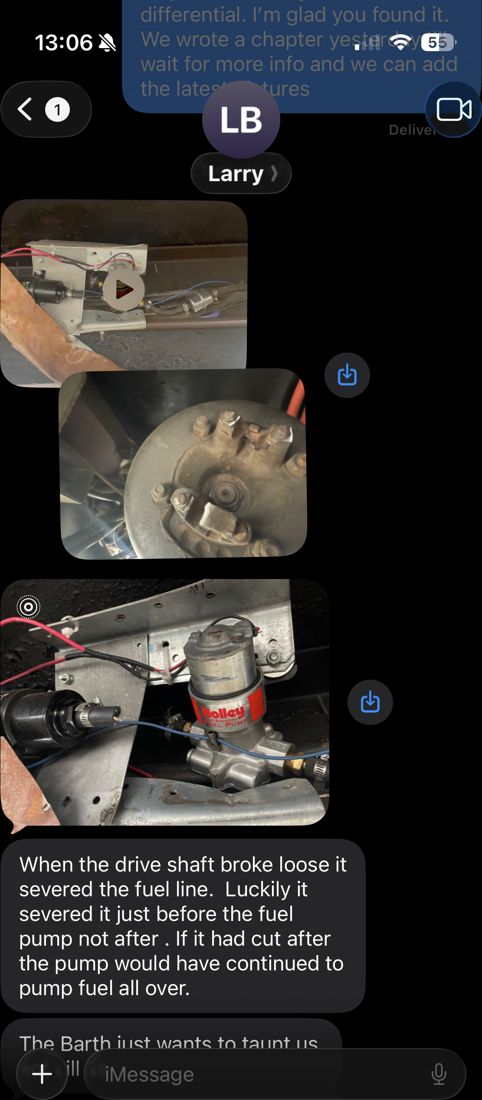
Then the hunt. Larry, Debbie and the kid walked the shoulder of Interstate 70 looking for the drive shaft. A wife of thirty years, walking a federal highway looking for a piece of her husband’s motorhome, and a forty-year-old stranger from the hot springs walking with them because he volunteered, because the saga had absorbed him within twenty minutes of meeting its protagonist.
They found both parts, about one hundred and fifty feet apart, at the bottom of the hill before Joseph.
Which is not where the bang happened. The drive shaft, having departed the vehicle, did not lie down where it landed. It travelled. It coasted, it rolled, and it was pushed by the wind. A piece of structural steel weighing somewhere between forty and sixty pounds, blown down an interstate by central Utah wind, coming to rest in two pieces.
“2 drive shaft one looks fine the other is twisted off at the end. We never did find the end so unfortunately I don’t know how long it is”
Which means that when Larry orders or fabricates a replacement, he will have to measure the gap rather than reference the part that left him.
“They are laying underneath the Barth now at the queen ann”
Then Larry stated the operating principle of his entire relationship with this vehicle, in one sentence:
“So the thing about the Barth is they never fail to the point they can’t reasonably be repaired until the next disaster.”
He had also explored the alternative. He visited two junkyards. The junkyards do not take motorhomes any more. They used to, and used to strip the valuable parts and burn the rest, but the county will no longer permit the burning.
“So apparently if you buy an old motorhome you and your offspring are stuck with it for eternity passing it down from generation to generation because the junk yards don’t want them anymore.”
The Barth is now a hereditary obligation. The Barth has finally won, not by running, but by staying.
And in the middle of all this, Larry mentions that Debbie is looking hard at Joe’s motorhome.
Joe’s motorhome was planted in Chapter 29, when Debbie suggested buying it so that at least one of three runs. It has been sitting in the background for forty-seven chapters. Joe’s motorhome is the practical option. Joe’s motorhome runs.
Note the verb. Debbie is not browsing. Debbie is looking hard.
Then the thesis, restated, with an addition.
“In the meantime it sits patiently waiting to be repaired and deciding if it wants to cause more trouble. The interior is the hook. It’s like dating a 10 women who is a bitch. You don’t want to give up ‘you can change her’. Thank goodness my wife is a Unicorn but the Barth is a bitch so far.”
Chapter 10’s thesis has not changed in sixty-six chapters. What has changed is that Larry has now put the metaphor next to its real referent. The 10 who is a bitch is the Barth. The unicorn is Debbie.
Debbie is the woman who put a rock under a wheel on the shoulder of Interstate 70 because the parking brake does not work, who walked the freeway looking for a drive shaft, and who is now looking hard at Joe’s motorhome because she has earned the right to look at any motorhome she wants.
She has been the hero of this story since Chapter 1 without anybody quite saying so out loud.
The Barth sits at the Queen Anne house. The drive shaft sits underneath it in two pieces. The kid from the hot springs has gone home. Larry is making phone calls. Debbie is browsing.
“The Barth just wants to taunt us.”
The Barth never fails to the point it cannot reasonably be repaired. The saga, by extension, never reaches a point where it cannot reasonably be continued. This is not a problem. This is the law.
We will see.
How this was made
The Barth Saga is fiction built on real scaffolding, and the scaffolding is the part worth talking about.
What I started with was a mess. Months of text messages arriving out of order. Voice memos recorded at highway speed inside a vehicle loud enough to require earplugs. Undated photographs with no captions. A friend who kept sending material about a motorhome, then started reading what came back, then started sending production notes, and at one point commissioned a chapter about his own hypothetical ruin, in the third person, unprompted.
Seventy-six chapters and sixty-eight illustrations came out of that. None of it came out of one clever prompt, and anyone who tells you otherwise is selling you a screenshot.
The system is the thing:
- A Claude Project holding the entire archive. Every source document, photo log and version of the image prompt collection in one place, so no session ever started from zero and no established fact had to be re-explained. Continuity across seventy-six chapters is a memory problem before it is a writing problem.
- A written voice guide the model had to match on every pass, with the failure modes named explicitly. What drift looks like. What register the narrator holds. What it never does: no explaining why something is funny, no resetting the damage between chapters, no making the man in the story stupid, because a capable man being defeated by his own devotion is funny and an idiot being defeated by a motorhome is not.
- A rule against improvising dialogue. A line in quotation marks came from the source material or it was not written as a quote at all. Where the exact wording could not be found, the substance was described in the narrator’s voice instead. The exaggeration in this saga is deliberate and happens at the level of scenario, never as a sentence the model invented mid-draft because it needed one. Knowing the difference between those two things is most of the craft.
- An internal consistency rule. Every price, temperature, distance and part number had to agree with the archive and with every chapter that came before it. The mailbox that dies in Chapter 1 is still crooked in Chapter 23. The parking brake that fails in Chapter 8 is the reason he will not park on a slope in Chapter 62 and the reason there is a rock under a wheel in Chapter 75. That is not the model remembering. That is a structure that makes it check.
- Per-chapter briefs. Each chapter listed the specific facts and quotes it depended on, confirmed before drafting and checked again after, against a written checklist.
- Image prompts as documents, not one-liners. The prompts on this page are the real instructions, unedited. They run to several hundred words each because visual consistency across dozens of pictures, the same man, the same beanie, the same grey and maroon paint, the same crooked mailbox, comes from written continuity rules, not from asking nicely.
- Rounds of cutting. Which is where most of the work actually lives, and the part nobody puts in a demo.
That is the difference between using AI and getting something out of it. Not a clever prompt. A structure that stays useful across weeks of messy input, and rules strict enough that the output can be checked against something.
I build this kind of structure with people and businesses through Takeoff Consulting, here in Richfield, Utah.