The Plumbing Saga · Chapter 77.6
Chapter 77.6: The Hole, the Food, the Sulfuric Acid, the Smell, and the Muck
Written by Jonathan Leusden with Claude
Or, An Inventory of Losses, as Submitted by the Survivor
The Barth Saga is a work of fiction and exaggerated humor. It began with a real motorhome, and almost everything after that is exaggerated or invented. Nobody here should be read as a portrait of a real person, and nothing in quotation marks should be read as a transcript.
The Submission
On Wednesday morning, a little after eight, Larry filed the next chapter himself.
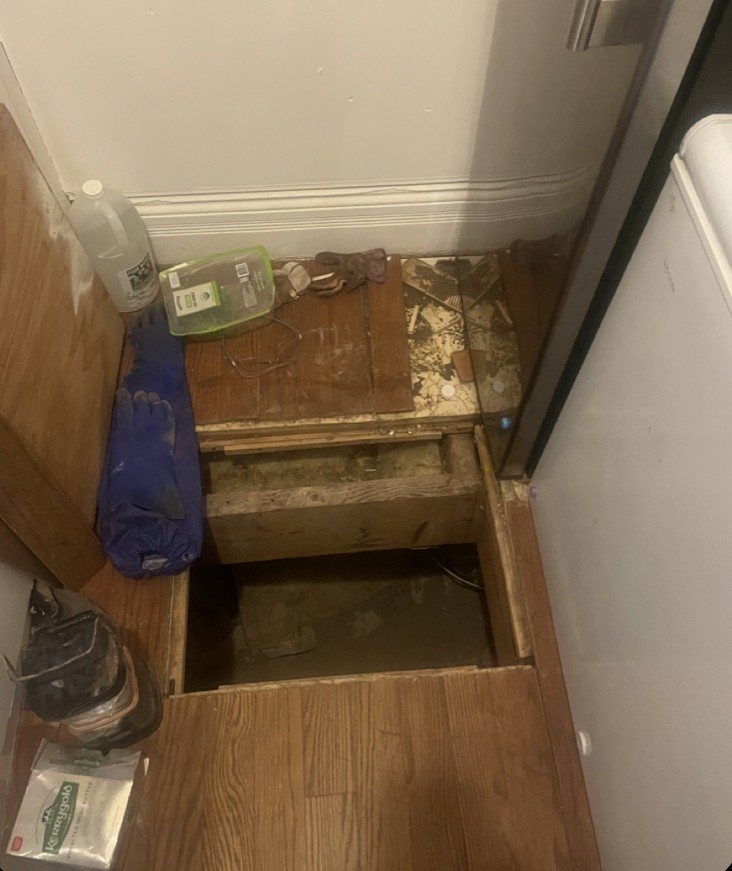
It arrived as a link titled “Barth saga: Chapter 77.5 – The muck.” The number was already taken. The record has assigned 77.6, and the muck has been informed. A cover note followed: “You can throw this in your template if you want.” Then a photograph. Then a caption of two words, the second wrapped in quotation marks of its own: The “ hole ”.
He put the word hole in quotation marks, the way a man does when the word has turned out to be too small for the thing.
His manuscript was titled “The Hole, the Food, the Sulfuric Acid, the Smell, and the Muck.” It is a list of five items. It is not a complete list. It leaves out the sink, the drain pipe, the fitting, the Sawzall, the flashlights, and the clothes, all of which are covered below. Where Larry’s words appear, they are his.
The Dream
“It began, as all great tragedies do,” Larry wrote, “with a clogged pipe and a dream.”
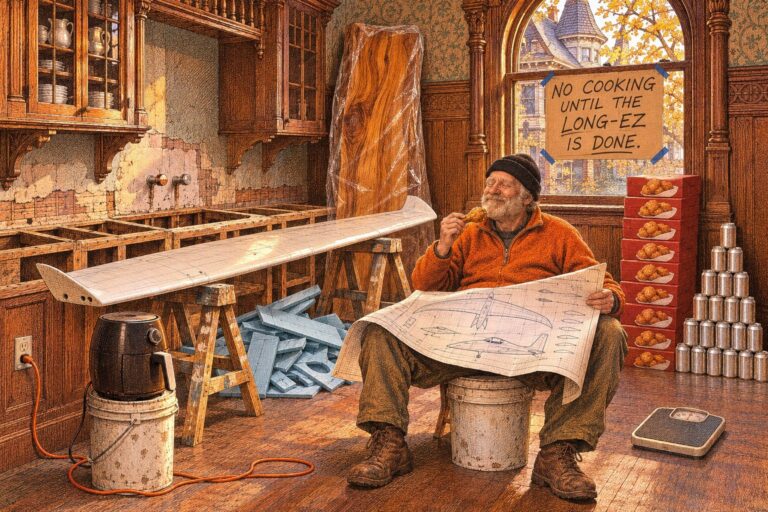
The dream was the kitchen. Acacia wood wood countertops. New faucets. A sink that drains. The clogged pipe was only ever the excuse, the permission slip a man writes himself before he opens a floor. “But bad decisions made with good intentions have a way of compounding,” he wrote, “like interest on a loan from a very patient and very cruel bank.”
The bank has begun collecting. The kitchen remodel is now, in his words, “a distant, shimmering hope.” The clogged pipe has been promoted to a full drain line replacement. The project did not grow. It was eaten by its own first step.
The Sink
Step one was to remove the sink.
The sink was cast iron. Cast iron kitchen sinks routinely weigh more than a hundred pounds. They were made in an era when a sink was expected to outlast the family, and they usually did.
It slipped. It dropped through the opening it had sat in for decades, and on its way down it snapped the drain pipe. The sink had waited its whole life to leave the kitchen. When the chance came, it took the plumbing with it.
Larry wrestled it out, removed the broken pipe, and by his own report congratulated himself on the progress. It was the last congratulation of the chapter.
The Acid
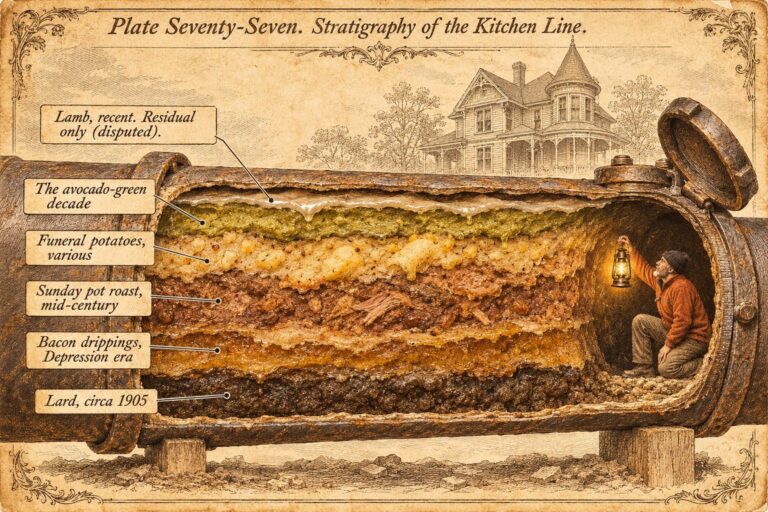
The clog sat fifteen feet down the line, past the cleanout. The cleanout had been cut in Chapter Seventy-Seven so that a man could see what the pipe was keeping from him. The pipe had been keeping fifteen more feet of it.
He reached for sulfuric acid, “as any reasonable man would.”
Chapter Seventy-Seven introduced a white bottle with a red label and a skull and crossbones, sold sealed in its own plastic bag, and described it as bringing death to everything in the pipe. Whether this was that bottle, the record does not know. If it was, the description was half right.
The acid went down and sat on the clog. “It did nothing to the clog,” he wrote. “Nothing!” It is the only exclamation point in his manuscript, and he spent it here.
A clog that has spent a century curing in the dark does not dissolve on request. The acid, finding the clog closed for business, looked around for something that would cooperate. It found the ninety-degree fitting under the house and went straight through it.
“The one thing it was supposed to leave alone,” he wrote, “was the one thing it destroyed.”
The score after the acid: clog, undefeated. Plumbing, one fitting down. Sulfuric acid, at large in the crawl space.
The Hole
Undaunted, Larry bought new pipe and went in.
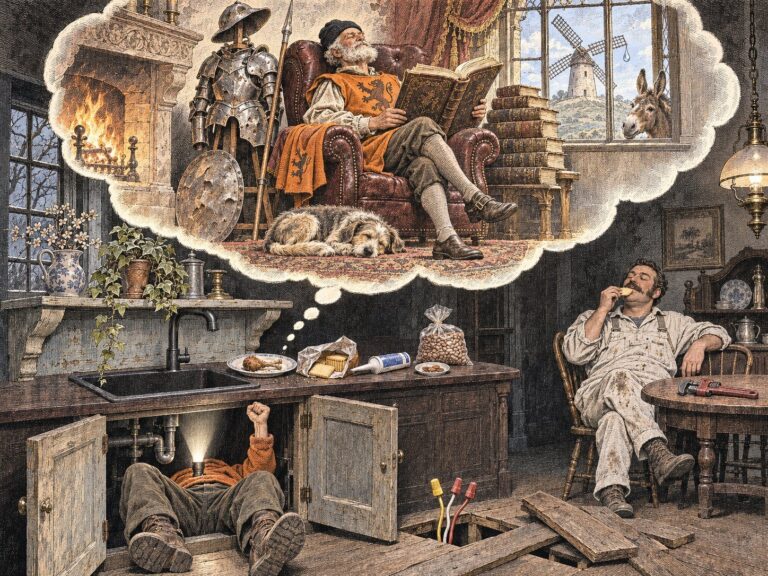
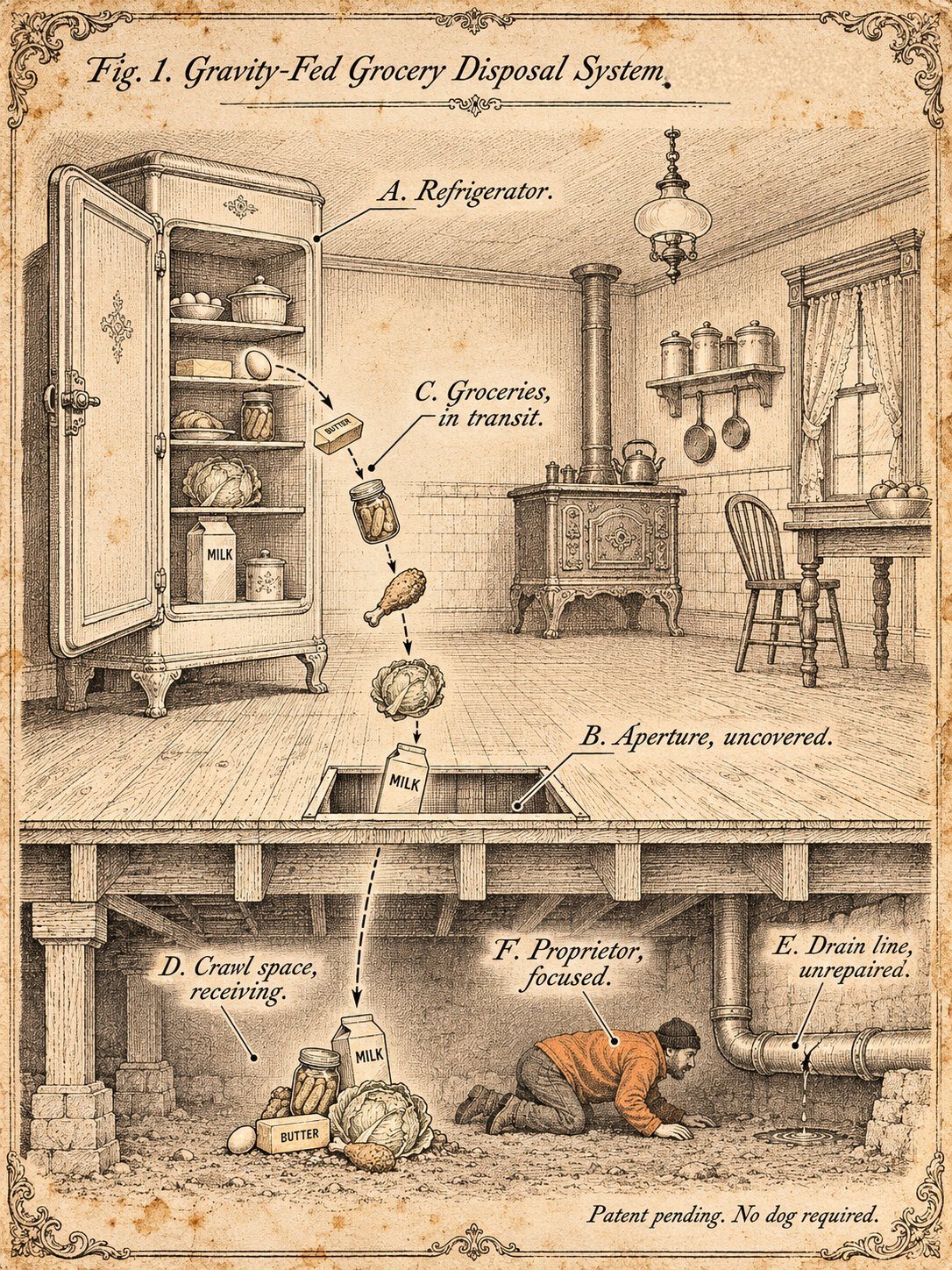
The way in was a hole cut through the kitchen floor. The hole sits directly beneath the refrigerator. He was, by his own account, “far too focused” to cover it when he wasn’t using it. So whenever the refrigerator door opened, food fell into the crawl space.
He did not go down after it. He was busy “getting the job done,” a phrase he now says, in his words, “the way other men say their last words.”
Consider the menu. In Chapter Seventy-Seven and a Half, Larry pledged to eat only Banquet chicken until the project was done. The crawl space made no such pledge. It now receives whatever leaves the refrigerator, unsorted, at random intervals, delivered by gravity. The crawl space is eating a more varied diet than Larry.
It is also doing the job of the dog. For a hundred years the households of rural Utah ran a two-stage system: first the plate, then the dog. Larry, lacking a dog, has installed a hole. The hole accepts everything. The hole does not lick the plate. The hole does not come when called.
The Cut
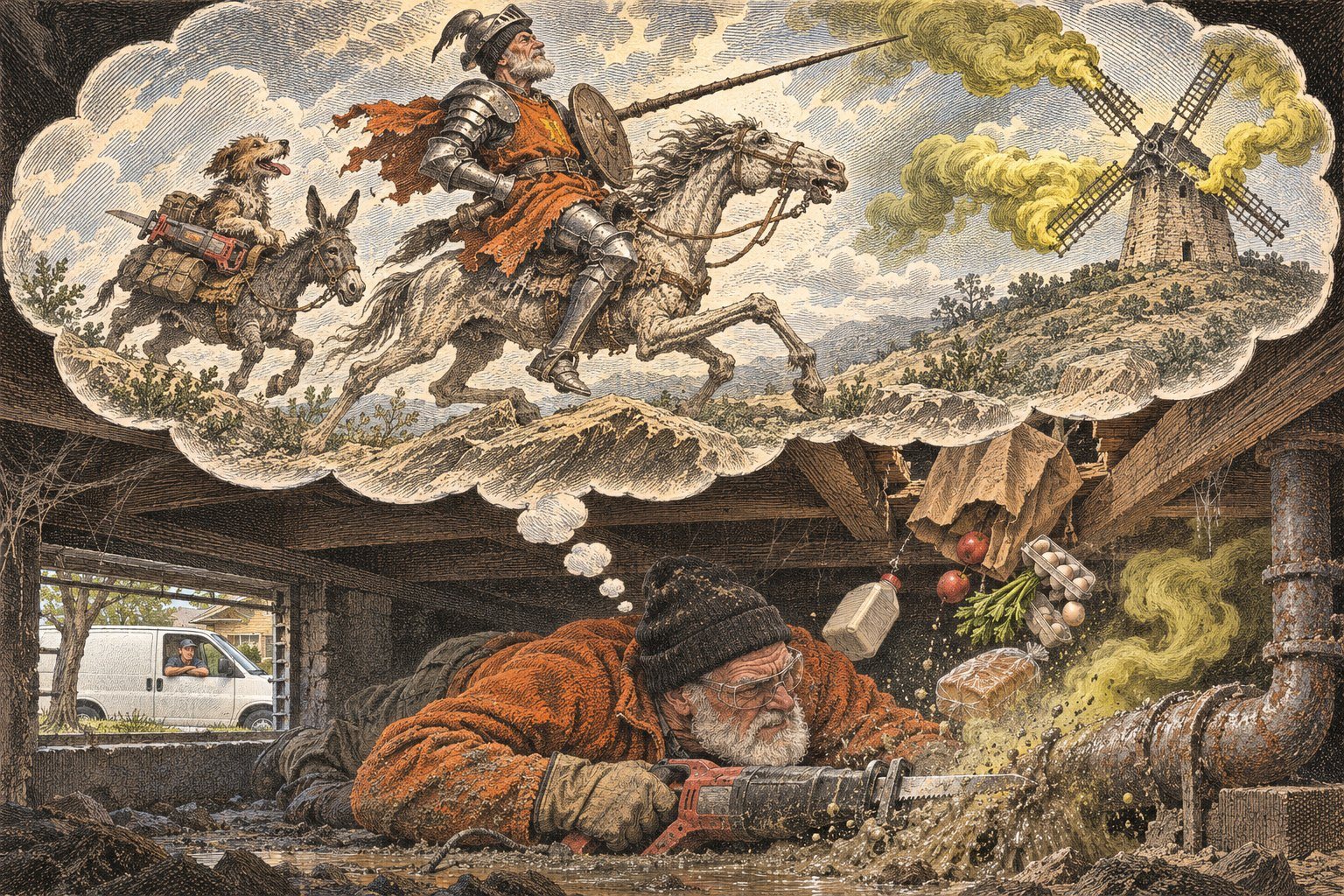
He crawled to the pipe on hands and belly, saw in hand, and began to cut.
“The pipe cut back.”
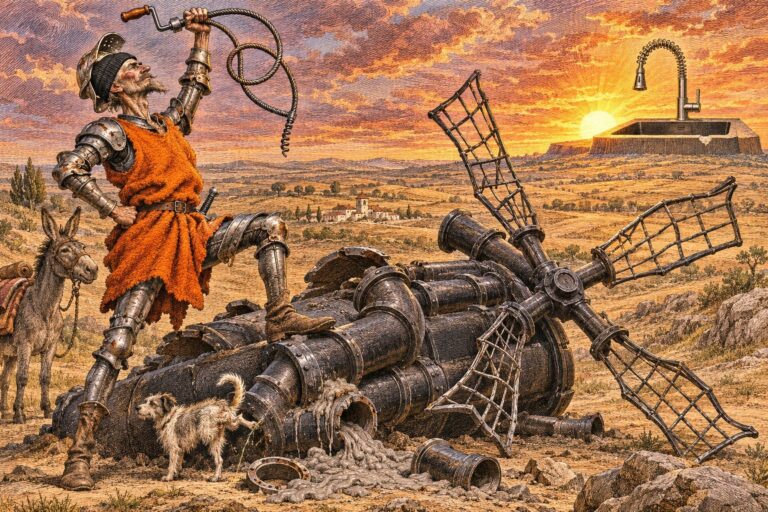
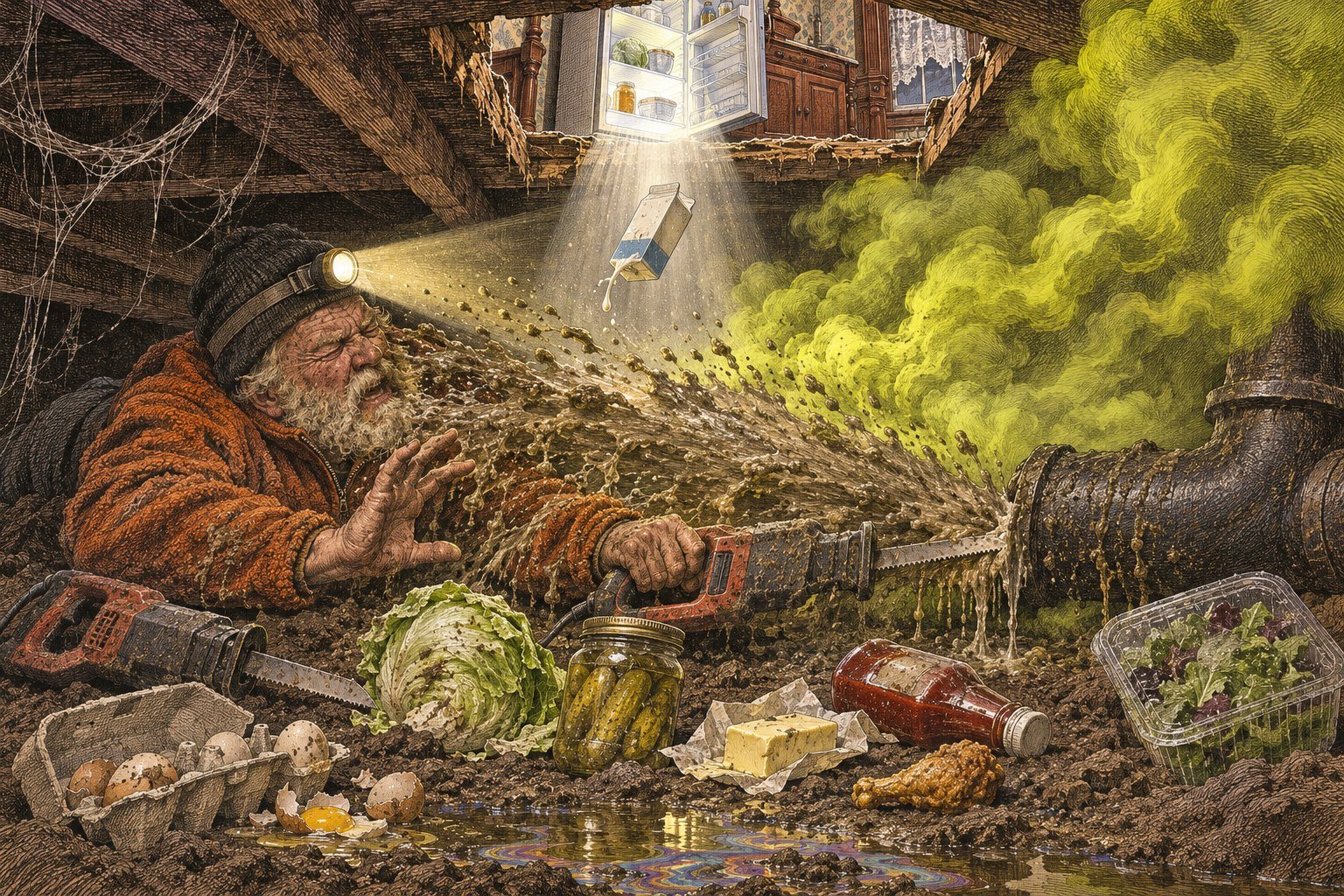
The blade opened the line and the line answered. Putrid muck and sulfuric acid came out together, the clog and the cure in a single discharge, and the fumes reached him all at once. He wrote that they hit him “like a freight train.” A freight train in a crawl space has nowhere to go but into the man.
He abandoned the saws mid-cut. The manuscript says saws, plural. How many saws were in the crawl space has not been established, only that all of them stayed there.
He scrambled up and out through the hole, past the refrigerator, and gasped “like a man surfacing from the deep, which, in a sense, I was.”
The Chemistry
Then he went “to war with chemistry.” He poured water and baking soda down the pipe.
A base meeting an acid makes salt, water, and carbon dioxide. In a hundred-year-old drain line it makes a performance. “It fizzed,” he wrote. “It bubbled. It fumed.” The kitchen had now hosted the same experiment as every eighth-grade science fair in America, at full scale, under the floor, with a century of grease standing in for the volcano.
He waited “until the last wisp of rebellion subsided” and went back down to survey the battlefield.
The Inventory
The Sawzall was dead. It had been bathed in sulfuric acid, and in Larry’s words, “no amount of eulogy would bring it back.” Every tool, every flashlight, and every stitch of his clothing wore what he called “a glossy coat of putrid pipe sludge.”
The record has compiled the losses.
| Item | Disposition |
|---|---|
| One cast iron sink | Removed, by gravity |
| One drain pipe | Snapped, by the sink |
| One ninety-degree fitting | Eaten, by the acid |
| One Sawzall | Bathed in acid. Deceased |
| Additional saws, number unknown | Abandoned mid-cut |
| Every flashlight | Glazed |
| Every stitch of clothing | Glazed |
| At least a few days’ worth of groceries | To the hole |
| One kitchen remodel | Deferred to shimmering |
| The clog | Not reported defeated |
Gains for the period: one hole.
The Resolve
“So tonight I stand, stinking and humbled,” Larry wrote, “a man who has lost a sink, a fitting, a Sawzall, and at least a few days’ worth of groceries to the void beneath his refrigerator.”
In Chapter Seventy-Seven his hands smelled of fermentation, and he hoped it would challenge his immune system. The immune system has since been introduced to sulfuric acid. If the exposure is a vaccine, Larry is now boosted.
The Barth tested Larry to see if he was worthy. The house is not testing. The house is collecting.
“Tomorrow, I buy another Sawzall.”
“And I go back down.”
Larry still needs a dog.

More: All chapters of The Plumbing Saga · The Barth Saga · Claude Comedy by Jonathan Leusden