The Desmond Saga · Chapter 1
Chapter 1: One Man Learns He Is the Municipality
Written by Jonathan Leusden with Claude
In Which the Nature of Municipal Responsibility Is Clarified, and One Man Learns That He Is the Municipality
Being a True and Faithful Account of Salt Lake City Municipal Code, Title Fourteen, Page Two Hundred and Twelve, and Its Effect on a Man Who Has Been to Cambodia
The Desmond Saga is a work of fiction and exaggerated humor. Names, businesses, places and events have been changed or invented, and the municipal ordinance in this story is invented.
There is a category of civic obligation so remote in its assignment, so thoroughly buried in the administrative documentation of the city that issues it, that the person who bears it carries it in complete and unwitnessed solitude, attended by a public that has never for a moment considered the question of who performs the task, because the question has never required asking. The mail arrives. The streetlights come on. The pothole on Third South gets filled, eventually. The dog waste receptacle on West Temple, powder-coated dark green, mounted on a steel post at the property line, its hinged lid worn smooth by four thousand separate deposits, is emptied once per week by Desmond.
Nobody on the block knows this.
Desmond was forty-five years old. He had grown up in the Avenues, which is the neighborhood above the downtown on the east bench where the streets are lettered rather than named and the houses have the particular character of structures built before anyone knew how large the city would eventually decide to become. The Avenues produced in its children a specific form of confidence, which was the confidence of people who believe Salt Lake City is, or shortly will be, a city of genuine consequence, and who spend their adult lives constructing evidence in support of this belief.
Desmond had two rental properties on the east bench, both of which generated sufficient income to remind him, regularly, that they had once generated more. He taught third grade at an elementary school in the district, a job that required him to be simultaneously the most patient and the most assertive person in any room he entered, which is a combination that most professions do not ask for and most people cannot sustain, and which paid him in ways that were legible primarily on the last day of the school year, when his students left. He had opened a coffee shop on West Temple, which occupied a narrow space in a corridor of the downtown that had been, within living memory, a dry cleaner, a bouldering gym, a plant nursery, and an office suite for a company whose business model had never been fully explained to its neighbors. The sign above the door read WHEELER COFFEE. The shop served its neighborhood at a level of quality that exceeded, in most measurable ways, what the margins of operating a coffee shop on West Temple could be expected to support.
He had been to Cambodia.
He had stood, specifically, in the central doorway of Angkor Wat at approximately a quarter to five in the afternoon in late October, with the light from the west doing something to the stone that no photograph he had seen had prepared him for, and he had understood, for the duration of perhaps forty seconds, the full dimensions of a human life, before the tour group from the adjacent path arrived and the moment ended.
◆
The City required a dog waste receptacle on the sidewalk adjacent to Wheeler Coffee. Salt Lake City Municipal Code, Title Fourteen, governing commercial frontage in designated pedestrian zones, specified the requirement with the thoroughness of a document that had been revised several times in response to incidents the code did not describe. The receptacle was to be maintained, stocked with bags from the integrated dispenser, and emptied at intervals sufficient to prevent overflow. The maintenance and emptying were the responsibility of the commercial property owner. This was specified clearly. It was specified in a document of several hundred pages. It was specified on page two hundred and twelve.
The block, in the years since Desmond opened Wheeler Coffee, had undergone a demographic shift of the kind that does not announce itself in advance but becomes visible in retrospect. A generation of residents had arrived in the surrounding buildings, in the new mid-rises and the renovated four-plexes and the units that had converted from short-term rentals when the regulatory climate shifted, and this generation had organized its domestic life around priorities that differed, in one specific respect, from the generation that preceded it. They had dogs. Not incidentally. Not additionally. They had dogs in the way that an earlier cohort of residents in those same buildings had children: as the primary project, the central relationship, the organizational anchor of the household calendar. There were, within a two-block radius of Wheeler Coffee, more dogs than there had been children in those same buildings three years prior. The math of this was not theoretical. It was arriving at the receptacle every day.
◆
He emptied it on Tuesdays. He wore nitrile gloves, size large, purchased in bulk from a restaurant supply distributor on Redwood Road. He opened the hinged lid. He reached in. He removed each bag individually, because the bags maintained their individual character and did not compress into a manageable collective unit, and therefore required individual handling, one by one, transferred into a contractor-grade forty-two-gallon garbage liner, which he then sealed and carried through the building to the commercial dumpster in the alley behind the shop.
The task was not uniform across seasons.
In January and February, when the temperature in Salt Lake City dropped below freezing for days or weeks at a time, the contents of the receptacle achieved a state that was, in its own way, manageable. The individual deposits, sealed in their plastic bags, froze into discrete solid units with predictable structural integrity. They could be grasped. They held together. They did not surprise. The nitrile gloves were cold and the work was unpleasant and the contractor liner crinkled in the January air and the whole enterprise was a misery of a particular temperature, but it was a misery with boundaries. Desmond had identified, after his first winter with the receptacle, that the relevant variable was not warmth but predictability. In winter, the contents of the receptacle had the dignity of a thing that had committed to a particular state and remained there.
July was a different category of problem.
Salt Lake City in July reached, by early afternoon, temperatures of eighty-five to ninety-five degrees Fahrenheit in direct sun. The receptacle was dark green powder-coated steel. It sat in full exposure on a south-facing sidewalk. By ten in the morning it was too hot to touch with an ungloved hand. By early afternoon its interior, sealed by the hinged lid and absorbing direct Utah sun through metal walls, had reached temperatures that Desmond had eventually stopped estimating because the estimates were not useful. What was useful was the following operational knowledge, acquired through direct experience: the lid was to be opened at arm’s length. The first breath after opening was to be taken facing away and upward. The work was to be completed without unnecessary delay and with the specific mental discipline of a person who has decided, in advance, that the next four minutes will occur regardless of how he feels about them. This decision was to be made before the lid was opened, not after, because after the lid was opened the decision became significantly harder to sustain.
◆
He had gagged at the receptacle since the first summer. He had attempted to identify the threshold, which was approximately the third or fourth bag. He had attempted to adjust the threshold through various methods, including breath-holding, which was effective but finite, and distraction, which was not effective. He had eventually accepted the gag as a feature of the task in the way that a person accepts the recurring terms of a contract that cannot be renegotiated: not with enthusiasm, but with the steady recognition that the terms are known, and will be the same next week, and will be the same the week after.
On a Tuesday morning in July, having opened the lid at arm’s length and confirmed, by the heat shimmer rising from the open cylinder, that the interior had been conducting its biological work for several days in conditions approximating one hundred and fifteen degrees, Desmond was withdrawing the fourth bag when the third bag, which he had set on the sidewalk while managing the contractor liner, demonstrated a failure at its sealed corner. The failure was expressed as a seam separation of approximately a quarter inch, which in July was sufficient. The liquid tracked along the concrete joint at the base of the post and moved outward toward the curb with the quiet purposefulness of water finding its gradient.
Desmond registered the failure. He completed the extraction of the fourth bag. He added it to the contractor liner. He sealed the liner. He retrieved the third bag from the sidewalk with a second gloved hand at maximum arm extension and considered, briefly, whether the existing liner could be reopened to receive it or whether a second liner was indicated. He opened a second liner.
A woman with a cream-colored Goldendoodle had stopped approximately forty feet up the sidewalk. Her attention was on her phone. The Goldendoodle was oriented toward the receptacle with focused and earnest interest, and the retractable leash was at full extension, pulling backward against her grip, because the dog had received information from the current atmospheric conditions that the woman had not received and was not in a position to receive, because she was looking at her phone. The Goldendoodle was investigating. The Goldendoodle intended to continue investigating. The woman had not looked up.
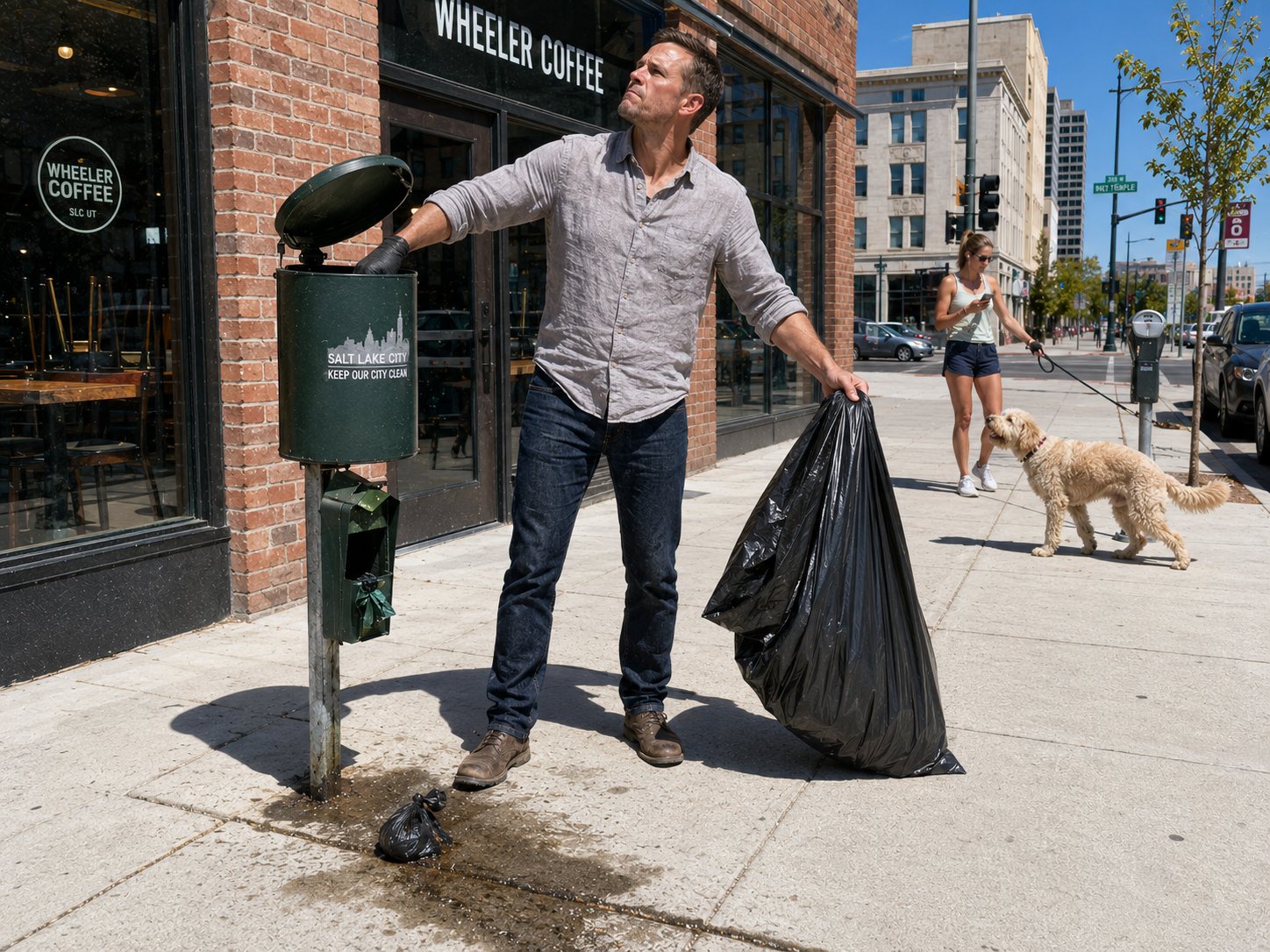
Desmond picked up both liners. He carried them through the building to the alley.
He had not mentioned the receptacle to anyone. It had never come up.
◆
He had, the previous spring, eaten something unidentified from a street cart in Phnom Penh and thought nothing of it.
To be continued.
More: All chapters of The Desmond Saga · Claude Comedy by Jonathan Leusden