The Sire Saga · Chapter 3
Chapter 3: The Guardian Quarterly
Written by Jonathan Leusden with Claude
In which a property begins to cost what it earns, two sons fail to remember a holiday, a printed newsletter arrives by courier on cream stock with a bolded number on its second page, a veterinarian in a small Nevada town accepts a cash payment for twenty minutes of work, and the architecture of an opportunity is studied for the location of its load-bearing walls.
The Sire Saga is a work of fiction and exaggerated humor. Names, businesses, places and events have been changed or invented, and nothing here should be read as a factual account of any real person or company.
I. The Morning Calculation
The letter from the Larkfield Community Association arrived in the building’s mailroom on a Wednesday in the second week of May, three days after Mother’s Day, in an envelope with a return address printed in Times New Roman at twelve points and a logo featuring a stylized juniper tree that conveyed, by intention or by accident, the visual register of an institution that had once been a homeowners’ association and had subsequently become a venue for grievance. Diane retrieved it from her mailbox at seven forty-one in the morning, having taken Henry down to the small gated grass strip at the south side of the building for his second walk of the day, and she did not open it until she was back upstairs at her kitchen counter with a cup of coffee at her left elbow and her laptop open in front of her at the aggressive tab.
She opened it. She read it twice. She set down the letter. She picked up her phone.
The letter explained, in two pages of language that had been drafted by someone who was being paid by the hour, that the Larkfield Community Association had recently been made aware of short-term rental activity at her property, and that the Larkfield City code enforcement office had been so informed, and that the property would therefore be subject to the city’s recently amended ordinance limiting short-term rentals to one hundred and eighty cumulative nights per calendar year, and further, that any rental of the property as a single contiguous unit to a party exceeding the household size customarily associated with a single-family residence would require the addition of off-street parking sufficient to accommodate the increased vehicle count, the addition of which would require both Larkfield City planning approval and Larkfield Community Association architectural review, the latter of which had a current backlog of approximately seven months.
The property in question was a four-thousand-two-hundred-square-foot house in upper Larkfield with five bedrooms, three and a half bathrooms, a two-car garage, an unfinished basement that the property manager had finished at her own expense in exchange for a percentage adjustment in their split, a flagstone patio with a view east toward the Wasatch that was visible from a hot tub the property manager had also installed, and a furnished interior the cost of which Diane was repaying out of her monthly share of the revenue at a rate that, by the property manager’s projections at the time the arrangement was made, would conclude in seventeen months. The arrangement had been operating for nine months. The aggressive tab had a separate column for the Larkfield property. The column was the second-most aggressive on the spreadsheet, behind only the column for international shipments, which had not yet begun.
The property manager was a superhost on Airbnb. She had eleven other properties in her portfolio. She had recommended the furniture vendor. She had recommended the photographer. She had written the listing copy. She had set the pricing strategy, which involved a base nightly rate of seven hundred and twenty dollars and dynamic surcharges for weekends, holidays, ski season, and the two weeks of summer during which her algorithmic model suggested travelers from California paid without examining. The model had so far been correct. The property had earned, in its first nine months, approximately one hundred and forty-one thousand dollars in gross revenue, of which Diane’s share, after the management split and the furniture amortization and the cleaning fees and the platform fees, was approximately fifty-three thousand dollars. The aggressive tab projected, on a full year of operation, a stabilized annual net to Diane of approximately ninety-eight thousand dollars.
The Larkfield City code enforcement office, by its newly active ordinance, was about to reduce that figure by approximately half.
Diane opened a second tab on her laptop. She titled it LARKFIELD. She did not give it a color, because she had not yet decided what color the property was. She listed, in the first column, the things she would have to do: hire a land-use attorney, request a meeting with the HOA architectural review committee, request a pre-application meeting with Larkfield City planning, obtain a survey of the existing parking footprint, design a parking expansion that would not violate the setback requirements she had not yet read, submit drawings for review, attend the HOA meeting where the drawings would be reviewed, attend the city meeting where the drawings would be reviewed, address any objections, address any further objections, pay the application fees, pay the permit fees, pay the contractor, pay the contractor’s overrun. The list ran to sixteen items. She did not estimate the cost. She did not estimate the time. She closed the tab.
She picked up her coffee. It had gone cold. She drank it.
Henry, on the kitchen counter where he had recently begun to sleep in the mornings because the kitchen counter received the warm light from the eastern window, watched her. His bell did not ring because he had not moved.
II. The Sunday That Had Been
Mother’s Day, that year, had fallen on the second Sunday of May. Diane had spent it walking Henry at six fifteen and six forty-five and again at eight ten, and then had spent it cleaning the apartment in the way that a person cleans an apartment when she is waiting for a telephone call, and then had spent it not cleaning the apartment in the way that a person stops cleaning an apartment when she has accepted that the telephone call will not arrive in the form she had been waiting for.
Her older son, who was thirty-one and lived in Tacoma and worked at a company whose product she did not understand, had texted at four forty-seven in the afternoon. The text said Happy Mother’s Day, hope you’re having a good one. He had not called. He had not asked how she was. He had not asked about Henry, whose existence he had been informed of in March and which he had acknowledged with a thumbs-up. Diane had replied Thank you sweetheart, love you. He had not replied to her reply.
Her younger son, who was twenty-nine and lived in Albuquerque and was, by his own account, in a period of transition, had not texted at all. He had posted, on Instagram, a photograph of a hiking trail with a caption that said grateful for the moms in my life. The caption used the plural. Diane was not tagged. Diane did not appear in the photograph. Diane had liked the post at six o’clock in the evening because not liking it would have been a statement she did not have the energy to make.
She had not mentioned any of this to the Friend, who was at that time in the Bay Area and who, in his own household, did not have children, and whose mother was deceased, and who would not, therefore, have understood the particular grammar of the Sunday in question. He had texted her on Sunday morning at nine fourteen and had said Happy Mother’s Day, Diane. She had replied with a heart. He had replied with a heart. The exchange had ended there. It had been the warmest exchange of her day.
On Wednesday morning, sitting at the kitchen counter with the Larkfield letter in front of her and Henry asleep on the warm tile, Diane looked up from the letter and remembered the heart and considered, for approximately four seconds, whether the warmest exchange of one’s Mother’s Day having been with a man who was using one’s apartment as the operational hub of an international canine sperm distribution venture constituted a fact about the world or a fact about herself. She determined that she did not know. She determined that she would consider this later.
She put on her shoes. She clipped on Henry’s harness. The bell rang.
III. The Newsletter
She walked Henry to the gated grass strip after she finished her coffee. The third walk of the morning, by the building’s internal schedule, was not technically the third walk. It was the walk she took after the morning had already produced a difficulty she had not yet found the energy to solve, and during which she stood at the base of the small ornamental cherry tree at the south side of the building looking east at the Wasatch, the snow nearly off the upper third, May nearly half done, while Henry sniffed the same patch of ground he sniffed every morning and reached, by his own internal clock, the conclusion that the patch had not changed since the previous walk and required no further investigation.
She returned to the lobby at eight forty-six. The doorman, who had been on duty since six and who had watched her go down and come back up and go down again and come back up again, looked up from the small monitor in front of him and said, Morning, Diane. Courier left this for you.
He held out a cream envelope. It was larger than a standard letter envelope, the size used for promotional mailings and small catalogs, and it bore on its return address the same small serif font the breeder used on his website, on the contract, on the seven-page guardian agreement Diane had signed without reading the seven-year non-compete clause that had, in the months since, become Section 11 in her interior bookkeeping. The return address read THE GUARDIAN PROGRAM, with a post office box in a town an hour south and the small juniper-stylized logo. The logo was not, Diane registered, the same as the Larkfield Community Association’s juniper, which she had noticed on the envelope upstairs because she had spent twenty minutes that morning looking at it. The two junipers were unrelated. The two envelopes were unrelated. They had simply arrived on the same Wednesday in May at the same address by entirely separate mechanisms of delivery, in the same week, to the same woman.
She took the envelope upstairs. She set it on the kitchen counter beside the Larkfield letter. She did not open it immediately. She made another cup of coffee. She drank half of it. She poured the other half down the sink. She picked up the envelope.
She opened it.
Inside was a printed newsletter, eight pages, on cream stock with the small serif typography the breeder favored, bound at the fold with a single staple. The cover bore the title THE GUARDIAN QUARTERLY, with the subtitle SPRING ISSUE, and a photograph of a Munchkin Bernedoodle puppy lying in a sunbeam on what appeared to be a sheepskin rug. The photograph was, Diane registered without needing to look at it twice, a photograph she herself had taken of Henry in March, posted to her Instagram on the eleventh, and which had received four thousand seven hundred likes including a private direct message from the breeder thanking her for the photograph and saying it was exactly the energy his program was about.
She read the newsletter.
The first page was a welcome letter from the breeder, dated the first of May, addressed Dear Guardian Family, and signed in his small precise hand with the postscript spring already, where does the time go. The letter ran four paragraphs. It thanked the recipients for what the breeder called your remarkable partnership in our program, mentioned that the past quarter had seen the placement of six new guardian families in three states, and noted with delight that the cumulative waitlist for the breeder’s puppies had passed two hundred and forty-seven families. The number was bolded in the letter. The breeder had clearly enjoyed typing it.
The second page was a feature he called THE GUARDIAN FAMILY ALBUM, which consisted of eight small photographs arranged in a grid, each captioned with the name of the dog and the building or neighborhood. Henry was in the top row, second from the left. Henry, Salt Lake City. The photograph was the same March sunbeam image. Maple was in the bottom row, third from the left. Maple, Salt Lake City. The other six dogs were in Tucson, Boise, Spokane, Seattle, Park City, and a building Diane did not recognize in Salt Lake City, the dog of which was named Juno and which belonged, according to the small italic line beneath the photograph, to a woman named Renee, whose Instagram account, begun in November, had eleven thousand four hundred followers.
The third page was a feature on the photographer the breeder recommended for guardian photographs. The photographer’s name was Marcus. Marcus had a website. The website was printed in the newsletter. Marcus offered guardian families a fifteen-percent discount, which the breeder noted he had arranged personally as a benefit of the program. Diane had used Marcus for the holiday photographs she had taken with Henry in December. She had not known until this moment that Marcus was the breeder’s recommended photographer. She had thought she had chosen him.
The fourth and fifth pages were a centerfold spread titled UPCOMING FIRST COLLECTIONS, which listed, by registered name and date, the seven young male dogs whose first scheduled collections would occur in the next ninety days at the breeder’s facility an hour south. Henry’s registered name was on the list, dated for the third Tuesday of May, which was six days away. The list also included the registered names of dogs Diane did not know belonged to guardians she did not know in buildings and neighborhoods she did not know. The list was a list. The breeder had presented it without commentary. It was operational.
The sixth page was a reminder about feeding schedules, the seventh page a brief paragraph on the importance of the gold bell collar for what the breeder called brand cohesion across our placement community, and the eighth page was a small notice that the breeder’s spring guardian intake was now closed and that the next intake would open in September. The notice thanked current guardians for referrals and listed, by first name and last initial, the six guardians who had successfully referred a new placement in the past quarter. Lyle K. was one of them. The notice thanked Lyle specifically for two referrals.
Diane turned the newsletter over. She turned it right-side up. She placed it on the kitchen counter beside the Larkfield letter. She looked at the two pieces of paper side by side for a length of time she did not measure.
She had not been chosen. She had been matched.
She had thought, for nine months, that the breeder had selected her from among many applicants for the specific qualities she presented as a potential guardian, that the conversations she had had with the breeder about Henry’s nutrition and the size of her windows and the height of her ceilings had been conversations specific to her. She had not understood that these were the conversations the breeder was having with twenty-two other guardians in twenty-two other buildings, that the application she had filled out was the application all of them had filled out, that the gold bell collar she had bought as a small loving touch was the gold bell collar he had recommended to all of them, that Marcus had been Marcus for all of them, that her photographs of Henry, which were the photographs she had taken in her own light with her own eye, were generating waitlist inquiries which were being matched, free of charge, to applicants like Lyle on a lower floor, who had, by the breeder’s count, successfully referred two further placements, which she now understood meant that Lyle had introduced two more guardians to the program in the months since he had introduced her.
She had been Lyle’s first referral.
She had not, in nine months, understood that she had been a referral at all. She had understood the elevator conversation of the previous summer as a kindness from a neighbor she had since come to like. The kindness had been a kindness. It had also been a system operating on a kindness’s schedule.
She had thought she was Henry’s mother. She was Henry’s host.
She picked up the Larkfield letter. She picked up the newsletter. She folded each one in thirds. She set them in a small stack on the kitchen counter. The stack was two documents thick.
The wind moved the upper branches of the cherry tree, far below, where Henry’s previous walk had registered no novelty. Henry, on the warm kitchen tile, had not moved. The bell did not ring. Diane looked at her phone. There was a text from the Friend. It said Driving to Nevada in the morning. Will explain when I’m back.
She did not reply.
IV. The Vet in Nevada
The Friend left the Bay Area at four fifty-three in the morning on Thursday and drove east across the Sierras and into Nevada, through the long flat valleys that opened toward the desert, and arrived in a small town at one twenty-two in the afternoon, having stopped twice for fuel and once at a rest area to walk for ten minutes because his lower back had begun to express opinions. He had not slept well. He had not eaten anything that morning except a protein bar and a banana he had purchased at a gas station in the mountains. He had a printed sheet of paper on the passenger seat that contained, in his small precise hand, the address of a veterinary practice in the town, the name of the veterinarian, three questions he intended to ask, and the cash he intended to pay, which was three thousand two hundred dollars, withdrawn that morning from an account he had opened under a holding company name.
The veterinarian’s name, in the saga, was Dr. Garrity. He was sixty-one. He had been in practice in the town for nineteen years. He had grown up on a ranch outside Tolliver Flat, two hours north, and he had returned to the town after veterinary school because it was the closest community to his parents that needed a vet and because the cost of opening a practice there was approximately one quarter of the cost of opening a practice anywhere in California. His practice operated out of a single-story building on the east side of town that had previously been a tire shop, the conversion of which had preserved the two large bay doors and had not, in the eleven years since the conversion, fully eliminated the smell of rubber. He saw approximately forty-two animals per day. His receptionist had quit in February. He had not replaced her. His wife answered the phone now, when she was not working her own job at the irrigation district office.
The Friend arrived at one twenty-six. He waited in the small lobby for nineteen minutes, during which time he watched a man bring in a Border Collie with a torn pad, and a woman bring in a yellow Lab whose breathing she described as wrong, and an older couple bring in a cat in a cardboard carrier that had once held wine. Dr. Garrity saw all three before he saw the Friend, and he saw them efficiently, the way a man sees patients when he has accepted that the alternative to efficiency is the failure of the practice. The Friend did not mind the wait. He had brought a book. He read four pages.
At one forty-five, Dr. Garrity came to the lobby in a pair of canvas trousers and a denim shirt under a white coat that had not, in the recent past, been laundered to the standard a veterinary practice in a more populated jurisdiction would maintain. He had a coffee in his hand. He nodded at the Friend.
The Friend stood. He introduced himself by his first name, which was the name he had used for all eleven prior phone calls. Dr. Garrity gestured to the office at the back. The Friend followed.
In the office, which contained a desk, two chairs, a wall calendar from a feed company two years out of date, and a photograph of two adult children in graduation regalia, Dr. Garrity sat down and asked the Friend three questions. The first question was whether the dog in question was healthy and current on vaccinations. The Friend said yes, and produced a one-page summary of Henry’s veterinary records, which Dr. Garrity read for forty seconds and set aside.
The second question was whether the dog in question was the registered property of the party requesting the service. The Friend said that the dog was the registered property of a breeding operation in Utah that had placed the dog with a guardian under a contract that retained breeding rights to the LLC and that he, the Friend, was acting on behalf of an arrangement that operated parallel to that contract. Dr. Garrity looked at the Friend for a long moment.
The third question was, Why are you here, son.
The Friend, who had prepared for the first two questions and had prepared a script for the third, did not deliver the script. He said, Because nine vets in Salt Lake County said no, and four in eastern Nevada didn’t return my call, and you did.
Dr. Garrity nodded. He drank his coffee. He set down the cup. He said, Eight hundred dollars per collection. Cash. I do it in twenty minutes. I don’t ask whose dog it is and I don’t fill out a form. I see two dogs a week like this for ranchers who have working sires they want banked and don’t want the paperwork. If your dog comes in once a week, my schedule can take it. If your dog comes in twice a week, I want twelve hundred for the second one because my afternoon is worth more than my morning. If you tell anyone where you got this service, I never saw you, and the next time you come in I won’t be available.
The Friend said, Understood.
Dr. Garrity said, Bring the dog any Tuesday or Friday morning before eleven. Bring the cooler. I’ll do the collection in the back room. The collection takes twenty minutes if the dog is willing. If the dog is not willing, it takes thirty and I still charge you the same. I have the lubricant. I have the cones. You bring the extender if you want to ship it. If you want me to do the dilution, that’s another hundred dollars and I want to know the buffer.
The Friend said, I’ll bring the buffer. I’ll do the dilution.
Dr. Garrity said, That’s also a consideration. I’m not selling you anything I don’t have to sell you.
The Friend wrote down everything Dr. Garrity said in the small precise hand he used for category headings. He paid the eight hundred dollars in cash, which Dr. Garrity counted once and placed in the drawer of the desk. They shook hands. The Friend walked out to his car. The drive back to the Bay Area, which he intended to complete that night, was eight hours. He had eight hours.
He sat in the car in the parking lot of the converted tire shop for three minutes before he turned the key. He looked at the printed sheet on the passenger seat. He looked at the address of the veterinary practice. He looked at the three questions he had prepared. He looked at the line in his own handwriting at the bottom of the sheet that read Consider learning the technique yourself.
He had read about it. He had watched four instructional videos. He had read a chapter in a Colorado State University small-animal reproduction textbook that he had purchased from a used bookseller in Berkeley. The procedure, he had learned, was not technically difficult. It required a gloved hand, a non-spermicidal lubricant, a sterile collection cone, a thermos at body temperature, a calm environment, and an animal who knew the person performing the procedure. The Friend met four of the five requirements. The fifth was Henry, who had been raised by Diane and who would tolerate, the Friend believed, almost anyone Diane tolerated. The Friend was, in Henry’s experience, a person Diane tolerated. The Friend believed Henry would tolerate him in return.
He had not yet decided whether to learn the technique. He had decided to consider it.
He turned the key. He drove.
V. The Math
He arrived at the long-stay hotel in the Bay Area at one fifty-three on Friday morning. He slept for four and a half hours. He woke at six twenty-seven. He made coffee. He opened the spreadsheet.
The math, by Friday morning, looked like this.
A healthy Munchkin Bernedoodle stud at maturity, projected adult weight between eighteen and twenty-three pounds, could be expected to produce per collection a sperm-rich fraction of between one and two milliliters of ejaculate containing approximately two hundred million sperm, with a normal motility range of seventy to eighty percent. The Friend used two hundred million as his working estimate, conservatively. He used seventy-five percent motility as his working estimate, conservatively. The viable motile sperm per collection was therefore one hundred and fifty million.
The minimum dose for a reliable artificial insemination, depending on the method, ranged from one hundred million motile sperm for intrauterine insemination to two hundred million motile sperm for intravaginal insemination. The Friend’s spreadsheet assumed the more conservative two hundred million figure for purposes of guaranteeing pregnancy rates that justified premium pricing. This meant that, per collection, Henry would produce roughly seventy-five percent of one full intravaginal insemination dose.
This was not enough.
If the Friend used the intrauterine assumption of one hundred million motile, each collection was one and a half doses. If he extended the sperm-rich fraction with the standard one-to-three dilution recommended for fresh-chilled shipping in Tris egg-yolk buffer, the resulting volume was approximately four to six milliliters total, which could be split into either one dose or, at the more aggressive end of credibility, two doses, the second of which would carry slightly under the recommended motile count and would therefore carry slightly elevated risk of breeding failure, which would manifest, three to four weeks after the recipient breeder’s insemination, as the breeder reporting that the female had not conceived and demanding a refund or a second shipment.
The aggressive tab had a column for this. The column was titled COMP. The column was projected at sixteen percent of shipments. Sixteen percent was the figure the Friend had derived from the broader fresh-chilled artificial insemination success literature, which suggested an eighty-percent baseline pregnancy rate even under ideal conditions. The Friend’s projections, at one-and-a-half-dose dilution, modeled a twelve to fifteen percent additional failure rate, which he rounded to sixteen for safety. Each comp shipment cost the operation approximately four hundred and twenty dollars in materials, plus the data logger if it was not returned, plus the Friend’s time.
Henry, if collected on a forty-eight-hour interval consistent with the published research on stud dog collection frequency, could yield three to four collections per week without degradation of sperm quality. Daily collection was technically possible for five to seven days but resulted in sperm output decline that the Friend’s spreadsheet modeled as unacceptable. He settled on three collections per week as the operating baseline, with a fourth collection permitted in weeks where backlog required it.
Three collections per week, at one and a half doses per collection with aggressive dilution, produced four and a half shippable doses per week. The Friend modeled the year at forty-six shippable weeks, allowing for Henry’s recovery, illness, travel, and the breeder’s mandatory monthly collection on his own premises, which produced zero shippable doses because they were not the Friend’s collections to ship. Forty-six weeks at four and a half doses per week produced two hundred and seven shippable doses per year.
Two hundred and seven doses, at the international premium price the Friend’s market notes suggested could be commanded in the first eighteen months before regional supply caught up, was a number that justified, in his projections, everything.
He wrote the number down. He looked at it. He closed the spreadsheet.
He went to the kitchenette. He poured another cup of coffee. He looked out the window at the parking structure. He thought, for the first time, about what would happen in the nineteenth month.
VI. The Window
It had been waiting. He had not been ignoring it. He had been waiting until he had the figures.
The figures, on Friday morning, were these. The first shipment to Bangalore would land within ten days. The breeder in Bangalore had a registered kennel, two adult females in standing heat, and three years of operating experience producing F1 Bernedoodle litters of a related but visually distinguishable phenotype. The breeder would inseminate his two females within the chilled semen viability window. He would, in approximately sixty-three days, have a litter of between four and seven puppies on the ground. He would hold one or two of those puppies back as breeding stock. He would, in approximately fourteen months, have a male of his own that he could collect from. He would, in approximately eighteen months, be selling that male’s semen, derived from Henry’s semen, to other breeders in the region at a price that would be approximately seventy percent of the Friend’s premium.
This was not theft. This was not a contract violation. This was biology operating exactly as the recipient breeder had purchased it to operate. There was no clause in any contract the Friend could draft that would prevent it, because the act of artificial insemination produced offspring whose genetic material was, by every common-law standard, the property of the offspring’s breeder, not the property of the semen’s source. The Friend had researched the question with three intellectual property attorneys, each of whom had told him, in approximately the same words, that international enforcement of breeding restrictions on biological material derived from artificial insemination across sovereign jurisdictions was, in their professional opinion, not something a person should plan to be able to do.
The Friend, who had grown up in the kind of household where the word plan was the most important word in the English language, had nodded and thanked each attorney and paid each invoice. He had then, in the privacy of his hotel room in the Bay Area, sat with the implication.
The implication was that the operation had a window. The window was the time between Henry’s first shippable collection and the moment at which the first recipient breeder began selling derived semen at a discount to the Friend’s price. The window, by his projections, was eighteen months. Possibly twenty-four if the recipient breeder was slow. Possibly fourteen if the recipient breeder was efficient and well-connected. The Friend’s spreadsheet now contained a tab labeled WINDOW. The tab contained the projection. The tab was a color.
The strategic implication was that the Friend had to maximize volume during the window, charge the absolute premium during the window, develop as many parallel markets during the window as possible, and accept that the operation, in its current form, had a terminal expiration date measured in months, not years. It was not a business. It was an extraction.
He understood this. He understood it in the precise way he understood most things he had paid an attorney to clarify. He sat with it for one hour and thirteen minutes on Friday morning, drinking coffee, looking at the parking structure, and at the end of that period he opened a new document and began, in the small precise hand he used for category headings, to list the additional markets he intended to develop in the next ninety days.
Brazil. Argentina. South Africa. South Korea. Turkey. Saudi Arabia. The Philippines. Mexico. He stopped at Mexico because Mexico shared a land border with the United States and he was not sure whether shipping by land changed the customs question, and he made a note to ask. He underlined the list once. He set down the pen. He picked up his phone.
He texted Diane. The text read: Found a vet. Tuesday and Friday mornings. Going to be a lot.
The text arrived at the apartment in Salt Lake City at seven nineteen on Friday morning, where Diane was sitting at the kitchen counter with the Larkfield letter folded in thirds beside her laptop and a cup of coffee that had gone cold, and where she had been awake since five fifty-three, and where Henry was sleeping on the warm tile.
She read the text. She did not reply.
She picked up her phone, opened it, scrolled to the conversation thread with her older son, looked at the Happy Mother’s Day, hope you’re having a good one from Sunday, set the phone down, and did not reply to that either.
The bell rang. Henry had moved.
VII. The Two Trapped People
By Friday evening, in different time zones and in different postures and with different expressions, two people sat with the same architecture in front of them.
The Friend sat at the desk in the long-stay hotel in the Bay Area. The spreadsheet was open. The WINDOW tab was visible. The list of additional markets was on the desk in the small precise hand. Beside the list was a printed instructional diagram of canine collection technique, downloaded from a textbook supplementary website, the corner of which had been folded over. He had not yet decided whether to learn the technique. He had decided, when he returned to Salt Lake City on Saturday, to bring the diagram with him in his bag, and to leave it in his bag, and to look at it again on Sunday.
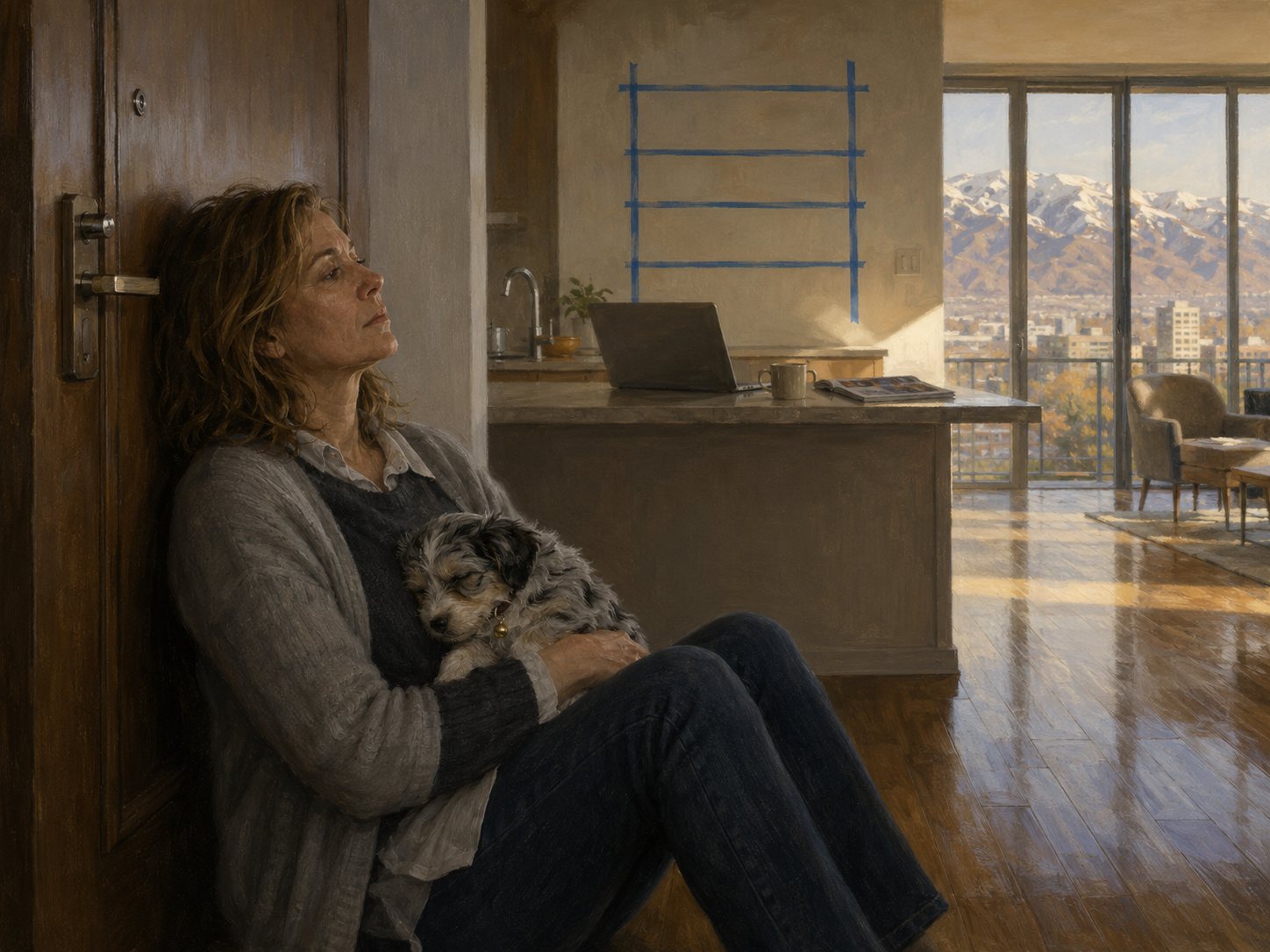
Diane sat on the floor of her apartment in Salt Lake City with her back against the door, in approximately the same posture in which she had ended Chapter Two. Henry was in her lap. The bell did not ring because Henry had stopped moving. On the kitchen counter, visible from where she sat, were three documents folded in thirds and stacked in the order she had set them down on Wednesday. The Larkfield letter. The Guardian Quarterly. The unopened text from her property manager, which was not a document but which she had begun, over the course of the week, to think of as one.
She had read it. She had set it down. She had sat down.
She thought, in the order in which she thought them, the following things. The Larkfield property was no longer a cash machine. The Larkfield property was a litigation expense. Her older son had not called. Her younger son had not posted a photograph that included her. The breeder had not chosen her. The breeder had matched her. The Friend, who was the only person in her life whose every action toward her in the past nine months had been the action of a person with a plan, was at this hour eight hundred miles away in a hotel in the Bay Area learning how to take semen from a dog. He had texted her. The text was on her phone. She had not opened it.
She picked up the phone. She opened the text. She read it. She closed the phone. She looked at Henry. Henry’s small breathing rose and fell against her thigh. He weighed five pounds and seven ounces. He was, by every measure available to her, the only entity in her life that had not, in the past nine months, revealed itself to be a structure with load-bearing walls in a different place than she had been told.
She put her hand on his small warm head.
That’s also a consideration.
More: All chapters of The Sire Saga · Claude Comedy by Jonathan Leusden