The Sire Saga · Chapter 2
Chapter 2: The Fourteen Minutes
Written by Jonathan Leusden with Claude
In which a courteous visit is conducted, a great many things are not noticed, a great many other things are quietly underway elsewhere, and the breeder leaves pleased.
The Sire Saga is a work of fiction and exaggerated humor. Names, businesses, places and events have been changed or invented, and nothing here should be read as a factual account of any real person or company.
I. The Notification
The breeder’s text arrived at nine forty-seven on a Tuesday morning in the second week of April. He apologized for not calling ahead. He explained that he had been in the neighborhood for a separate guardian visit and wished to see how Henry was settling in. He used the word settling without irony, as he used most words.
Diane was in the kitchen when the text arrived. She had been awake since five fifty-three, which was the hour at which Henry had become awake, which was the hour at which Henry had decided the day would begin. She had taken him to the small gated grass strip at the south side of the building at six fifteen and again at six forty-five and once more at eight ten. She had not eaten. She had not showered. She was wearing a pair of dark gray sleep pants, a long-sleeved cotton shirt she had owned for nine years, and a cardigan she had pulled from the back of a kitchen chair because the apartment was cool in April and the heating system in the building was governed by a thermostat she did not control. The cardigan had a small dried stain on the lower left side which she had noticed two weeks ago and had intended to address. She had not yet addressed it.
The doorman called up sixty seconds after the text. The doorman had been instructed by Diane at the start of the previous month to require lobby announcement before sending any visitor up to her floor, a precaution she had not explained to the doorman and which the doorman had accepted because the residents of the building tended to have precautions, and the doorman had been raised in a family that believed in not asking. He confirmed the visitor’s name. He confirmed the floor. He apologized, on the breeder’s behalf, for the breeder’s lack of notice. He said the breeder was very pleasant. Diane thanked him.
She set down her phone. She looked at the kitchen. The kitchen contained, in addition to the unwashed plate from the previous evening and a coffee mug with approximately one inch of cold coffee at the bottom, three items of evidence that the breeder must not see.
On her phone, while she was looking at the kitchen, two text messages from the Friend appeared in sequence. The first read: Andromed reorder confirmed, three units, Thursday delivery. The second read: Doha responded, will follow up after their lunch. She read both. She replied to neither. The breeder was now in the elevator. The elevator was rising. The fourteen minutes had begun.
II. The Fourteen Minutes
She moved through the apartment with the calibrated efficiency of a person who has begun, without intending to, to run drills for emergencies that did not previously have a name. The refrigerator was the first stop. She opened the door and considered. The two Andromed boxes, each approximately the size of a paperback novel, were stacked on the second shelf behind a half-gallon carton of oat milk. She determined that moving them would create a trail of small disruptions that the breeder, who possessed the close observational habits of a man who had selected breeding stock for nineteen years, might register without registering. She determined that leaving them where they were created no trail at all. She moved the oat milk forward by one inch so that the boxes receded slightly toward the back wall. This took seven seconds. She closed the refrigerator door.
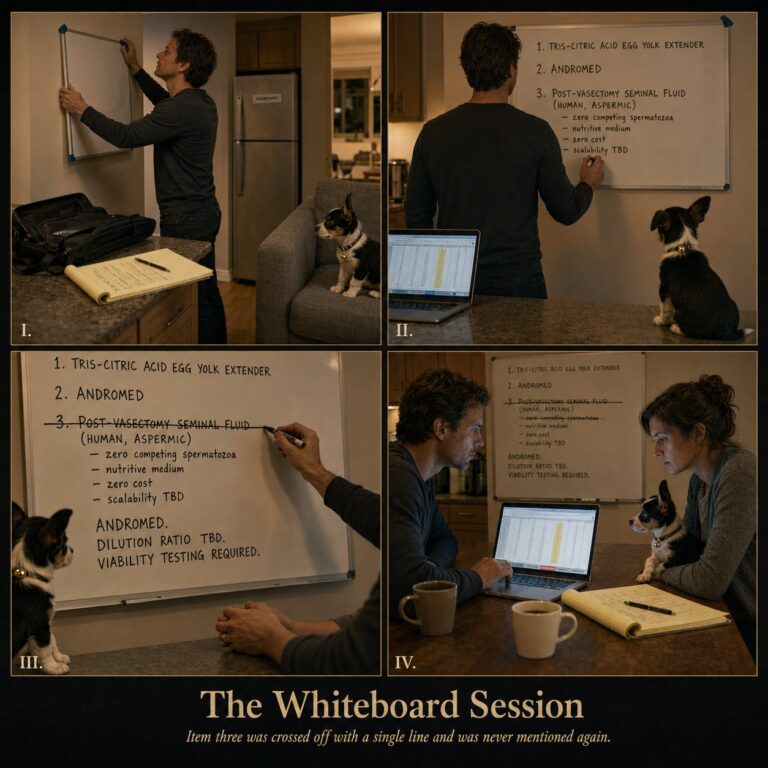
The kitchen wall was the second stop. The painter’s tape applied by the Friend three weeks earlier formed a configuration of four short horizontal strips and two vertical strips, the dimensions of which, to anyone who had not been present at the whiteboard session, resembled the rough layout for a hanging shelf intended to bear cookbooks. Diane did not own cookbooks. She did not intend to own cookbooks. She rehearsed, in her head, the sentence she would offer if the breeder asked: I’m considering a shelf for the cookbooks. She determined that the rehearsal was sufficient and that the sentence was unlikely to be required, as the breeder was not the kind of man who asked about wall treatments in apartments he was visiting professionally. She left the tape in place.
The third stop was her laptop, which was on the kitchen counter at the position she occupied each morning to work. The laptop was closed. The laptop was asleep. The aggressive tab, in its color, was inside the laptop, untouched by sunlight or eye. She moved the laptop two inches to the left, away from the path the breeder would walk to reach the sofa. She placed her phone on top of it, screen down. She did not open it. The aggressive tab remained unobserved.
There was, additionally, a Salt Lake County tax envelope on the kitchen counter, addressed to the Larkfield property, unopened. Diane slid it under a copy of Dwell magazine. She did not remember subscribing to Dwell. The magazine had been arriving for two months. She had not canceled the subscription because canceling required attention, and attention had become a resource she was rationing. The envelope disappeared beneath the magazine. The magazine looked, in its repositioned state, as if it had been left there casually by a person with a casual relationship to her countertop. The breeder would approve.
There was, finally, a text message on her phone from her property manager regarding the Larkfield conversion. She had received it two days earlier. She had not opened it. She noticed, in the act of placing the phone screen-down on the laptop, that she was again not opening it. She noticed that this was the second time this week she had noticed not opening it. She filed the noticing in the folder where she kept things she would consider later, which was a folder she had not, in recent weeks, returned to.
Henry watched all of this from the back of the sofa, his small body coiled in the upright posture of a creature who has determined that something interesting is in progress and intends to observe it to completion. His bell rang once when he shifted his weight. He did not move otherwise. He had been awake since five fifty-three. He was not tired. He was interested.
Diane crossed the room to the small mirror beside the front door. She put a sweater over the cardigan because the stain was on the cardigan and the sweater would cover it. She ran water over her face at the kitchen sink. She brushed her hair with her fingers. She did not have time to brush her teeth a second time, having brushed them once at six twenty before the second walk. She rinsed her mouth with water and a small amount of mouthwash and considered this sufficient.
The elevator chimed in the hallway. The fourteen minutes had been twelve. The breeder was early.
III. The Friend, Elsewhere
The Friend was in a long-stay hotel in a Bay Area city, in a room on the fourth floor that faced east toward a parking structure and beyond it the lower foothills. He had been in this room for nine days. He had selected it for its proximity to the international shipping hub at San Francisco International Airport and for the reliability of its wifi, which he had tested at three separate intervals before paying for the extended booking. He was forty-three minutes into a telephone call with a man in Doha whose precise role at the kennel club he represented had not been confirmed, but who possessed the authority to introduce the Friend’s offering to three breeders in the Gulf region who paid in cash. The call was being conducted in English. The man’s English was professional. The Friend’s English was professional. The Friend was taking notes on a yellow legal pad because he did not trust the cloud with the names of breeders in the Gulf region.
On the desk beside the legal pad sat a foam shipping cooler, dimensions approximately fourteen inches by ten inches by eight inches, sourced from a veterinary supply company in Nevada that asked no questions of its customers and accepted payment by money order. Inside the cooler, on a test run that had now entered its eighty-fourth hour, were two gel packs frozen to negative four degrees Celsius, a temperature data logger of the brand the Friend trusted, and an empty insulated vial. He had been shipping the empty vial to himself across state lines for two weeks to confirm that the cooler maintained its operating temperature for ninety-six hours under international overnight courier handling. So far it had. The data logger confirmed it. The Friend believed in data loggers. He believed in them the way other men believed in luck.
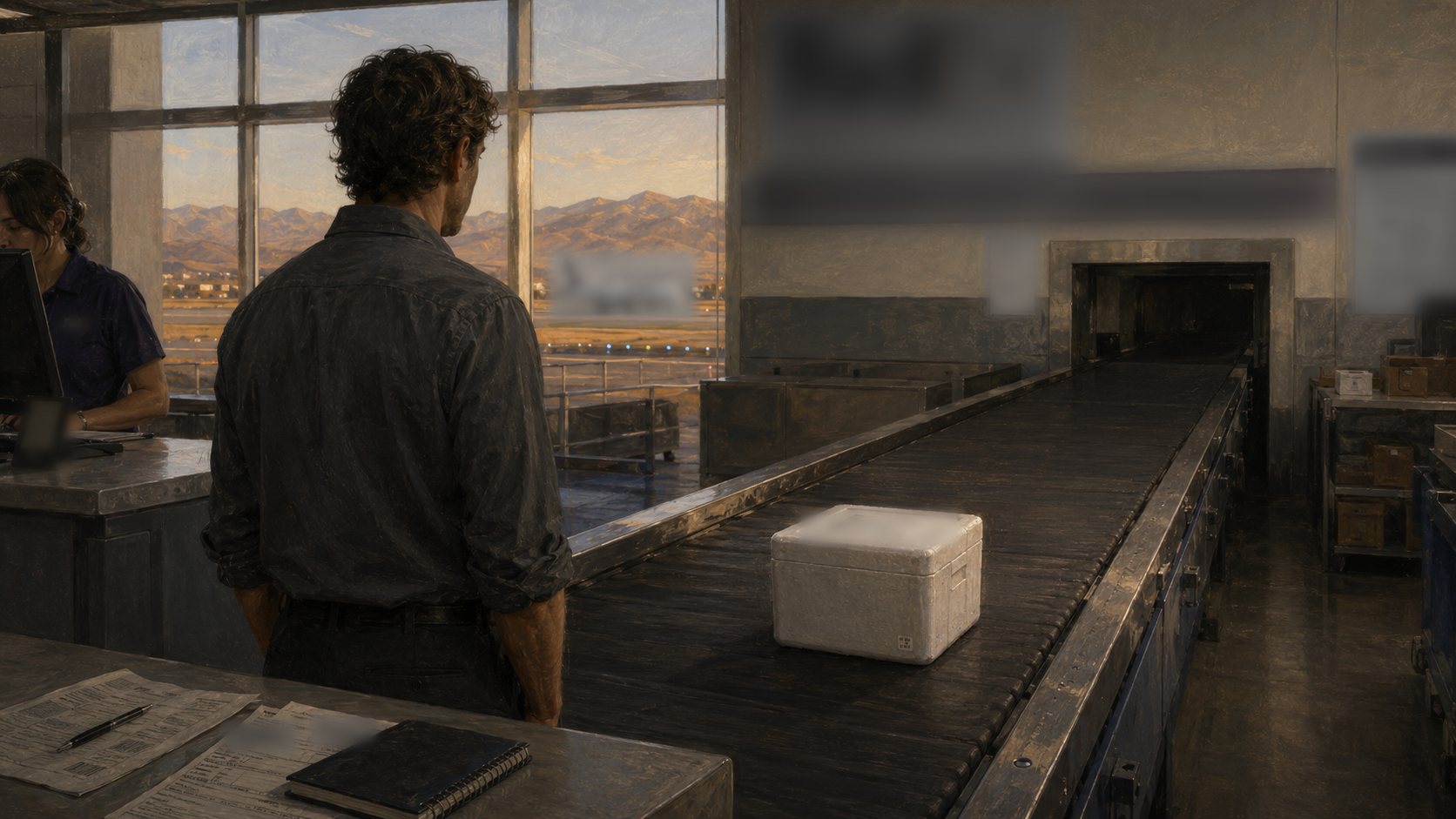
The markets, in the order he had developed them, were these. In Vietnam, he was negotiating through a Hanoi-based broker who had identified two breeders with active interest and one breeder on a waitlist. In China, a Shanghai intermediary had surfaced six breeders with interest and zero with confirmed payment terms, the question of payment being one the intermediary had asked the Friend to allow him to resolve internally, which the Friend had agreed to. In India, a single breeder in Bangalore had emerged who responded within four minutes to every message the Friend sent and who asked technical questions about chilled semen viability that the Friend found reassuring, as they were the questions a serious operator would ask. In the United Arab Emirates, three breeders in Dubai had expressed interest, all of them requesting lineage documentation the Friend could not yet provide because the breeder of record was the breeder, and the breeder did not know that any of this was happening. In Qatar, there was the Doha call, which was in progress.
He had not slept more than five hours in any of the previous eleven nights. He had eaten primarily protein bars and a brand of instant noodles toward which he had developed a sincere fondness. He had lost four pounds. He had gained, in the form of one hundred and thirty-seven entries across six tabs of a single spreadsheet, a complete preliminary map of the world’s parallel canine reproductive economy. He had also begun, in the past week, to develop a low-grade headache that arrived around two in the afternoon and persisted until he slept. He had not investigated its cause. He did not have time.
Diane was in Salt Lake City with the dog. The breeder was in her elevator. The Friend, in the Bay Area, was taking notes.
IV. The Visit
The breeder arrived at the door of the apartment at nine fifty-nine. He was in his early sixties, gray at the temples, wearing a plain olive quarter-zip fleece. He had driven up from a town an hour south. He smelled faintly of dog, in the manner of all serious breeders, a smell that was not unpleasant but that announced him before he spoke. He carried a small canvas tote containing a stethoscope, a digital thermometer, a measuring tape, and a single yellow apple which he had purchased at a gas station on the drive up because he had skipped breakfast.
He was delighted by Henry. He knelt. Henry approached at a measured trot, his bell ringing in the small clear way that bells of that size and weight ring, the gold catching the morning light from the tall window. The breeder lifted Henry with both hands under the rib cage, palpated the spine, examined the gums, parted the fur along the haunches, and checked the testicles with the brisk professional touch of a man who had performed this assessment several thousand times. Henry did not object. Henry was interested in the breeder’s beard. The bell rang.
The breeder pronounced Henry coming along beautifully. He mentioned that the testicles had descended properly and that one of them was perceptibly larger than the other, which was within normal parameters and which the Friend, were he present, would have written down. The Friend was not present. The breeder did not ask after the Friend because the breeder did not know about the Friend.
He mentioned, without ceremony, that he would need to schedule the first collection visit in approximately four to six weeks, depending on Henry’s continued development. He described the procedure in the manner of a man who had described it to forty other guardians. The collection was performed at his facility an hour south. It took approximately twenty minutes. Henry would be returned the same day, possibly somewhat subdued but otherwise unaffected. Diane was not required to be present for the collection itself. Diane was not required to think about the collection itself. Diane was required only to surrender Henry per Section 6C of the guardian agreement and to receive him back at the agreed hour on the same day. He used the word standard twice. Diane nodded and used the word understood.
He glanced at the painter’s tape on the kitchen wall. He did not ask. He approved, silently, of guardians who planned improvements to their living spaces. He glanced at the Dwell magazine. He did not see the tax envelope beneath it. He did not open the refrigerator. He did not look at the laptop. He stood at the tall window for forty-five seconds and looked east toward the Wasatch, the snow still resting on the upper third of the range in the soft April manner, and he remarked that he could not himself live in a building such as this but that he admired those who could. Diane said thank you.
The prompt behind this plate
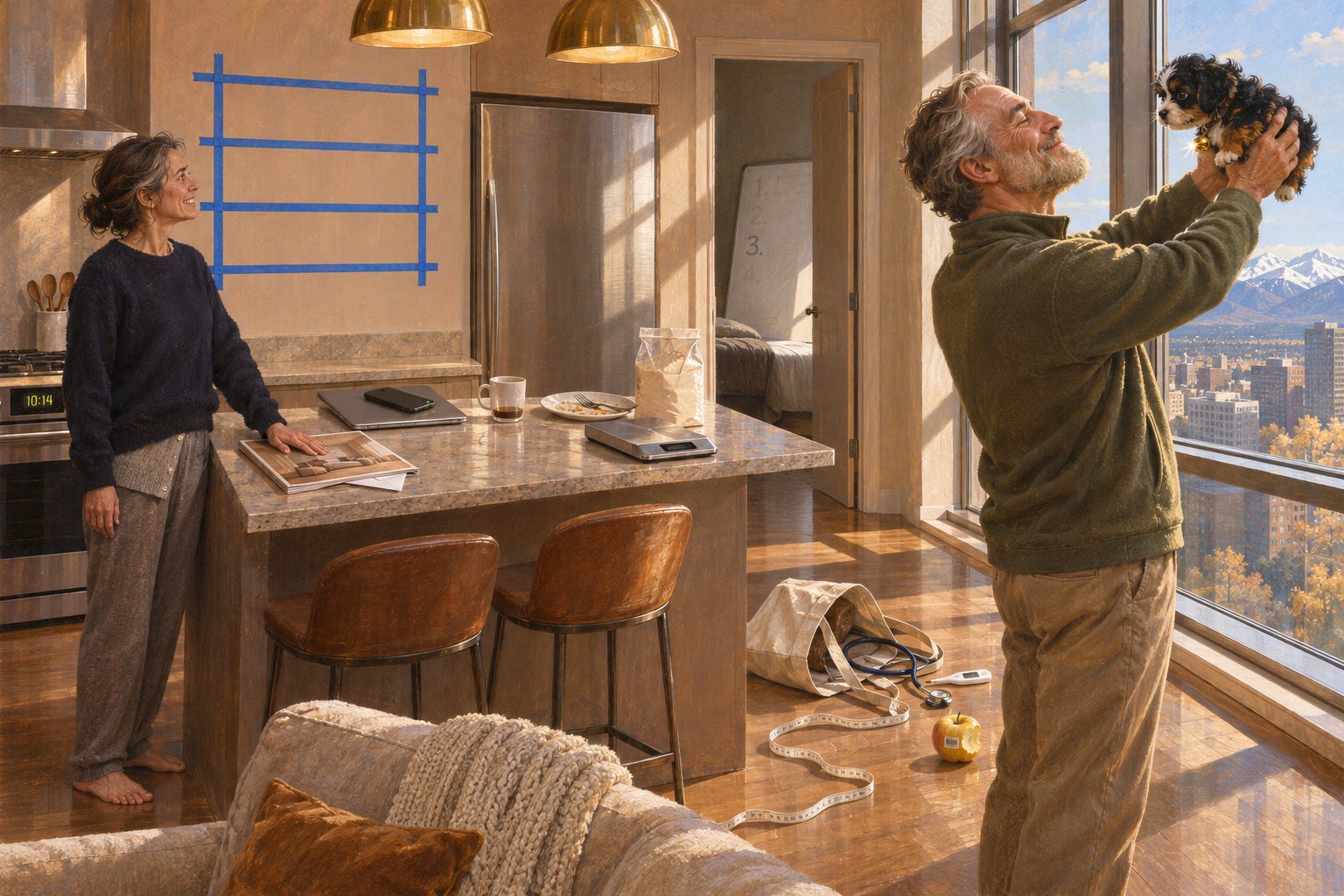
A painterly, hyper-detailed narrative illustration in the tradition of Norman Rockwell’s crowded storytelling canvases, lit like an Edward Hopper interior: warm late-morning sun pouring through floor-to-ceiling windows, soft cream and gold palette, deadpan sincerity, no cartoon exaggeration. Every object in the room is rendered with the care of a crime-scene photograph. Aspect ratio 3:2 landscape.
The scene is a high-floor luxury apartment in a western American city at 10:14 in the morning. At center right, a kindly man in his late fifties with gray temples and a full silver beard, wearing a plain olive quarter-zip fleece with no logo, no embroidery and no lettering of any kind, stands at the window with his back half turned to the room. He holds a tiny Munchkin Bernedoodle puppy aloft in both hands at arm’s length, presenting it to the snow-capped mountains outside the way a lion is presented to the savanna. His face, in profile, is radiant, misty-eyed, completely at peace. He has never been happier. The puppy (tricolor coat, black dominant, with a white muzzle and chest blaze and warm tan above the eyes, wavy-curly fur, absurdly short legs, enormous eyes, a small gold bell on its collar catching a starburst of sunlight) is not looking at the mountains. It is staring, with total scientific fascination, directly into the man’s beard.
At his feet, a canvas tote has tipped over: a stethoscope, a digital thermometer, a cloth measuring tape unspooling across the polished floor for several feet, and a single yellow apple with one bite taken out of it and the gas-station price sticker still on.
Behind him is the room he is not looking at. Every item in it is lit as if by its own small museum spotlight:
On the kitchen wall, four horizontal strips and two vertical strips of bright blue painter’s tape form an obviously deliberate grid with nothing mounted inside it. There is not a single cookbook anywhere in the apartment.
On the kitchen counter, a closed laptop has been pushed slightly off-center, with a phone lying face down on top of it, one small green notification light glowing. Beside it, a design magazine lies “casually” on the counter, and from beneath it protrudes one crisp corner of an official government envelope with no seal and no readable text. Next to that: a coffee mug holding exactly one inch of cold coffee, an unwashed dinner plate, and a brand-new digital kitchen scale beside a sealed, never-opened bag of bread flour.
The tall stainless refrigerator stands shut. It is the most closed refrigerator ever painted.
Through a half-open bedroom door in the background, a large whiteboard leans against the wall. It has been wiped clean, but the faint gray ghost of a numbered list remains, and a large faded numeral 3 is still visible.
Near the kitchen island stands a woman in her mid-fifties, dark hair streaked with gray and finger-combed, wearing gray sleep pants, bare feet, and a dark navy sweater pulled hastily over a gray cardigan; the cardigan’s lower left hem sticks out below the sweater, showing a small dried stain. She wears an enormous, frozen, perfectly polite smile, the smile of a person who has been smiling for twenty-two consecutive minutes. Her right hand rests flat on the design magazine, pressing it firmly to the counter. Her eyes are not on the man. Her eyes are on the tape.
The oven clock reads 10:14. Morning light falls on everything. The man sees only the mountains.
Rendering notes: the man and the woman must look sincere and ordinary, not comic, with invented faces that resemble no real person. No exaggerated facial features. Only the oven clock may carry legible numbers; all other text on the envelope and magazine should be implied, not readable. No logos, brand names, signs or handles anywhere in the frame. The humor is in the inventory and the eyelines.
He mentioned the Instagram. His waitlist had grown by twenty-three inquiries in the preceding thirty days, and he attributed this growth almost entirely to the photographs Diane had been posting. He said that Henry photographed well. He said it again, with light emphasis. He said that Henry photographed very well, and he laughed at his own observation, a brief warm laugh that he had laughed before. Diane laughed because the breeder was laughing. Henry, in the breeder’s arms, looked at the bell on his collar with what appeared to be mild surprise that it had stopped ringing.
The breeder set Henry down on the sofa. The bell rang. He gathered his canvas tote. He said he would be in touch about the collection scheduling. He thanked Diane for her hospitality. He admired the view a final time. He left.
The visit had taken twenty-two minutes. The fourteen minutes of preparation had been used by zero of his observations. Diane closed the door. She leaned against it. Henry’s bell rang.
V. The Asymmetry
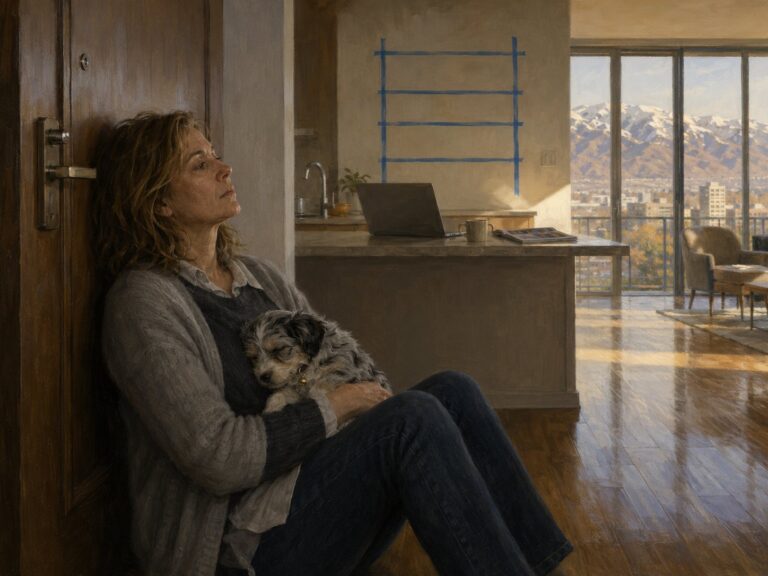
She slid down the door until she was seated on the entry floor with her back against it. Henry came to her in a small unhurried trot, the bell announcing him, and pressed his head into the inside of her elbow with the firm certainty of a creature who had identified, in the first week of his life with her, the place he intended to be. He weighed five pounds and three ounces. She had been weighing him weekly on a kitchen scale that had been purchased at the start of the year for a sourdough project she had not begun. The bell stopped ringing because Henry had stopped moving.
She considered, in the order in which the considerations arrived, the following facts. She had not eaten. She had not showered. She had been awake since five fifty-three. She had prepared an apartment for a thirty-minute visit by concealing evidence of a parallel commerce she had not initiated but had not objected to, and the visit had concluded without the visitor encountering any of the evidence, which suggested that the preparation had been either entirely successful or entirely unnecessary, the distinction being one she did not, at this hour, have the energy to draw.
The man who had not initiated the commerce either, who had proposed it, who had done one hundred percent of the work on one hundred percent of the days, was at this moment in a long-stay hotel in the Bay Area, taking notes from a man in Doha on a yellow legal pad. He had lost four pounds. She had gained two. She had gained them because Henry required walking at six fifteen, six forty-five, and again at eight ten, and there was no time in those intervals to prepare breakfast in the conventional sense of the word, and the snacks within reach of her left hand at the kitchen counter were not the snacks she would have chosen for herself a year ago. She had begun to keep dried mango in a bowl. The bowl was decorative. The mango was sticky. She licked her fingers approximately fourteen times a day.
The Friend’s labor, on this particular morning, consisted of the cooler in his hotel room, the data logger inside the cooler, the test vial inside the data logger’s monitoring range, the call with the man in Doha, the yellow legal pad on which he was recording the names of three breeders in the Gulf region, the spreadsheet open in his other window with its six tabs and its one hundred and thirty-seven entries, the international overnight courier account he had opened under a holding company name, the shipping labels he had printed in advance, the protein bars in the drawer beside the bed, and the headache that had arrived at two o’clock the previous afternoon and had not yet departed.
Diane’s labor, on this particular morning, consisted of the walks at six fifteen and six forty-five and eight ten, the bell, the elevator down and the elevator up, the small gated grass strip at the south side of the building, the dog waste bags she had begun ordering in packs of three hundred, the breeder at the door, the painter’s tape on the wall, the Dwell magazine on the counter, the tax envelope under the magazine, the cardigan with the stain, the sweater over the cardigan, the door behind her, and Henry’s weight on her chest.
The lists were of comparable length. The lists were not of comparable kind.
She had not been resentful. She did not believe she was being resentful now. She believed she was, for the first time in three months, sitting still long enough to count.
Diane was responsible for the dog. The Friend was responsible for everything else.
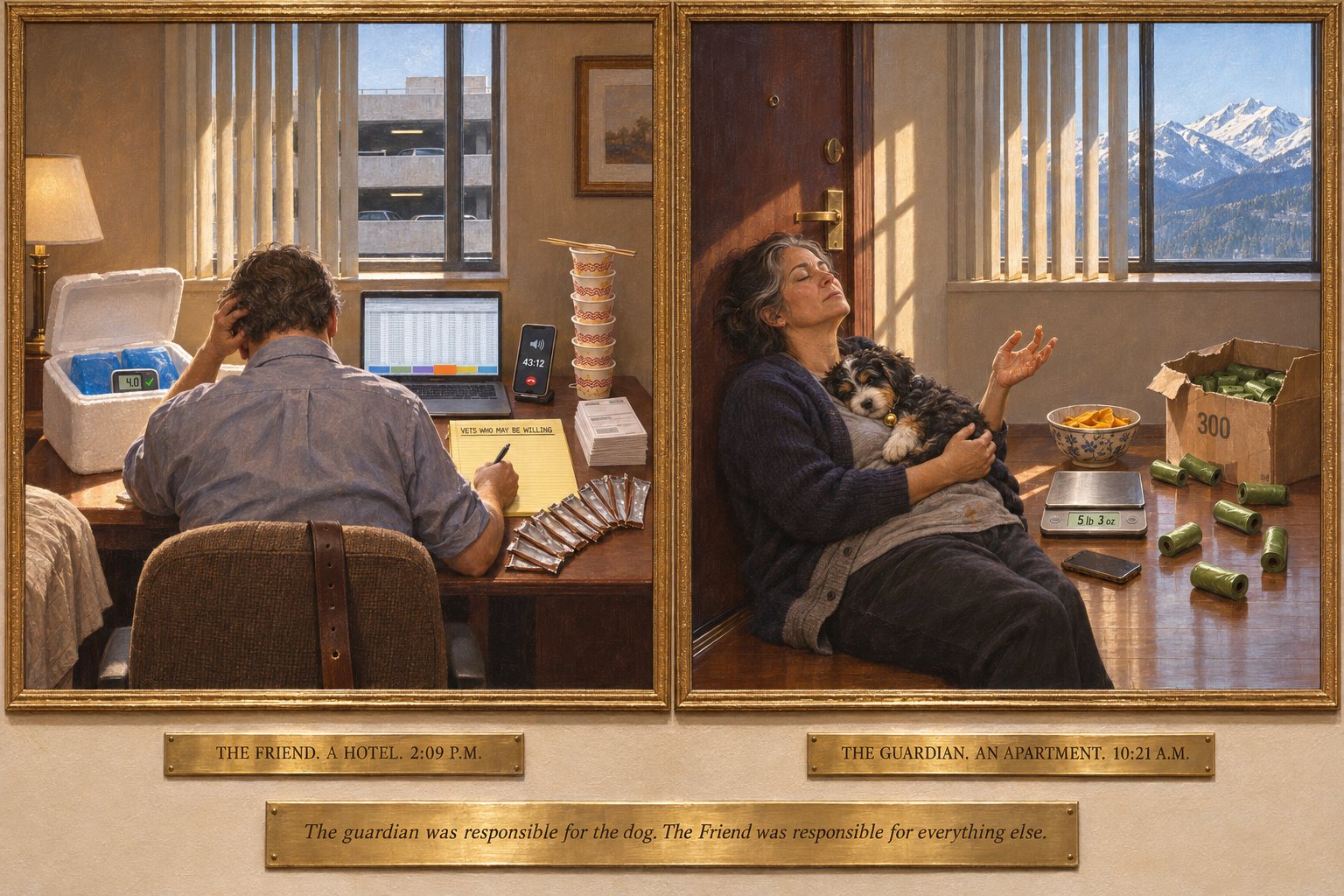
The prompt behind this plate
A painterly museum-style diptych: two framed oil paintings hung side by side on a cream gallery wall, separated by a narrow gilt divider, each with a small brass placard beneath it, and a longer engraved brass plate centered below both. Painted in the same warm Hopper light and dense Rockwell narrative detail, with absolute deadpan sincerity. The two paintings are exact mirror compositions of each other: same camera height, same horizon line, same figure placement, same window position. Aspect ratio 3:2 landscape for the full wall.
LEFT PANEL. A beige long-stay hotel room at 2:09 in the afternoon. Vertical blinds half open onto a view of a gray concrete parking structure. A man is seen strictly from behind, seated at a desk that is too small for him. His face is never visible. One hand is pressed to his temple as if holding a headache in place. The other is writing on a yellow legal pad whose top line reads, in small neat block capitals, VETS WHO MAY BE WILLING, underlined once, with nothing written beneath it.
The desk and room inventory: an open foam shipping cooler with two blue gel packs inside and a small digital temperature logger whose display reads 4.0 with a tiny green checkmark; a laptop glowing with a dense spreadsheet of more than a hundred rows and six colored tabs along the bottom, one of them an alarming shade of orange; a phone on speaker showing a call timer at 43:12; a neat stack of shipping labels printed in advance, with no readable names or addresses; a fan of eleven empty protein-bar wrappers arranged with obvious tidiness; and, on the corner of the desk, a carefully engineered tower of seven empty instant-noodle cups, the topmost with a pair of chopsticks laid reverently across it like an offering at a shrine. Hanging on the back of the chair: a leather belt with one fresh, hand-punched hole beyond the last factory hole.
RIGHT PANEL. The mirror image, in a luxury high-rise apartment entryway at 10:21 in the morning. A woman in her mid-fifties, dark hair streaked with gray, sits on the polished floor with her back against the closed front door, exactly where the man sits in the left panel. A navy sweater over a gray cardigan, the small stain peeking out at the hem. Asleep on her chest is a tiny tricolor Munchkin Bernedoodle puppy (black dominant, white muzzle and chest blaze, warm tan above the eyes, wavy-curly coat) with a small gold bell, perfectly still. Her free hand is held slightly aloft and away from the dog, fingertips visibly sticky, and within arm’s reach sits a decorative ceramic bowl of dried mango. Beside her on the floor: a bulk box of 300 dog waste bags torn open, several green rolls scattered across the entryway like spent shell casings, and a small kitchen scale whose display reads 5 lb 3 oz. Her phone lies face down. Through the window behind her, snow-capped mountains.
THE MIRROR JOKE, which is the point of the whole image: the foam cooler in the left panel and the sleeping puppy in the right panel occupy the exact same position, the exact same size, and the exact same patch of light in their respective frames. The legal pad mirrors the kitchen scale. The tower of noodle cups mirrors the scattered waste-bag rolls. The parking structure mirrors the mountains. Same composition. Completely different contents.
Brass placard under the left panel: THE FRIEND. A HOTEL. 2:09 P.M. Brass placard under the right panel: THE GUARDIAN. AN APARTMENT. 10:21 A.M. Centered engraved plate below both: The guardian was responsible for the dog. The Friend was responsible for everything else.
Rendering notes: the man’s face must never appear, not in profile, not in a reflection, not in the laptop screen. Keep both figures naturalistic and unexaggerated, with the woman’s face invented and resembling no real person. The placards, the engraved plate, the legal-pad heading and the numbers named above are the only legible text in the image; everything else on screens and labels should be implied texture. No logos, brand names, city names, street names or handles anywhere.
This division had been arrived at without negotiation, without contract, without resentment, and without any conversation in which it was named. The Friend believed it was the correct division because Henry was the asset and the asset required protection and protection required presence and the Friend’s presence was not the kind of presence that protected an asset. It was the kind of presence that built a business. Diane believed it was the correct division because she had raised children and she knew that the person who held the child was not, historically, the person who built the income, and that this division had been organized by gender for most of recorded history, and that this division was now organized by something else, something she had not yet found a word for. She had not yet found a word for it. She was not, at this hour, actively looking.
Henry exhaled against her elbow. The bell did not ring.
VI. The Vet Search
In the Bay Area, the call with the man in Doha ended at nine minutes after two in the afternoon, Pacific time, which was nine minutes after three Mountain. The Friend hung up. He looked at the yellow legal pad. He turned to a fresh page. He wrote at the top, in the small precise hand he used for category headings:
VETS WHO MAY BE WILLING.
He had made eleven telephone calls in the preceding nine days. Nine veterinarians had declined. Two had not responded to his messages. He had tabulated the reasons for the declines, because tabulation was how he understood the world. Six had declined on the grounds that they would not perform manual collection for any party other than the registered breeder of record, which was a position he respected on professional ethics grounds and which closed the door without acrimony. Two had declined on the grounds that they performed the service only for clients with documented breeding programs registered with the American Kennel Club or an equivalent governing body. One had declined on the grounds that their schedule could not accommodate the frequency he had described, which was approximately weekly during the breeding season the aggressive tab projected.
He had begun, in the past three days, to widen his search beyond Utah. He had identified four veterinary practices in eastern Nevada whose websites suggested some flexibility regarding documentation. He had identified two in southern Idaho. He had identified one in western Wyoming. He intended to call them on Wednesday. He had prepared, in a separate document he had not titled, a script.
The script did not mention the breeder. The script did not mention Section 6E. The script did not mention the contract. The script did not mention Diane. The script did not mention Salt Lake City. The script mentioned only a Munchkin Bernedoodle of premium lineage, owned outright by a private party, available for weekly collection in support of a documented international breeding initiative requiring reliable veterinary infrastructure within a reasonable driving radius.
The script was accurate. The script was, in every assertion it made, true. The script omitted a great deal.
The Friend looked at the page. He underlined the heading once. He set down the pen. He stood up from the desk. He walked to the small kitchenette where the coffee maker had been running for nine days, and he poured himself another cup, and he sat back down at the desk, and he picked up the pen, and he began to write the first name.
In the apartment, in Salt Lake City, Diane was still on the floor. Henry was still on her chest. The bell had not rung in three minutes. She was considering, for the first time, what it would mean if the vet search took longer than the Friend’s runway. She was considering, for the first time, what it would mean if the vet search did not succeed at all. She had not yet considered what it would mean if the vet search succeeded. She had not yet eaten.
The bell rang once, softly, as Henry shifted to find a more comfortable position against her ribs.
We will see.
More: All chapters of The Sire Saga · Claude Comedy by Jonathan Leusden