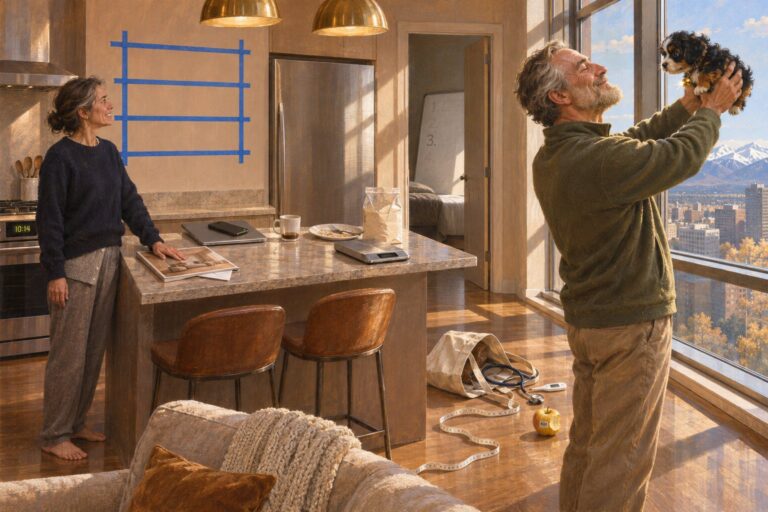
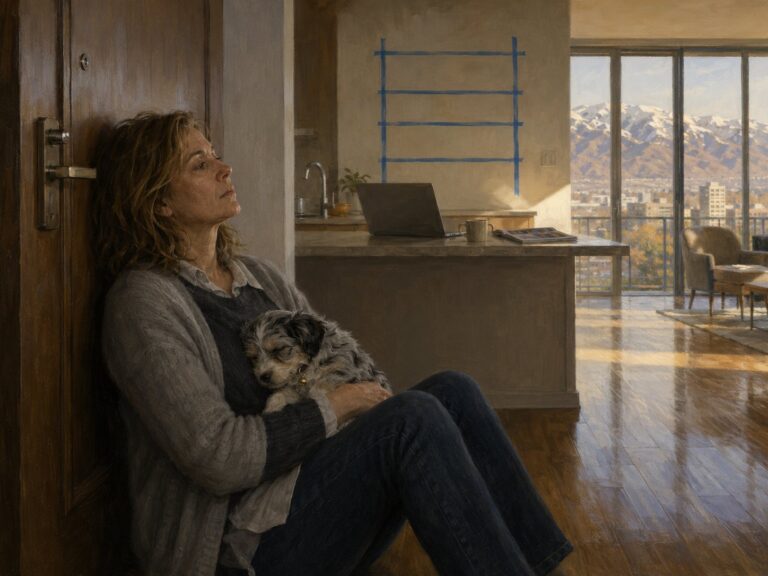
The Sire Saga · Chapter 1
Chapter 1: The Whiteboard Session
Written by Jonathan Leusden with Claude
In which a portfolio is optimized, a puppy is acquired, several solutions are proposed, and one of them is never mentioned again.
The Sire Saga is a work of fiction and exaggerated humor. Names, businesses, places and events have been changed or invented, and nothing here should be read as a factual account of any real person or company.
I. The Portfolio
The decision about Henry began, as Diane’s decisions generally did, with a spreadsheet.
She owned a house in Larkfield. She had not paid it off but she owned it in the way that people own things they are in the process of finishing paying for, which is to say she owned it enough to make decisions about it and not enough to stop thinking about it. The question she had been working through for several weeks was how to convert the Larkfield property into a rental while satisfying the zoning requirements of Salt Lake County, the tax obligations of the state of Utah, and the various opinions of entities whose names appeared on documents she had read carefully enough to know she should read more carefully.
The apartment she had moved into was on a high floor of a new building in the part of Salt Lake City that the building’s marketing materials described as vibrant, which was accurate in the way that marketing materials are accurate when they select the best available true thing and present it as the whole truth. The building had a rooftop with an infinity pool and hot tubs and a bowling alley and a golf simulator and a full weight room and outdoor gathering areas with views east to the Wasatch and west toward the airport and the lake, which on clear days was the particular flat silver of a surface that has decided not to be impressive and achieves impressiveness anyway.
Diane had looked at the rooftop on the day she signed the lease and thought: this is the correct decision. She thought this with the same clarity with which she had looked at the Larkfield house six years earlier and thought: this is the correct decision. She was a person who made correct decisions. The decisions occasionally required subsequent decisions to remain correct, but that was the nature of decisions in a world that did not hold still.
Henry was one of the subsequent decisions.
II. The Calculation
She had been looking at puppies for three weeks before she found the listing. Not casually. With the methodical attention she brought to any acquisition: reading reviews, comparing breeds, evaluating temperament profiles, assessing the relationship between projected adult size and apartment square footage. She had ruled out golden retrievers on the grounds of shed volume. She had ruled out French bulldogs on the grounds of veterinary expense. She had ruled out several other breeds on grounds she could articulate precisely and did not need to articulate to anyone because she was making this decision alone, in the way that a person who has raised children and arrived at the other side makes certain decisions.
She had raised children. She knew what unconditional love cost in labor hours and interrupted sleep and the specific recalibration of expectations that occurs when an animal or a person who depends on you turns out to need more than the literature suggested. She knew that eighty percent of pet ownership, stripped of the photographs and the rooftop conversations with strangers who wanted to hold the dog, was logistics. Feeding schedules. Veterinary appointments. The particular 4 AM alertness of a creature that does not understand why the building’s rooftop closes at eleven.
She signed up for the guardian home program anyway. She had done the math. The dog would be provided to her at no cost. She would keep him for up to seven years. At the end of seven years, once the breeder had finished using him for what the breeder intended to use him for, legal ownership would transfer to Diane. She would have a dog. The dog would be, by that point, seven years old and would have lived his entire life in her apartment and would love her in the specific unconditional way of animals that have decided.
She had read the contract thoroughly. She had read most of Section 6. She had placed a yellow sticky note on Section 6E that said KEYS with a downward arrow and had intended to think about it later.
Henry currently weighed five pounds. He would weigh eleven to thirteen pounds at maturity. He fit in the carrier the way that problems fit in the space before they become problems: completely, with room to spare.
III. The Arrival
The dog arrived on a Tuesday in the soft-sided carrier, and Diane understood within forty seconds of opening the door that the math had been correct and also that the math had not captured everything relevant.
His coat was black and white and the particular warm tan that appears above the eyes of certain dogs and functions as the biological equivalent of a character reference. He had a gold bell collar. The bell made a sound when he moved. He moved constantly, and then he stopped moving and looked at Diane with the expression of an animal that had made a permanent decision, and the bell was quiet, and Diane understood that the eighty percent had already begun and that she was going to be fine with it.
The contract called him Sire Prospect KD-4. Diane called him Henry. Henry did not respond to Sire Prospect KD-4.
She was not required to post photographs of Henry on social media. The contract required only that if she posted, she credit and hashtag the breeder. This is the distinction between a rule and a trap. The rule would have been easy to follow or easy to avoid. The trap required only that she find Henry sufficiently beautiful to share with strangers, which she did, beginning on the third day, when he fell asleep in a patch of afternoon light on the linen sofa and she took the photograph before she had decided to take it. She hashtagged the breeder. Four hundred people she had never met liked the photograph. The breeder texted to say Henry looked wonderful.
She replied: he really does.
She did not mention the Friend, or the second spreadsheet, or the Andromed extender currently residing in her refrigerator behind the oat milk, placed there on a Wednesday by a person who had not been asked and had not announced it and had simply determined that certain preparations could not wait for a formal conversation.
IV. The Contract
The agreement was between Diane and the breeder, a Utah-based breeding operation whose paperwork carried three different business names, which was either three businesses or one business that had been named during a period of creative abundance.
The relevant terms: the dog was owned by the breeder until the age of seven. Diane bore all non-reproductive veterinary expenses. Diane could not move more than thirty miles from Salt Lake City for the contract’s duration. Diane could not engage in any dog breeding related business outside her relationship with the breeder. Breach of the breeding provisions triggered twenty thousand dollars in damages. And per Section 6, Subsection E:
Because breeding is time-sensitive, the Breeder requires prompt access to the Guardian Dog. The Guardian agrees to give the Breeder a set of house keys, or another way into the home, in an emergency or whenever the Guardian cannot be reached.
The sticky note said KEYS. The arrow pointed down. The breeder had a key to the high-floor apartment with the rooftop infinity pool and the Wasatch views and the refrigerator that now contained, behind the oat milk, a product called Andromed that Diane had not purchased and whose presence she had not yet formally acknowledged.
She had raised children. She knew how to hold two realities at once without requiring them to resolve.
V. The Whiteboard Session
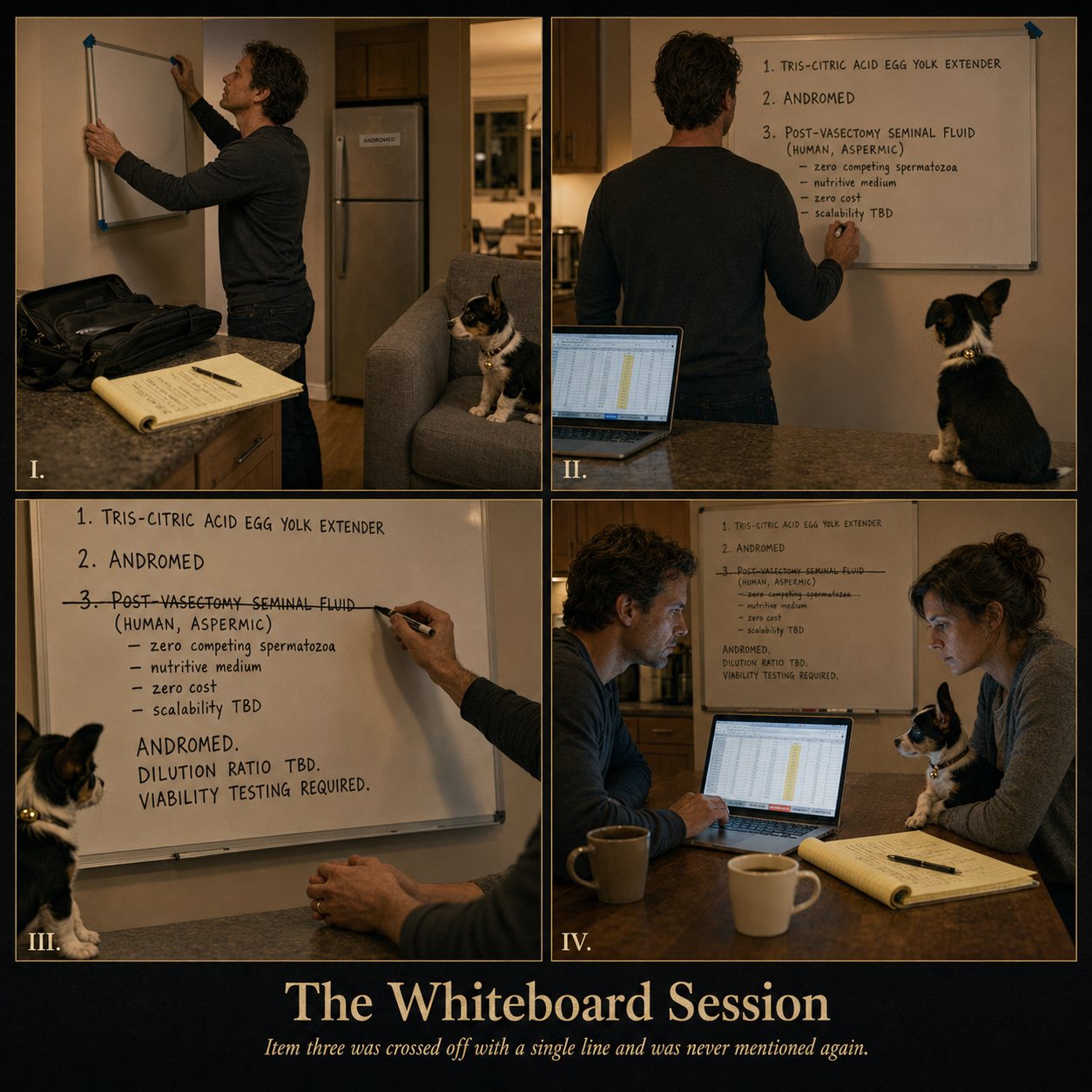
The Friend arrived Saturday with a laptop, a legal pad, and a portable whiteboard he unrolled and affixed to the kitchen wall with painter’s tape he had brought himself.
He had a biochemistry background he described as adjacent. He had a vasectomy, which he mentioned not as a confession but as a credential, in the way of a man who understands that certain biographical details become professionally relevant in contexts that could not have been anticipated at the time of the procedure. He did one hundred percent of the work. He had not yet been paid anything. He had accepted these terms because he understood, with the clarity of a person who always does all the work, that the person who holds the asset never does the work, and he had decided that this time he would be on the correct side of that arrangement.
Henry observed the whiteboard installation from the couch with the alert patience of an animal reserving judgment.
The Friend uncapped a marker. He wrote at the top: THE SUBSTRATE PROBLEM. He underlined it twice. He said: the semen is the asset. The question is how far you can extend the asset without degrading the asset. He said this the way a person says something they have been waiting three days to say.
He wrote, numbered and in order, the candidate cutting media:
1. Tris-citric acid egg yolk extender. Industry standard for canine assisted reproduction. Shelf life up to five days chilled. Documented viability at dilution ratios to 1:10 in cattle operations. Canine-specific literature suggests a conservative ceiling of 1:4 without viability testing. The aggressive spreadsheet tab assumes 1:6 pending confirmation.
(Note: the aggressive tab has its own color.)
2. Andromed extender. Commercial product, glycerol-free, developed specifically for chilled canine semen transport. Available without prescription. Already in the refrigerator.
(Note: arrived Wednesday. Behind the oat milk. Diane had not been informed in advance. The Friend considered this a logistical decision rather than a social one.)
3. Post-vasectomy seminal fluid, human, aspermic. The Friend wrote this one more slowly. He said, without turning around, that the seminal plasma of a post-vasectomy male was functionally identical in composition to standard seminal fluid with the single and in this context decisive difference that it contained no competing spermatozoa. He said it was, from a purely substrate perspective, a nutritive medium. He said it had never been tested in canine assisted reproduction contexts to his knowledge, which he acknowledged was a limitation, but that the absence of evidence was not evidence of absence, and that the potential scalability of a zero-cost cutting medium with zero competing genetic material was, he said, worth a moment of serious consideration before the field was narrowed. (He did not turn around while presenting this item. Henry’s bell rang once, softly, in the silence that followed.)
Diane looked at the whiteboard for a long time. She looked at item three for a duration the Friend later described, to no one, as longer than he had expected but shorter than he had feared.
She said: cross that one off.
The Friend drew a line through item three. He said the Andromed was the right call anyway. Regulatory profile cleaner. Literature more developed. Last thing they needed was a result they could not replicate.
Diane said: also it’s insane.
The Friend said: that’s also a consideration.
He turned back to the whiteboard. He wrote: ANDROMED. DILUTION RATIO TBD. VIABILITY TESTING REQUIRED. He wrote this in the clean block letters of a person who had moved on and intended to demonstrate it structurally.
Henry jumped from the couch to the kitchen counter in a single arc that suggested the counter had always been the destination. The bell rang. The Friend opened the laptop to the second spreadsheet. He said: let me show you the math.
Diane looked at Henry on the counter. Henry looked at the whiteboard with the focused attention of a five-pound animal who had decided to take an interest. Outside, thirty miles in every permitted direction, Salt Lake City held its position. The Wasatch did not move. The breeder’s key was on the hook by the door, slightly separated from Diane’s keys, recently placed, facing outward.
She had raised children. She knew how to begin.
We will see.
More: All chapters of The Sire Saga · Claude Comedy by Jonathan Leusden